Pages

Showing posts with label Book Review. Show all posts

Thursday, September 25, 2025

'God Without Passions' by Samuel D. Renihan

God without Passions: The Majesty of God's Unshakeable Perfection,
by Samuel D. Renihan, Broken Wharfe, 2024, 86pp

Throwing in 'I am passionate about...' has become a hackneyed phrase in Uni personal statements, CVs and job interviews. Beyond the worlds of study and work, someone might say, their real passion in life is for hang gliding, foreign travel, or whatever. In other words, we consider 'passion' to be a highly commendable thing. Someone who professed to lack any sort of driving passion would strike us as rather dull. Depressed, even. 

A book with the title God Without Passions might sound rather off-putting, then. Who'd be interested in a remote, passionless deity? But passions weren't always viewed quite so positively. That struck me only recently when reading John Aaron's Thomas Charles of Bala (Banner of Truth Trust, 2022). Charles lived from 1755-1814. In his day passions tended to be viewed with some suspicion. You wouldn't necessarily admit to harbouring them in a job application.  

Chapter 4 of Aaron's  biography details the preacher's pursuit of and eventual marriage to Sally Jones. When a young man Charles was based in Milbourne Port, Somerset and his beloved Sally in Bala, North Wales. Their long distance courtship was largely conducted by letter. In their correspondence Sally played hard to get and was forever second guessing the purity of her own and Charles's motivation for getting married. What if their budding romance were simply a matter of blind passion, she wondered?  In one of his letters Charles acknowledged, "Passions are unsteady things; they are no sooner excited but they subdue again, and cannot be depended upon." (p. 61). 

With that in mind it is little wonder that the Second London Baptist Confession of Faith, 1689 states, 'God is... a most pure spirit,  invisible, without body, parts, or passions' (Chapter 2:1). The Particular Baptists were not being idiosyncratic on this point. They were simply echoing the theological consensus of Reformed Catholic theology. That consensus is beginning to break down in the world of contemporary Evangelicalism (see here). In fact the doctrine of divine impassibility has become the subject of passionately argued debate. 

Renihan doesn't approach the impassibility of God with theological daggers drawn. His approach is irenic, lucid and pastorally motivated. The writer accepts that Scripture itself often speaks of God in terms of a human seeming emotions. In Genesis it is said that prior to the Flood 'the Lord was sorry that he had made man... and it grieved him to his heart' (Genesis 6:6).  In Ezekiel 6:9 the Lord complains about Israel, 'I have been broken over their whoring heart that has departed from me'. 

What are we to make of such language? For a start it is qualified in the pages of Scripture itself. The Lord's statement, 'I regret I have made Saul king' (1 Samuel 15:11) should not be taken at face value. Why? Because of the words we find in the very same chapter, 'the Glory of Israel will not lie or have regret, for he is not a man, that he should have regret.' (1 Samuel 15:29). How may we reconcile these two sayings of the Lord? Well, we need to recognise that in the Scriptures God speaks of himself in accommodated language that is accessible to us, given our human limitations. We often have regrets about decisions we made and opt for a different course of action when things don't work out as we planned. God's plans always work out, including the raising up and removal of Saul. Divine 'regrets', then are merely apparent, signalling the outworking of his eternal decree in this world of time. 

When we confess that God is 'without passions' one thing we are saying is that he is not affected by anything that happens outside of his own being. Nothing can therefore upset God's eternal blessedness or disturb his peace. Human beings are not like that. As Renihan points out, we are creatures of affections and passions. In our affections we are attracted by what we consider good and repelled by what we see as bad. We may be cheered by the kind words of a friend. We may be hurt by the cruel barbs of an enemy. Passions may be defined as twisted affections. They are characterised by undue intensity, or even irrationality. Taken in that sense says Renihan, 'to love is an affection, to lust is a passion; to be angry is an affection, but to rage is a passion'. (p. 21). 

You can see why Sally Jones and Thomas Charles wanted to avoid being motivated to marry merely by blind passion. And clearly, passions so defined cannot be attributed to an eternal and unchanging God. Neither can affections for that matter, for as we have said God is not affected by anything outside of himself. But does that mean when the Bible speaks of the love of God, or the wrath of God, that the Scriptures are merely playing with words? Certainly not. God loves and we love, but while love in humans may be analogous to the  love of God, we don't love as God loves. God is love in the fulness of his infinite, eternal and unchanging being. Similarly with the wrath of God. Unlike us, he isn't provoked into fits of raging fury. Divine anger is the expression of God's unalterable justice when faced with sin.

God's love, justice and faithfulness and so on are not passions or affections, then. They are divine perfections, of which our human equivalents are a shadowy likeness. But in the incarnate Son of God we have one who was both impassible according to his divine nature and who possessed a full range of human feelings, yet without sin. While the Son could not suffer and die as God, he did suffer and die in our place as Man. Because the two natures are united in the person of Christ, we do not say that his human nature was given as a sacrifice for sin. Rather we confess with Paul, 'the Son of God loved me and gave himself for me' (Galatians 2:20). 

Confessing that God is 'without passions' is of great pastoral worth. If the love of God was an affection like ours, his affection might change if the object of his affections changed. But God does not love as we do, because he was attracted to what was good in us. Neither is his love a flash in the pan passion. God loves us with an everlasting love that flows to us from the depths of his being. He loves us even as sinners, which is why he sent his Son to save us by his blood. He loves us as his children, wayward and fickle though we are. It is precisely because God is impassible that Paul can assure suffering saints, 'nothing can separate us from the love of God in Christ Jesus our Lord'. (Romans 8:39). 

We can therefore trust God to keep his promises and rest in his faithfulness, 

The steadfast love of the Lord never ceases; his mercies never come to an end; they are new every morning; great is your faithfulness. (Lamentations 3:22-23). 

Samuel Renihan has produced a most helpful introduction to the doctrine of divine impassibility. He wrestles with the biblical text sensitively and draws upon the theological wisdom of the past to illuminate his accessible study. The publisher Broken Wharfe is to be congratulated for making this handsome volume available. Now going for only £4.50.  

Wednesday, August 20, 2025

Baptised with Heavenly Power, Philip H. Eveson

Baptised  with Heavenly Power:
The Holy Spirit in the Teaching and Experience
of D. Martyn Lloyd-Jones
by Philip H. Eveson
Mentor/Christian Focus, 2025, 421pp

Last November my wife and I visited Cardiff to watch the Wales v South Africa rugby match at the Principality Stadium. It was raining quite heavily that day, so we decided to do a bit of window shopping before the game. We wandered around various departments in the John Lewis store and then headed into St. David's centre, which was thronged with Christmas shoppers. Sarah spotted some familiar faces in the crowd. It was Philip and Jenny Eveson accompanied by one of their grandchildren. 

I first became acquainted with the author and his wife when I was a student what was then the London Theological Seminary (now simply London Seminary), from 1988-90. Mr Eveson was not only Resident Tutor at the seminary at the time, he was also pastor of Kensit Evangelical Church, of which I became a member. The seminary was founded by D.  Martyn Lloyd-Jones in 1977. His influence still loomed large when I studied there. 

We stopped to chat and Philip mentioned he had written a book that was being prepared for publication. This book. He was kind enough to have a review copy sent to me. The author was personally acquainted with Lloyd-Jones and had heard him preach on numerous occasions. I hadn't even heard of the famous preacher until after I was converted (circa 1984), and by then he had died (1981). However, I came across some his books as a young believer and read them avidly. As I recall the first Lloyd-Jones title I read was Prove All Things, followed by Joy Unspeakable. As I was beginning to feel the first stirrings of a call to pastoral ministry a lay-pastor friend lent me a copy of Preaching and Preachers. 

By the time I arrived at seminary I had read most of Lloyd-Jones's multi-volume expositions of Romans and Ephesians. Although it wasn't until later that the final volumes in the Romans series were published. What impressed me about Lloyd-Jones's writings was his strong emphasis on biblical doctrine, wedded to a deeply experiential thrust. He defined preaching as 'theology on fire', which sounded good to me. It wasn't until I arrived at the seminary that I discovered that Lloyd-Jones's teaching on the work of the Holy Spirit was the cause of some controversy. Influential leaders such as John Stott, Donald Macleod and Peter Masters were quite critical of some of Lloyd-Jones's writings. Some detractors even accused him of being a 'crypto-Pentecostal', or 'Reformed-Charismatic'. 

It seems that there are still some misgivings about aspects of Lloyd-Jones's teaching on the work of the Holy Spirit. Eveson writes in part to correct these misapprehensions, but he goes beyond answering critics to offer a constructive account of what Lloyd-Jones had to say on key elements of the Spirit's work. He does this in the opening chapters by locating the preacher in the context of the Reformed tradition, especially that of the Welsh Calvinistic Methodists of the Evangelical Revival. As the label suggests leaders such as Daniel Rowland and William Williams were solidly Reformed in their doctrine, but they had also experienced an outpouring of the Spirit that enabled them to preach with great power. They urged their converts to seek full assurance of salvation through the witness of the Spirit. 

It wasn't unusual for an older generation of Reformed writers to understand New Testament terms such as 'baptism with the Holy Spirit' or 'sealing of the Spirit' to denote a special empowering of the Spirit to give boldness in preaching and assurance of salvation. Lloyd-Jones drew upon this aspect of the tradition in articulating his views. In fact, his exposition of the sealing of the Spirit in Ephesians 1:13 and the witness of the Spirit in Romans 8:15-16 draws heavily on the work of the Puritan Thomas Goodwin. 

Eveson gives close attention to Lloyd-Jones's handling of the biblical materials on the person and work of the Holy Spirit. Chapters are devoted to the baptism, sealing and filling of the Holy Spirit. The writer interacts with critics of Lloyd-Jones's views. He is honest enough to point out that the preacher didn't always express himself consistently. In some sermons Pentecost is seen as the 'birthday of the church' that constituted her the one body of Christ, in others he distances himself from that position. Whatever may be thought of some of the details of Lloyd-Jones's expositions, it seems evident that the New Testament holds out the promise that since Pentecost a greater fullness of the Spirit may be sought and experienced by believers. Preachers are in need of the Spirit's empowering presence in their ministries. Believers may be filled with the Spirit, granting them assurance of salvation and inexpressible joy in the Lord.  

There has been a widespread recovery of expository preaching in Evangelical Churches in the United Kingdom. That is welcome, of course, but in practice what passes for 'expository preaching' can on occasion be reduced to an explanation of the meaning of a Bible passage, with a few words of application thrown in. A sermon may even be nicely structured and well-illustrated, but the element of 'theology on fire' may be conspicuous by its absence. Eveson provides a helpful corrective to this tendency in a number of chapters devoted to Lloyd-Jones's teaching on the relationship between word and Spirit in preaching. 

Preachers must proclaim the truth of Scripture faithfully and accurately, but they also need to  experience something of the wonder of that truth in their own hearts and lives. Eveson draws upon Lloyd-Jones's testimony to his own spiritual trials and experiences of God to help explain what made his preaching ministry so compelling. While it is true that the Spirit is always at work whenever the word of God is proclaimed, the Spirit's power may be more or less evident, both upon the preacher and also in the lives of those who hear the truth. Having only just been filled with the Sprit at Pentecost, the early church prayed that the Lord would 'grant your servants to continue to speak your word with all boldness' (Acts 4:29). The Lord answered their prayers by filling the people afresh with the Holy Spirit (Acts 4:31). The contemporary church urgently needs a fresh outpouring of the Spirit in all his fulness and Christ-exalting power. That is what will make the 'Quiet Revival' we are hearing so much about a 'Great Awakening'. 

Well, it was good to renew fellowship with the Evesons that rainy afternoon in Cardiff. I'm grateful for the review copy of Baptised with Heavenly Power. It's a powerful reminder of some vital truths. For my summer project at the seminary I wrote a essay on 'The Sealing of the Spirit'. I drew upon the writings of D. Martyn-Lloyd Jones, Thomas Goodwin and others in seeking to understand the meaning of Paul's words in Ephesians 1:13. Graham Harrison, lecturer in Christian Doctrine at the seminary oversaw my project. In his remarks on the essay, Harrison commented, 'Remember, there is always more with God'. That, in essence, is the burden of this book.

Thursday, April 24, 2025

'Time for Judgement: God’s judgement and ours in times of crisis' by Paul Yeulett

Day One Publications, 2024, 432pp, pbk

‘May you live in interesting times’, says the old Chinese curse. Well, we have certainly been living though ‘interesting times’. The coronavirus pandemic engulfed much of the world in 2020-21. Then in 2022 Russia invaded Ukraine. That conflict caused a global spike in utility bills, triggering a cost-of-living crisis. Added to that is a sense that having turned its back upon the Christian faith, much of Western culture is in bondage to idolatrous forces. 

For a good part of this period the reviewer was preaching though the Book of Jeremiah. The prophet’s warning of the Lord’s judgements upon Israel and the nations seemed uncannily up-to-date. Jeremiah spoke repeatedly of, ‘pestilence, sword, famine and captivity’ (Jermiah 15:2). But is it appropriate to apply the words of Old Testament prophets to the church and wider world today?

We are certainly not in the same position as Jeremiah whose writings were inspired by Spirit. He could say, ‘Thus says the Lord… I will give all Judah into the hand of the king of Babylon.’ (Jeremiah 20:4).  We need to be a little more circumspect as we seek to pronounce on what the Lord is doing in our day. None the less, God has given us the Holy Scriptures which bear witness to the judgements of the Lord in history. Mindful of that, Paul Yeulett helps us to understand recent upheavals in the light of God’s Word.  

Like the men of Issachar, we need to be people who have ‘understanding of the times, to know what Israel ought to do’ (2 Chronicles 12:32). The writer’s analysis of the period through which we are living may not command the reader’s agreement in every respect, but his work helps us discern the hand of the Lord in contemporary events. He also endeavours to show how the church should respond to the challenges of the hour. In an age of ‘pestilence, sword, famine and captivity’ we are called to authentic godly living and passionate gospel preaching. 

Monday, April 03, 2023

The Pastor as Counselor: The Call for Soul Care by David Powlison

Crossway, 2021, 76pp
 
In this little work, David Powlison underlines the uniqueness of pastoral counselling. All pastors are counsellors, but their counselling ministry is distinct from others who offer a ‘talking cure’ to distressed individuals. Pastoral counselling is about soul care, that ‘art of arts’ that aims at helping form people into mature and fruitful followers of Jesus. Pastors are not to maintain a professional distance from those they seek to counsel. Pastoral counselling is part and parcel of the minister’s close relationship with members of the flock he is called to serve.
 
The pastor’s counselling may take place in snatched conversations at the fringes of church life, where he asks people how they are doing and seeks to encourage them in the Lord. When bereavement, family breakdown or other forms of suffering strike, the counselling will be more intensive. Similarly, when a pastor gives support to a believer who is engaged in a massive struggle with temptation and sin.
 
In all these things the pastor offers counsel not as an expert with all the answers, but as a fellow-sufferer and fellow-sinner. The work is to be carried out in God-dependent prayer, as the minister endeavours to apply the teaching of Scripture to the troubled soul. Personal counselling is not an alternative to public preaching. It is an extension of the pastor’s calling as a minister of the word of God in the service of the people of God. 

*Reviewed for the Banner of Truth Magazine 

Thursday, March 30, 2023

Natural Theology by Geerhardus Vos

Reformation Heritage Books, 2022, 106pp
 
Gerhardus Vos will be know to readers of this blog for his famous work, Biblical Theology, published by the Banner of Truth Trust. Vos served as Professor of Biblical Theology at Princeton Theological Seminary from 1892 until his retirement in 1932. His main interest during that period was in tracing the redemptive-historical flow of the Bible’s big story. Prior to that he taught at the Theological School at Grand Rapids, where among other things Vos lectured on dogmatics and natural theology.
 
It is commonplace to say that God has two books in which he has revealed himself; the ‘Book of Nature’ and the ‘Book of Scripture’. The task of natural theology is trace what can be seen of God’s self-revelation in the created order. In a useful introduction to the work under review John V. Fesko places Vos’s contribution to the field of natural theology in the context of Reformed thought. John Calvin and his fellow Reformers drew on the teaching of earlier theologians to emphasise that while God reveals his existence to all in nature (Romans 1:19-20), natural revelation cannot give saving knowledge to sinners. Fesko argues of Cornelius Van Til’s negative attitude towards natural theology was a departure from the mainstream Reformed teaching as represented by Vos.
 
The main body of the work is drawn from notes made on Vos’s lectures on natural theology by his students at Grand Rapids. His lectures would follow and question and answer format. This is retained in the text. But what may have been an effective means of communication in the lecture hall does not work quite so well on the printed page. The Q&A approach makes it more difficult for the reader to follow the overall drift of Vos’s argument and a sense of momentum is lost.
 
That said, there are good things here. Vos gives attention to the meaning of natural theology. He discusses the strengths and weaknesses of arguments for the existence of God. The Professor interacts with older and more modern objections to arguments for God’s existence, many of which are still doing the rounds today.
 
*Reviewed for the Banner of Truth Magazine, 

Wednesday, March 29, 2023

Pure Church: Recovering God's plan for local churches

Edited by: David Skull, Andrew King & Jim Sayers
Grace Publications, 2022, 283pp

I've been using this book as a tool for discussing church membership with someone who is not from a Baptist background. Meeting up to discuss a chapter or two at a time has helped to clarify the biblical teaching on the church that we seek to put into practice as a fellowship. The aim of this work is to sketch out a biblical vision of church life from a Grace Baptist perspective. The premise here is that God has a plan for how local churches should function and that he has revealed that plan in Holy Scripture. Of course, there are true gospel churches other than of the Grace Baptist variety. That is acknowledged in the first chapter, on The Visible Church. The visible church is the manifestation on earth of the universal church of Jesus Christ to which all genuine believers belong, irrespective of the denominational label. But the visible church is only made manifest when a local congregation holds to and holds forth the message of the gospel. 

That is the place to start when it comes to the biblical doctrine of the church. Not in finding snazzy new ways of 'doing church for the 21st century', but by having a sound grasp of the gospel of salvation that calls the church into being. These are the truths of 'first importance' defined by the apostle Paul in 1 Corinthians 15 and helpfully outlined by Jim Sayers in the first chapter. Issues such as church membership and the proper subjects of baptism are second order doctrines. They may not be essential for salvation, but they are certainly not unimportant when it comes to recovering a biblical understanding of church life. 

Evangelicals have sometimes justified serving in theologically mixed denominations on the grounds that having unconverted members in the churches makes them a 'good pool to fish from'. Convinced Baptists believe that according to the New Testament local churches are gatherings of converted and baptised people where the Lord's Supper is celebrated. These matters are helpfully discussed in chapters two to five, on Conversion, Baptism, Membership and The Lord's Supper. 

On the Day of Pentecost Peter urged his hearers, “Repent and be baptized every one of you in the name of Jesus Christ for the forgiveness of your sins, and you will receive the gift of the Holy Spirit." (Acts 2:38). Luke then tells us, "So those who received his word were baptized, and there were added that day about three thousand souls." (Acts 2:41). That repentant and baptised people were added to the Jerusalem church strongly suggests a properly defined church membership made up of converted individuals. We should also bear in mind that it was possible for someone to be removed from the membership of a local church should they stray into serious error, or fall into open sin. The fact that they could be put out implies that they were formally received into the church in the first place. 

We live in highly individualistic times in which the consumer is king or queen. That may be well and good when it comes to choosing our favourite breakfast cereal, but such an attitude can be disastrous when it comes to following Jesus. The Lord has not simply saved a bunch of random individuals. He is gathering people together into his body, the church. If we may continue with Luke's description of the rapidly congregation at Jerusalem, "And they devoted themselves to the apostles' teaching and the fellowship, to the breaking of bread and the prayers." (Acts 2:42). Discipleship and discipline are two sides of the same coin when it comes to how local churches seek to form converts into fruitful followers of Jesus. See chapters six and seven. 

Discipleship is an essential element of the Great Commission, Matthew 28:19-20. It involves both formal teaching by pastors and teachers in the church and also members caring for each other and encouraging one another in the life of faith. Church discipline acts as a corrective when church members stray. Its purpose is to safeguard the purity of the church and to restore the straying member to faithful Christian discipleship. The Lord Jesus has given his local churches the keys of the kingdom that they may admit to their number those who have made a credible profession of faith and remove from their number those whose credibility as believers is in doubt. Attention is drawn to Matthew 18:15-20 and 1 Corinthians 5. 

Chapters eight and nine deal with the Independent governance of the church and church leadership. Baptists believe that each local church is independent under the lordship of Christ and subject to the authority of Scripture. The church members' meeting is the key decision making body of the church. Leaders are appointed by church members and may be removed by them if necessary. The biblical pattern for church leadership is one of a team of elders who share in the oversight of the flock, one or more of whom may be called to 'labour in the word and teaching' (1 Timothy 5:17) on a full time basis. The qualities required of overseers are detailed in 1 Timothy 3:1-7. Deacons are appointed to meet the practical needs of the church in line with Acts 6:1-7 and 1 Timothy 3:8-13.  

For all the right and proper emphasis on the importance of local churches comprised of baptised believers, the value of inter-church fellowship is also underlined in the final chapter on Gospel Unity. Churches with a shared confession of faith such as the Second London Baptist Confession, 1689 may wish to form formal associations. Confessional Grace Baptist Churches can enjoy fellowship with churches from other Evangelical and Reformed groupings. This may involve meeting together for times of ministry and prayer, or supporting shared activities like youth work. 

Despite the title, the writers of Pure Church do not claim that Grace Baptist Churches have reached a state of ecclesiological perfection and purity. Far from it. But they do hold that it is for the good of individual believers and churches when God's plan for the local church is followed. The various authors of this book have strongly Reformed Baptist convictions, but they do not lapse into sectarian polemic against those who belong to other church groupings. The stance taken is sometimes more 'Strict Baptist' on church membership and the Lord's Supper than all Grace Baptists would be willing to countenance. Surprisingly perhaps, the teaching of the Second London Baptist Confession on matters covered here isn't cited by the authors, which is something of an omission. That said, the work offers a lively and compelling vision of church life such as may be discovered in the pages of the New Testament. 

Tuesday, August 09, 2022

An Introduction to John Owen: A Christian Vision for Every Stage of Life, by Crawford Gribben


Crossway, 2020, 190pp

Crawford Gribben has written a full scale biography of John Owen entitled, John Owen and English Puritanism: Experiences of Defeat. This is something different. Here Owen's story is interwoven with his teachings on how the Christian faith casts light on every stage of life, from childhood to death and eternal life. Novices will find this a useful way of getting into Owen and will be stimulated to dive deeper. Seasoned Owen readers will discover fresh insights into some of his key writings. 

Childhood 

John Owen was a particular favourite among early Particular Baptists such as Nehemiah Cox. They valued his account of the relationship between the old and new covenants, which they saw as tending in a Baptist direction. Owen was an Independent and a paedobaptist, however. He wrote in defence of infant baptism, but he had a cordial relationship with the Particular Baptists.  Unlike other contemporaries he did not accuse them of being schismatic Donatists because they insisted on baptising believers who had been 'baptised' as babies. 

Owen's advocacy of infant baptism made for tensions in his ecclesiology. He acknowledged that in the apostolic church "all baptized initiated persons, ingrafted into the church" were recognised as "sanctified persons" (p. 57). Further, "the proper subjects of baptism" are "professed believers... and their infant seed" (p. 58). But this did not mean children of believers should be admitted to church membership, at least not until they had made a credible profession of faith. Admitting unconverted people into the church would have compromised the Independents' vision of churches as a gatherings of visible saints. 'Well, quite', Owen's Baptist friends may have been tempted to say. 

Issues of baptism aside, Owen firmly believed that the children of believers needed careful instruction in the faith. To that end he penned The Primer and The Principles of the Doctrine of Christ, Unfolded in Two Short Catechisms. These texts were intended to supplement the teaching children will have received in church meetings.   

Youth

The rise of William Laud not only made church life difficult for Puritan-minded types. It also made things rather challenging for godly students at Oxford and Cambridge. Certainly for Owen, whose dreams of pursuing an academic career at Oxford were dashed. 

Owen's university days had given him a good grounding in theology, but it was through the ministry of an unknown preacher in London that he was converted. Now he had an experiential knowledge of the truths he had studied so diligently at Oxford. 

Owen returned to the city in 1651, where he was appointed dean of Christ Church and then vice-chancellor of the university.  He took the opportunity to preach to the young people in his charge. Knowing the danger of having only an intellectual knowledge of the truth, the laid great emphasis on  practical godliness. John Locke was among Owen's students, but he didn't take kindly to the Puritan's attempts at fostering reformation among the student body.  

Two of Owen's sermon series preached to students at Oxford later became the basis of some of his most celebrated works, On the Mortification of Sin and Of Communion with GodIn the second title, Owen sought to show how the believer may enjoy distinct communion with each person of the Holy Trinity. He wanted his students not only to have a clear understanding of orthodox theology, but also to deep delight  in the one God who is Father, Son and Holy Spirit. 

Middle Age

The Restoration of the monarchy in 1660 spelled the end of Owen's role as a prominent public figure. He was dismissed from Oxford and had to keep a low profile, giving himself to pastoral ministry among Independent congregations. Owen now had to plead with the authorities to grant toleration to Puritans who would not conform to the Church of England. He argued that Nonconformists were law abiding citizens who sought to contribute to the common good of England. They were no threat to the established order and should therefore be accorded liberty to practice their faith free from persecution. Owen's ideas were later taken up by his old student, John Locke, in An Essay Concerning Toleration, which is often regarded as a key text in the development of classic liberalism. 

For Owen, middle age involved an experience of painful defeat that followed the collapse of Oliver Cromwell's Commonwealth. But if this world often meant suffering for the godly, Owen consoled himself, "It is but yet a little while before it will be no grief of heart unto us for to have done or suffered any thing for the name of the Lord Jesus." (p. 116).

Death and Eternal Life

John Owen looked forward to better days for Christ's 'peaceable kingdom' on earth. Jesus would not, he believed, "leave the world in this state, and set up his kingdom on a molehill." (p. 128). But in later life he lost confidence in his ability to understand what God was doing in history. Gone was the old certainty that the Lord was on the side of Parliament, showing his approval by granting the Ironsides victory over the Royalists at Naseby and Marston Moor. After all, the Charles II was now King, and those identified with the Good Old Cause found themselves on the losing side. He reflected, "I do not know... a greater rebuke, in the whole course of my ministry, than that I have been labouring in the fire to discover the causes of God's withdrawing from us without any success." (p. 130). 

John Owen died on 24 August 1683. He knew that death is not a kindly friend, but an unnatural rending of body and soul due to sin. But death could be welcomed, none the less. For the believer death means the end of a lifelong struggle with sin and a departure from this world to be with Christ. Despite the disappointments and reversals he experienced of his earthly life, Owen did not die a broken, disillusioned man. One of his final works was Meditations and Discourses on the Glory of Christ, in which he sought to set forth his view of the supreme glory of the Lord Jesus. The believing soul, which has glimpsed the glory of Christ by faith will at last see him by sight. "the sight of God in Christ, which is intellectual, not corporeal; finite, not absolutely comprehensive of the divine essence, is the sum of our future blessedness." (p. 139). 

In his conclusion the author reflects on Owen's lasting impact on society and the the church. The old Puritan's ideas on religious toleration helped to sow the seeds of classic liberalism. His theological writings are the subject of renewed attention in the contemporary Evangelical world. 

Crawford Gribben has ably opened up John Owen's Christian vision for every stage of life. An excellent read. 

* I am grateful to the author for kindly sending me a free copy. 

Thursday, June 30, 2022

The History of Christianity in Britain and Ireland: From the first century to the twenty-first, by Gerald Bray

IVP, 2021, 693pp

This looked like the book for me. The history of Christianity in these islands is a fascinating story. I've enjoyed some of the author's earlier writings Creeds, Counsels and Christ (Mentor) and The Doctrine of God (IVP). But I didn't get on with this title as well as anticipated. Bray writes very much from an Anglican perspective. His focus tends to revolve around the institutional church. Tables are given on how dioceses in England and Ireland developed over the centuries. Controversies in relation to the Established Church are discussed in some detail. The account can sometimes be a little dry and lacking in human interest, which is a pity as the Christianity in Britain and Ireland has produced some great characters. 

Plus, while billed as covering Britain and Ireland, England pretty much dominates, with occasional side glances at Scotland, Wales and Ireland. Even periods when a lot was going on in Wales like the Evangelical Revival in the 18th century and the other revivals that followed, little coverage is given here. The 20th century Welsh preacher D. Martyn Lloyd-Jones gets a mention, though. He is made to sound even more Welshy by the author referring to him as Dafydd rather than David Martyn. Inaccurately he is said to have called for Evangelicals to leave their denominations and join the FIEC (Fellowship of Independent Evangelical Churches), where in reality it was the BEC (British Evangelical Council). 

Not much is said about the impact of British Christianity on world mission. William Carey's pioneer work in India isn't mentioned, for instance. Were Baptists even a thing? Of course, in a work of this scale the writer will have to be highly selective, but a less Anglo-centric and Anglican-centric account would have made for a more rounded history. 

Gripes aside, there a good things here too. The shadowy origins of British and Irish Christianity are charted with care. The Medieval period isn't written off as a 'Dark Age' altogether devoid of gospel light. Take a bow, Anselm. Periods of Reformation and Revival and some of the key figures connected with them are given due attention. For an avowed Anglican Bray is highly sympathetic towards the Puritans and has little time for Charles I. 

The author's sweeping overview of the history of Christianity in these islands concludes with him charting the rapid decline in church attendance and influence in recent decades. The roots of decline are traced to factors in the Victorian era, where many people had a 'form of godliness', but knew little of its power. Bray makes it clear that where churches are growing in this secular age they tend to be biblically faithful, gospel preaching fellowships. Church groupings that have changed their beliefs to fit in with the times are on their way out. Maybe there was something to be said for Lloyd-Jones's 1966 call for Evangelicals to leave the doctrinally compromised denominations and come together to reach the nation for Christ? 

For now the church in Britain and Ireland finds itself 'singing the Lord's song in a strange land' as marginalised exiles. We must fight the good fight of faith and pray that our God will once more pour out his Spirit upon us in reviving power. 

Friday, June 17, 2022

The Restless Republic: Britain Without a Crown

Audibe edition, read by Lucy Tregar

Thursday 2 June 2022 marked the beginning of Her Majesty the Queen's Platinum Jubilee celebrations. It was also the day on which I finished listening to Anna Keay's gripping account of the time when Britain was without a crown. That wasn't an act party pooping Republicanism on my part. It just happened that being on holiday gave me time to listen to the final chapters of the author's book when sitting on Tenby beach. 

And a very splendid book it is too, brilliantly read by Lucy Tregar. The period of the Republic and Commonwealth is often thought of as a drab and colourless time. Puritan killjoys draped in Bible black endeavoured to suck the joy out of life with all the relish of a wasp stinging a small child. With them in charge living in these islands was about as much fun as Afghanistan  under the Taliban. 

Well no. Those old Puritans certainly took life seriously, but life in the Republic was far from dull. Radical political ideas were put to the test. Religious diversity and toleration were allowed to thrive. Within limits, of course. Almost recognisably modern newspapers began to roll off the presses. Even the formidably stern Lord Protector of England, Oliver Cromwell was known to throw a decent party. With music and high jinx. Anna Keay depicts a vibrant and restless republic indeed.    

While the subtitle promises an account of Britain Without a Crown, it's mostly about England, with a nod to Scotland an occasional side-glance to Wales, but a good hard look at Ireland. Of course it all went pear shaped on the death of Old Noll. But when Britain had a crown again, Charles II did not attempt to wind the clock back and rule with the high handed pretentions of his father, Charles I. Monarchs would now be of the constitutional, not absolute variety. 

The author devotes two chapters each to nine characters from the period of the Republic. Some were movers and shakers, others more marginal figures. The personalities depicted span the Republican/Royalist divide. The lawyer John Bradford presided at the trial of Charles I and went on to become President of the first Commonwealth Council of State. The staunch Republican became disillusioned when the Commons-led Republic was supplanted by the rule of Cromwell as Lord Protector. While Bradford and his fellow Republicans were willing to execute a king, there were limits when it came to turning the world upside down. Gerrard Winstanley's Digger commune at St George's Hill was brutally crushed. The landowning gentry who dominated England's newfound Republic were not about to turn the nation into common treasury for all. 

How defeated Royalists fared during this period is illustrated by the poignant tale of what happed to Lord Derby and his redoubtable wife, Charlotte Stanley. They were actively involved in trying to overthrow the Commonwealth and suffered the consequences. The L’Estranges of Norfolk kept their heads down, but still faced decimation at the hands of the Republican regime. Had Cromwell and Co acted with greater magnanimity towards their defeated foes, maybe there would not have been such a clamour for Charles II to take the crown when the Lord Protector died. 

The religious ferment of the time the London-based mystic Anna Trapnel. People would hang on her words as the young woman emerged from trace-like states to utter her oracles. Trapnel's prophecies addressed political as well as spiritual matters, so the authorities kept a close eye on her. For a time she was carted off to Cornwall where she could cause less trouble. Little is said of more mainstream Puritan figures such as John Owen or Thomas Goodwin. Baptists barely get a look in. 

Marchamont Nedham was a newspaper man. Initially a Royalist critic of the Republican regime, he was imprisoned in the notorious Newgate Gaol. On escaping he did a reverse ferret and courted favour with high up figures in the Commonwealth. His publication, Mercurius Politicus  became the must-read journal of the period. Nedham was careful to maintain his loyalty to the Republic. He exploited his contacts for insider news. Nedham cultivated an array of foreign correspondents whose reports gave the paper international scope. His columns not only included news and comment on current affairs, but also adverts. Mercurius Politicus did not survive the return of the King. 

William Petty was a man of science. And by that he meant the empirical study of nature, not uncritical acceptance of the theories of the ancient Greeks. On the continent Galileo got himself into trouble with the Vatican for advancing Copernicus' heliocentric account of the solar system. The lack of a centralised religious authority in England created space for men like Petty to follow wherever the evidence of nature led them. Petty made his name by almost miraculously restoring Anne Green to health after she had been hanged for murder. Petty and a colleague were about to perform an autopsy on Green when  they noticed she wasn't quite dead. The scientist put his methodical approach to good use in charting the territory in Ireland that was due to be taken from Irish Catholic landowners and given to Protestants in their place. Cromwell's Irish campaign and the subsequent attempts at land clearance showed the Republic at its vindictive worst. As John Owen commented in a sermon to Parliament, “How is it that Jesus Christ is in Ireland only as a lion staining all his garments with the blood of his enemies, and none to hold him out as a lamb sprinkled with his own blood to his friends?”

The man who dominated the era of the Republic was, of course, Oliver Cromwell. Keay neither paints him as a 'boo-hiss' villain, or a plaster saint. Cromwell was a complex character. His conversion to Christ changed the course of his life. He was too humble to take the crown when it was offered to him. Cromwell sought to be attentive to the voice of God addressing him through providence. He could be magnanimous in victory and was tolerant of religious differences within reason. His main political aim was not to achieve a perfect constitutional settlement, but to secure a godly reformation in the land. His Major Generals worked hand in hand with Puritan pastors to achieve that goal in the face of sullen hostility from the masses. Cromwell was an uxorious husband and doting father to his children, yet he feared accusations of nepotism and was cagey about promoting his sons to high office. On the other hand, the Lord Protector could also be harsh, bad tempered and impulsive. Successive parliaments were called and then dissolved. Papist Ireland was treated most cruelly.  His providentialist view of history meant that the Lord who gave him victory at Naesby and Marston Moor must have approved of his political actions, when that isn't necessarily the case. Prosperity isn't always a sign of the Lord's favour and the lack of it a token of his displeasure, as the Book of Job testifies. 

Disappointingly, the author does not adjudicate on whether it is true that a monkey kidnapped the infant Oliver Cromwell and carried him to the roof of Hitchingbrooke House, only to deposit the future Lord Protector of England safely back in his crib. Be that as it may, when Cromwell died the Republic was doomed to collapse. It didn't help that Oliver appointed his unsuitable son Richard to succeed him, rather than the altogether more capable Henry. Cromwell's old generals George Monk and Thomas Fairfax were not Republican purists. They craved stability and concluded that only restoring the monarchy could rescue the nation from chaos. And so it was that Charles II was crowned king. The Republic was no more. 

Listening to this colorful and captivating account of life in Britain without a crown was a salutary reminder that as an attempt at securing a godly reformation, the Commonwealth era was a spectacular failure. Witness the return of 'Merrie England' with the accession of Charles II to the throne. The Puritans' Calvinist theology should have told them that only inward transformation by the Spirit can make a people godly. Political imposition by the State won't cut it. The early Particular Baptists understood this and argued for a clear separation between church and state. 
 
Given the patriotic fervor that greeted Her Majesty's Platinum Jubilee celebrations it doesn't look as though Britain will be once more without a crown any time soon. Although King Charles III could always mess up spectacularly. Be that as it may, modern Britain would not be what it is today were it not for the Restless Republic depicted here. 

Thursday, March 17, 2022

Shakespeare by Bill Bryson

 William Collins, 2007, 200pp

Last autumn my wife and I enjoyed a week's holiday in the Cotswolds. Our base was the historic town of Tewkesbury. Little did we know when we booked to stay there some months earlier, that in late October 2021 Tewkesbury was to become the Covid hotspot of England. Infection rates had skyrocketed. Thankfully, we managed not to catch it. 

Plague aside, staying in Tewkesbury was convenient for visiting Cotswoldy hotspots such as Bourton on the Water and Stow on the Wold. The town, boasting an Abbey and battlefield site, was also handy for a quick drive to nearby Cheltenham, where we saw Dune in the cinema. It's not too far from Stratford on Avon, either, or 'Shakespeare country' as the Warwickshire Tourist Board likes to call it.

We've been to see I don't know how many Shakespeare plays over the years. In fact on our first date we went to see Kenneth Branagh's Henry V. Worked for us. A local amateur company, Shakespeare Live  stages an outdoor performance for a week in early July.  Well timed for a wedding anniversary night out. We've seen a few plays at Shakespeare's Globe in London. Who knew the Bard was woke before his time, with a penchant for gender fluidity so complex that he had women playing men's roles and even women playing men who were playing women? Box Tale Soup do an excellent Twelfth Night with puppets. And then there are the various films and TV versions, most recently The Tragedy of Macbeth with Denzel Washington in the title role.

But apart from a basic smattering of facts, I didn't know much about William Shakespeare himself. On our day trip to Stratford on Avon we booked a boat trip on the River Avon and a visit to Shakespeare's Birthplace. It was fascinating to look round the exhibits on display in the visitor centre and explore the playwright's childhood home. On our way out we passed through the gift shop and I was possessed by the sudden urge to buy a Shakespeare biography. As you might expect there were several on the shelves, but I opted for this one by Bill Bryson. Although I'd heard of the author this was the first book I had read by him.

Turns out that apart from a basic smattering of facts little is actually known about the world-renowned figure of English literature. Scholars don't have a clue what he was up to for huge chunks of his life. The only access we have to his inner thoughts and feelings is through his poems and plays. They don't necessarily represent his personal feelings or views on life. We can't be sure what he looked like, or even how his name should be spelled. By way of contrast we have a wealth of information from various reliable sources when it comes to the life and teachings of Jesus, who walked among men some 1500 years before Shakespeare, (see here).

Bryson carefully sifts the established facts of Shakespeare's life from the stuff of myth and legend. He sets the writer against the backdrop of his times and offers a brief analysis of his key poems plays. All is done with the lightness of touch and good humour for which the author is renowned. In a final chapter, Claimants Bryson briefly, but devastatingly critiques the claims of those who believe that an ordinary fellow like William Shakespeare could not possibly have written the great works associated with his name. 

Making Covid-stricken Tewkesbury our base probably wasn't such a bad idea for trying to understand Shakespeare's life and times, which were characterised by wave after wave of population decimating plague. 

Monday, February 14, 2022

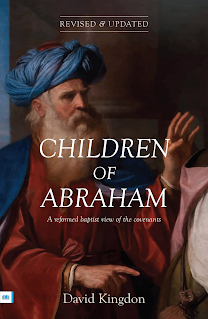
Children of Abraham: A reformed baptist view of the covenants, by David Kingdon

 
Grace Publications, 2021 edition, 256pp

Christmas Evans the Welsh Baptist preacher began his Christian life as a believer in infant baptism. He was outraged when he came across Baptists who contradicted his views. Evans set out to prove them wrong by reading the Bible from cover to cover and making a careful note of all the many references to the baptism of babies he discovered in holy writ. To his great disappointment he found none. Evans became a Baptist. The strength of the peadobaptist position, however, is not in its advocates' ability to produce killer proof texts in support of their position. Which is just as well. The case for infant baptism, rather, rests on elaborate biblical-theological arguments. Essentially it's all about the relationship between the old and new covenants, which is where David Kingdon rightly concentrates his considerable firepower. 

Paedobaptists hold that there is one overarching covenant of grace that is administered in different ways in the various biblical covenants. Under the old covenant, covenant membership was for Abraham and his offspring. Following on from that, paedobaptists contend that children of believers are also children of the covenant and should therefore be baptised. That is exactly the point that Kingdon sets out to dispute. 

Reformed Baptists certainly agree that there is one overarching covenant of grace. That covenant was first announced in the promise of Genesis 3:15 and was revealed with increasing clarity and fulness in the Abrahamic, Mosaic and Davidic covenants. They were not, however, administrations of the covenant of grace, the author argues. They were 'covenants of promise' (Ephesians 2:12). The covenants that God made with his people in the Old Testament period were earthly types and shadows of the blessings that would be granted under the new covenant. 

People were saved during the Old Testament period through faith in the promise of grace effected by Christ in the new covenant. In that sense the Saviour's death retrospectively atoned for the sins of old covenant believers, Romans 3:25-26, Hebrews 9:15. It was on that basis that 'Abraham believed God and it was accounted to him for righteousness' (Romans 4:3, citing Genesis 15:6). 

While it was true that all of Abraham's descendants were to be circumcised, not all of his offspring believed in the promise of salvation through Abraham's offspring, the Messiah. The Lord gave the Promised Land to the people of Israel, but not every inhabitant of the Land looked beyond it to the eternal inheritance of the new creation. In fact, it seems that only a remnant in Israel experienced the circumcision of their hearts to which circumcision in their flesh was but a sign, Deuteronomy 30:6, Romans 2:29). 

It is with that in mind that Paul could say, 'not all who are descended from Israel are Israel' (Romans 9:6). Belonging to God's covenant people by natural descent from Abraham was part and parcel of the earthly and temporary character of the the old covenant. That has now become obsolete since the Messianic offspring of Abraham has come, Galatians 3:16. Membership of the new covenant people of God is on the basis of 'believe and belong' whether Jew or Gentile, not natural descent (Galatians 3:29, 6:15-16). That is why baptism is only for those who have repented of their sins and believed in Jesus, for they alone are in Christ, Galatians 3:27. 

The old covenant distinction between outward membership of the people of God by descent from Abraham plus circumcision, and inward membership by circumcision of the heart and faith in the coming Messiah has been rendered null and void under the new covenant. In Jeremiah's promise of the new covenant (Jeremiah 31:31-34) all new covenant members of the people of God know the Lord, all have the law written on their hearts and all have their sins forgiven. Those things were only true for a godly remnant in Old Testament Israel. 

John the Baptist recognised the 'believing remnant' principle. The Baptist warned that Jewish people should not rest in the fact that they were descended from Abraham and circumcised, Matthew 3:9. He did not baptise the children of baptised adults, only repentant sinners who were waiting for Messiah to be revealed, Matthew 3:10-11. Christian baptism similarly is upon repentance and faith in accordance with the consistent witness of the New Testament, Acts 2:38-40, 8:36-38, 9:17-18, 10:44-48 etc. Church membership is for those who have made a credible profession of faith and have been baptised, Acts 2:41. 

David Kingdon originally published this work in 1973. This edition includes fresh maternal on the ministry of John the Baptist and the newness of the new covenant. Kingdon argues his case well, interacting throughout with representatives of the infant baptist tradition. In line with the Independent divine, John Owen, some Reformed Baptists have held that the old covenant was a republication of the covenant of works. Here Kingdon rightly lays stress on Paul's teaching that God's covenants with Israel were 'covenants of promise' that bore earthly and temporary witness to the spiritual and eternal blessings of the new covenant that are ours in Christ. 

Convinced paedobaptists will find much to chew on in his book as the writer calls into question some of their most cherished assumptions and points out weaknesses in their key arguments. Baptists will be helped to see that our position is rooted in sound theological reasoning as well as the plain teaching of the New Testament. As the author convincingly demonstrates, baptism is only for those who have repented of their sin and believed in Jesus Christ for salvation. Grace Publications are to be congratulated for publishing this revised and updated edition of Children of Abraham

Wednesday, November 10, 2021

Can We Trust the Gospels? by Peter J. Williams

Crossway, 2018, 153pp

'Gospel truth'. Really? Aren't the Gospel accounts of Jesus' life, teaching, death and resurrection just made up stuff that no rational person should believe? That's the question biblical scholar Peter Williams seeks to address in this little book. He produces a convincing cumulative case for the historical reliability of the New Testament Gospels; Matthew, Mark, Luke and John.

Few if any figures in the ancient world had so much written about them as Jesus of Nazareth. We not only have the witness of the four Gospels. Jesus is also mentioned in a number of non-Christian sources. These Roman and Jewish authors in no way intended intended to write favourably of the Christian faith.  Yet what they said bears out the essential facts concerning Jesus' life and death as recorded in the Gospels. These sources also describe Christian belief in the resurrection of Jesus from the dead and that the early church worshipped him as divine. 

Its is often suggested that the Gospels were written so long after the event that they can't be accurate. Like in the 'Chinese whispers' game, where a phrase is whispered into the ear of one person, who then passed it down the line to others. By the end of the game the phrase usually bears little resemblance to the one at the given at the beginning. 'Sausage, egg and chips' becomes 'postage stamps and crisps', or whatever. This idea is discounted by Williams. For starters, Jesus' treasured teachings weren't communicated in whispers to see what random stuff would come out the other end. They were committed to memory and handed on with great care. The author defends the view that the Gospels were written close the the period the describe, either by eyewitnesses (Matthew and John), or by writers who had access to eyewitness testimony (Mark and Luke). Even liberal scholars now accept an early dating of the Gospels. 

The chapter on Did the Gospel Authors Know their Stuff? is full of fascinating facts. The Evangelists certainly did. Their writings show deep familiarity with the Geography that forms the backdrop to Jesus' ministry.  For instance, local boy Matthew, Mark (based on Peter's testimony) and John refer to the 'Sea of Galilee', or simply 'the Sea'. Peter and John were fisherman on that stretch of water, so for them it was the sea. Luke who may well have hailed from Antioch near the Mediterranean refers to the same waters as 'the lake'. 

Williams delves into the way names are recorded in the Gospels, where the writers disambiguate names that were popular at the time. 'Jesus' was the sixth or seventh most popular Jewish Palestinian name in those days. Which is why when characters are recorded in the Gospels as speaking of Jesus  they often disambiguate, saying, 'Jesus of Nazareth' so listeners knew exactly which Jesus they were taking about. The quotes cited in the Gospels therefore have a contemporary ring to them. They were not made up after the event and placed in people's mouths for effect. When narrating what Jesus said or did the Gospel writers tend simply to say 'Jesus' without disambiguation, as they could be confident that their readers knew very well which Jesus they were talking about. 

As Williams points out, we don't get a sense that the Evangelists were deliberately corroborating each other's accounts. They weren't like criminals concocting their watertight alibis lest they be collared by the police. While there is overlapping material in the four Gospels (especially the 'Synoptics; Matthew, Mark and Luke'), each has their own unique touches. Williams highlights a number of 'undesigned coincidences' where one Gospel in supplying information that is missing from the others helps to fill out the picture. What Luke and John have to say about the sisters Mary and Martha is given a case in point. In different ways both Evangelists present Martha as down-to-earth and practical, while Mary is seen as the more contemplative sibling.  

Various questions that may cause people to doubt the truthfulness of the Gospels are also given attention. Do we have the actual words of Jesus? Has the text changed? What about contradictions? And so on. For me one of the most powerful arguments that Williams makes is about the person of Jesus himself. The one who emerges from the pages of the Gospels is clearly extraordinary in every way. Which is why the preacher from Nazareth continues to command our attention some 2,000 years after he waked on earth. It could be that the Gospel writers were literary geniuses who independently created this special character and put amazing words into his mouth. The simpler and more likely explanation is that Jesus was who they said he was, the Son of God in human form, John 20:30-31.

If you are interested in the Christian faith, but not yet convinced, this book may address some of your doubts. Believers will have their confidence in the Gospels confirmed. They will be able to use the author's arguments in discussing the faith with friends who may be sceptical about the Gospel records. Pastors reading this will have their understanding of the Evangelists' multifaceted witness to Jesus enriched, which will hopefully serve to make their preaching all the more persuasive. 

Gospel truth? Yes, really.

Thursday, July 08, 2021

The Rise and Triumph of the Modern Self, by Carl R. Trueman

The Rise and Triumph of the Modern Self: 
Cultural Amnesia, Expressive Individualism and the Road to Sexual Revolution,
by Carl R. Trueman, Crossway, 2020. 434pp, Kindle edition 

The other week Housing Secretary Robert Jenrick was interviewed on Times Radio. It's the job of journalists to put government Ministers on the spot by asking them tricky questions. But the nature of what constitutes a 'tricky question' changes. In this case Jenrick was quizzed on whether he agreed with his colleague, Liz Truss, the International Trade Secretary that you need to have a vagina to be a woman (see here). The Housing Secretary replied, 'I think there's a matter of biology, of course, what is a woman. I mean absolutely, I agree with Liz Truss. That's the point that she's made in the past.' Given the constraints of collective responsibility, how could Jenrick say otherwise? He knew, however, that a trap was being set and not wanting to offend the perpetually offended trans lobby, the minister qualified his words saying, 'Undoubtedly, of course we want to ensure that those people who are trans can live their life comfortably. I want everyone to be able to live their life the way they want to and be happy and to find love wherever they can do.' 

Expressive individualism 

You may be wondering how on earth we got ourselves into a position where journalists put government ministers through their paces by asking them whether women have vaginas. Since when did the basic facts of biology become a matter of political debate? Charles Taylor speaks of the 'social imaginary', a set of underlying assumptions that make beliefs plausible at any given time. In a less secular age faith in God was part of the 'social imaginary'. While a minority may have dissented, most people assumed the existence of a divine being and lived their lives accordingly. Now, not so much. These days the 'social imaginary' is limited to the immanent frame, haunted only on occasion by the sense of a transcendent realm. Similarly, the idea that a man can become a woman and just as much a woman as someone who was born female would have been regarded as nonsense until relatively recently. But now it is part of the 'social imaginary' and to dissent from that view is to attract accusations of 'transphobia', which Robert Jenrick for one was so keen to avoid

In this book Carl Trueman sets out how the 'social imaginary' of the Western world lent itself to the belief that a man can become a woman, or vice versa. Transgender ideology didn't emerge from nowhere. The writer traces its roots back to the 18th-century Romantic movement. Jean-Jacques Rousseau was the father of Romanticism. He held that people are born free and innocent, but are corrupted by society which imposes its oppressive values on the individual in order to force to them into conformity with accepted standards of behaviour. English Romantic poet Percy Bysshe Shelley agreed. He wanted to break free from from societal norms that were based on monogamous marriage so he could practice sexual self-expression. That was the only authentic way to live, free from outward constraints. The Romantics expected society to uphold basic moral values for the good of everyone concerned, but the emphasis was on the psychological fulfillment of the individual. 

Prime Minister Boris Johnson might call it 'cakeism', a case of  'having one's cake and eating it'. The Romantics granted the benefits of Christian ethics for society as a whole, but reserved the right to transgress the elements that hindered their self-expression. Friedrich Nietzsche saw things more clearly. If God was pronounced dead, then faith-based values ceased to have any validity. Heroic self-invention is the only way forwards. Add Karl Marx and Charles Darwin to the mix and all sense that human beings are distinct creatures with a nature bestowed upon them by God is lost. We are plastic people in a fluid world. 

Then along came Sigmund Freud to sex things up a bit. He basically thought that everything is about sex. Society enforces the suppression of the sex drive of the individual by insisting that desire is channelled through monogamous marriage. That may not necessarily be a bad thing, but if marriage is simply a social construct, people are free to deviate from its constraints if they wish. Freud had no time for belief in God, rendering marriage as a 'divine ordinance' meaningless. Taking their cue from Freud, Marxist thinkers such as Herbert Marcuse began to see patterns of oppression more in psychological than economic terms. People with sexual proclivities that deviated from the norms of society weren't so much 'depraved deviants' as victims of heteronormative oppression. 

The Romantics taught the primacy of psychological self-expression over and against the norms of society. Freud emphasised the primacy of the sexual in the realm of psychology. Marx argued that rather than being a fixed entity, human nature is shaped by the economic tides of history. Industrialisation had a profound effect on how society viewed the role of women. The rise of the machines meant that women as well as men could be employed in factories, eroding traditional gender-based distinctions. Modern medicine has made further erosion possible. Men may be given female sex hormones. They may submit to sex change surgery so that the body of a natal male is refashioned to resemble that of a woman. (DNA and internal reproductive organs aside). Expressive individualism demands that if a man feels he is really a woman, but trapped in the wrong body, his psychology trumps his biology and his gender identity must be validated by society. 'Trans women are women', get over it. 

That's what you get when the 'social imaginary' is the product of expressive individualism. Robert Jenrick's nod towards trans ideology cited earlier is a perfect case in point, 'of course we want to ensure that those people who are trans can live their life comfortably. I want everyone to be able to live their life the way they want to and be happy and to find love wherever they can do.' In this context the idea that sex is immutably rooted in biology and that biology should have something to say about sexual expression is regarded as oppressive. 

Tensions 

And so it is that in England the LGBT pressure group 'Educate & Celebrate' seeks access to schools so it can advance its mission to 'smash heteronormativity' (see here). Children are taught they can choose whether to be a boy or a girl, based on how they feel inside. Expressive individualism for kids. But there are pushbacks, especially from feminist groups whose whole outlook is based on women being oppressed by a patriarchal society on the basis of sex differences. Feminists resent the downgrading of their biological reality by men who demand to be recognised as women. They are also outraged that biologically intact males who identify as female are given access women's toilets, prisons and refuges. Parents are alarmed when it becomes apparent that their children have been exposed to the kind of trans propaganda promoted by groups such as 'Educate & Celebrate'. Even that bastion of 'muscular liberalism', Ofsted is now concerned about the influence of lobby groups on sex education in schools (see here). 

Adding the 'T' to the LGB lobby has also resulted in tensions. The gay lobby traditionally fought for rights on the basis that people don't choose to be gay or lesbian. Sexual identity, they claimed, is fixed and society should't regard same-sex attracted people as deviants who should be made to conform heterosexual norms. Trans ideology promotes the idea that sexual identity is not fixed, but fluid. If they wish, people should be able to identify as a gender that is different to their birth sex. 'Trans women are women' and woe betide anyone who says otherwise. But lesbian sexuality is based on attraction to people of the same sex, not male-bodied people who identify as women. The LGBT lobby group Stonewall is being dropped by government departments because of its attempts to silence gender critical voices and the misleading advice it gives on the Equality Act with regard to female-only spaces etc. (see here). 

True identity 

In an Unscientific Postscript Trueman looks at how things may pan out in Western culture, captured as it has been by expressive individualism. With the trans lobby labelling gender critical feminists as a bunch of no good 'TERFs' (Trans Exclusionary Radical Feminists), intersectionality isn't exactly providing a recipe for a more harmonious society. Free speech and with it freedom of religion is likely to come off worst when Christians voice their opposition to the LGBT agenda. After all, the 'heteronormativity' represented by traditional Christians is part of the problem and we can't have people voicing opinions that would disturb the phycological wellbeing of others. But we must stand firm and not allow the world to press us into its mould. Contra expressive individualism, people are not free to create their own identity. Human identity is a given thing, rooted in our being made in the image of God as male and female. Marriage can't simply be redefined so as to ignore that reality. The identity of the believer is not located in their sexuality, or gender identity, but in Christ. Our task is to preach him and all things in relation to him, Colossians 1:28-29.