Pages

Friday, September 22, 2023

Tom Holland on Pax: War and Peace in Rome's Golden Age


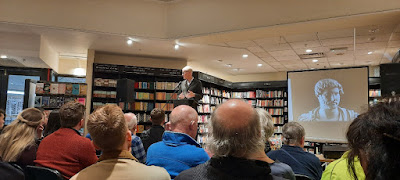
Last night we headed for Waterstones in The Galleries, Bristol to hear the author Tom Holland give a captivating talk on his latest tome, Pax: War and Peace in Rome's Golden Age. I received the book as a birthday present from my son and have just started to dip into it. The last time we heard Holland speak at the same venue he was promoting his previous work, Dominion: The Making of the Western Mind (see a report here). 

The speaker began by taking us to Hadrian's Wall, which marked the northernmost point of the Roman Empire. The Emperor Hadrian liked to visit the outposts of his vast domain, which stretched from Scotland to Arabia. The point of Hadrian's Wall was not so much to keep the barbarous Scots at bay, as to rub their noses in the fact that they had been excluded from the vast cultivated garden that flourished under Roman rule. 

Nero was the last Emperor to have descended from the great Augustus. His demise triggered the 'Year of the Four Emperors' in 69AD. Wannabes Galba, Otho and Vitellius failed to maintain their hold on power. Those who followed such as Vespasian, Domitian, Trajan and Hadrian ruled for long enough to ensure stability. That stability was the product of good PR as much as the might of the legions at the Imperial overlord's command.

The Emperors had statues erected in their honour across their domains. Coins bore the stamp of the Emperor's face. These images depicted how the Emperors wished to be seen, whether as aged throwbacks to antique virtue, or eternally young and virile rulers. Roman noblemen were usually clean shaven, but Hadrian affected a soldierly beard, which also gave him the aspect of a Greek philosopher. Holland had a suspiring amount to say about imperial barnets and beards. Otho's toupee made him an altogether unsuitable candidate for Emperor. No wonder he only lasted three months and a day in office. 

The writer described the Roman Emperors as the 'apex predators' of history. They ruled unhindered by any Christian notion of what constitutes right and wrong. After the death of his wife Poppaea, Nero spotted a slave boy who bore a passing resemblance to his dear departed Mrs. He had 'Sporus' castrated and married him. Following Nero's death, Vitellius sought to win the approval of the masses by having Sporus gang raped at a gladiator show. The poor lad only avoided this public humiliation by committing suicide. The short-lived rule of Vitellius ended when he was slaughtered by his successor Vespasian's troops. 

Holland described Christians of the time as 'Mesozoic mammals in a ecosystem dominated by dinosaurs.' But it was the little Christian mammals who won the day. The reason why we are appalled at the blood-soaked deeds of the mighty Emperors is that the 'Christian Revolution' totally transformed the moral landscape of the ancient world. How that happened is the story told in Dominion.    

Tuesday, September 19, 2023

The destroyer of worlds

‘Ban the Bomb’ was a thing in the 1980s. The Greenham Common women protested against the presence of nuclear missiles at the Berkshire RAF base. A little more modestly, I braved being told off at school for wearing a CND badge. Those were the days. The prospect of nuclear oblivion haunted our teenage imaginations. In their number-one single, Going Underground, The Jam lamented, ‘You want more money, of course I don't mind / To buy nuclear textbooks for atomic crimes.’ Fun, eh?

The man who wrote the ‘nuclear textbook’ was the subject of Christopher Nolan’s blockbuster movie, Oppenheimer. J. Robert Oppenheimer brought together some of the most brilliant scientists of his day to develop nuclear weapons ahead of Nazi Germany. Winning that arms race was a massive scientific achievement. The resulting bombs were dropped on Hiroshima and Nagasaki, hastening the end of World War II. Yet Oppenheimer was deeply disturbed by the weapon of mass destruction he had helped to create: ‘I have become death, the destroyer of worlds,’ the scientist reflected.

You won't find me sporting a CND badge these days. Sadly, nuclear weapons can’t be uninvented, although I certainly hope they will never be used again. Oppenheimer highlights what is best and worst about human beings. We are capable of the most astounding scientific breakthroughs, yet we are also capable of unleashing death and destruction on a massive scale. The Christian faith recognises that human beings are made in the image of God. Hence our exceptional abilities. But the Bible also testifies, ‘All have sinned and fall short of the glory of God’.

Jesus came to deliver us from sin by dying in our place. Christ’s resurrection from the dead brings the hope of a new creation for those who put their trust in him. The film Oppenheimer concludes on an ominous note, with the world teetering on the brink of nuclear oblivion. The Bible ends more hopefully, pointing us to Jesus as the one in whom there is life, the Saviour of the world. In the Book of Revelation, John is given this glorious vision: ‘I saw a new heaven and a new earth... and death shall be no more, neither shall there be mourning, nor crying, nor pain any more, for the former things have passed away’.

*For September edition of various parish magazines 

Monday, September 04, 2023

Rest

Even Jesus needed a break. After a time of extremely busy activity he said to his followers, ‘Come away and rest a while.’ The trouble was that the crowds got wind of where Jesus was heading and followed him there. Cue the feeding of the 5000. So much for that break. At least the intention to stop for a rest was there.

The Lord did not make us to keep going 24/7. We need a good night’s sleep and beyond that, regular breaks from the daily grind. God commanded the people of Israel to rest on the sixth day of the week, or the Sabbath. The Christian day of rest is Sunday, the first day of the week. It was on that day that Jesus rose again from the dead.

It is often during the summer that people take time off work for their main annual holiday. But there is a big difference between rest and leisure. The American novelist Marilynne Robinson  reflected, ‘The Sabbath has a way of doing just what it was meant to do, sheltering one day in seven from the demands of making money. Its benefits cannot be commercialised. Leisure, by way of contrast, is highly commercialised. But leisure is seldom more than a bit of time ransomed from habitual stress.’

I’m sure anyone who has braved a busy theme park would agree. You pay through the nose to spend up to an hour queuing for the brief thrill of a rollercoaster ride and then its on to the next thing. Fun, if you like hurtling around while upside down. Restful, not so much.

Yet it’s rest that our troubled souls and weary bodies long for. Days off and holidays are of some help, but there is more. We were made for God and it is only in being reconciled to him that we can find true peace. Jesus died on the cross for our sins that we may be forgiven and be put right with God. He says to us, ‘Come to me, all who labour and are heavy laden, and I will give you rest.’

* For the August edition of various local parish magazines 

Thursday, July 20, 2023

Better to Arrive than Travel

Yorkshire is often called ‘God’s own country’, especially by Yorkshire folks. Never by anyone from Lancashire, though, apparently. But I have no wish to reignite the Wars of the Roses, as you’ll be relieved to hear. What side would people from Wiltshire be on, anyway?

According to the well-known saying, ‘it’s better to travel than to arrive’. If you’re driving from Wiltshire to Yorkshire, it’s not, as we discovered the other week. At first, it’s OK as you speed north up the M5, casting a pitying eye on the columns of traffic making little progress as they head towards the beaches of the South West. But the further north you go, the slower the journey becomes. Mile after mile of crawling along the M6 at 10 mph, or stopped altogether. In the blazing sun. And the car’s air con has packed in.

It was certainly better to arrive in Yorkshire than to travel there. We enjoyed rambling on Ilkley Moor. Certainly not ‘bar’tat’*, though, with the sun beating down. There were magnificent dales and waterfalls to admire, lovely old towns and villages to explore, and, of course, tea at Betty’s, complete with the obligatory Fat Rascal scone.

In the Bible, the Christian faith is likened to a journey. The Old Testament heroes of the faith, Abraham, Isaac and Jacob, are described as pilgrims on their way to ‘a better country, a heavenly one’. No, they weren’t heading for Yorkshire, not even Wiltshire. Their eyes were on the city of God.

Jesus is the way to that special place. He died for our sins and rose again, so that those who believe in him may be with him for ever. The journey to that heavenly country is sometimes hard going, but it will be more than worth it.

* ‘bar’tat’ = without a hat.

For July edition of various local parish mags 

Tuesday, June 13, 2023

Broken Stones


Paul Weller at Westonbirt
Way back in the late 1970s/early 80s, I was a teenage mod. I had the Sta-Press trousers, button-down shirts, and desert boots to prove it. Plus the obligatory fishtail parka.  When it came to music, my favourite group at that time was The Jam. How heartbroken we fans were when lead singer and songwriter Paul Weller announced in 1982 that he was splitting the band.

But for Weller the music didn't stop there. He went on to form the Style Council and then became a solo artist. Riding the crest of a Brtipop wave, his album Stanley Road (1995) was a massive hit. I was listening to it the other day on my car stereo. The track ‘Broken Stones’ especially grabbed my attention. Weller sees a metaphor for life in pebbles kicked around on a beach:

Like pebbles on a beach
Kicked around, displaced by feet
Oh, like broken stones
They're all trying to get home

Kelly Jones of Stereophonics recently joined Weller on stage to sing this song.  

The track’s vision of people as ‘lost and alone...trying to get home’ says something profound about the human condition. There is a deep restlessness in our souls, a feeling that we are somehow lost and far from home. That applies to successful musicians like Paul Weller, as well as the likes of you and me.

Now, the singer does not claim to be a Christian, but what he says chimes in with what the faith has to say about restless humanity. The early church leader Augustine prayed to God, ‘You have made us for yourself and our hearts are restless until they find their rest in you.’ In our sin we are far from God, ‘lost and alone’. But we can’t escape that longing for home.

The Lord Jesus said of himself, ‘the Son of Man has come to seek and save the lost’. That is why Jesus came to die for our sins upon the cross and rise again from the dead. Through faith in him ‘broken stones’ are made whole and brought home to the Father. 

Kelly Jones joins Weller to sing Broken Stones 

Wednesday, May 10, 2023

‘King of kings’

On Saturday 6 May millions of us watched on TV as His Majesty King Charles III was crowned in Westminster Abbey. The Coronation Service was rich in ceremony and symbolism. The Archbishop of Canterbury anointed the king with oil and placed St Edward’s crown upon his head. The newly crowned King Charles III was given the ceremonial Orb and Sceptre, tokens of his royal power.  
 
Much of the symbolism associated with the Coronation was drawn from the Christian faith. The anointing recalls that kings in the Old Testament period were anointed with oil to symbolise that they were empowered for their role by the Spirit of the Lord. The Hebrew word ‘Messiah’ means ‘Anointed One’. The Greek equivalent is ‘Christ’.  St Edward’s crown, the Orb and Sceptre all feature crosses as a reminder that earthly rulers are subject to a greater King, Jesus.  
 
As the firstborn son of  Queen Elizabeth II, Charles was born to be King, although he only assumed that title on his mother’s death. Similarly, Jesus was born to rule. The angel of the Lord told Mary, Jesus’ mother, that her Son would sit upon the throne of his royal ancestor, David. When Jesus was born wise men from the East sought out the infant King of the Jews and brought him gifts of gold, frankincense and myrrh.
 
Yet when the Lord Jesus Christ was crowned on earth it was not with a jewel encrusted crown of gold, but with a crown of thorns in preparation for his crucifixion. ‘Behold your King!’ said Pontius Pilate of Jesus, the man he had condemned to die. Jesus could have used the power by which he calmed the waves and healed the sick to avoid the suffering and shame of the cross, but he did not. Jesus came to die in the place of sinners that we may be forgiven and be reconciled to God. His lifeless body was taken from the cross and laid in a borrowed tomb, which is where it remained until Easter Sunday morning when God raised his Son from the dead.
 
Forty days later Jesus ascended to heaven to assume his place at the right hand of God the Father. That was his Coronation Day, when Jesus was crowned King of kings and Lord of lords. He is exalted far above all rule and authority and power and dominion, and above every name that is named, not only in this age but also in the one to come. King Jesus offers his royal pardon to all who will come in faith and bow the knee before his throne.

*For May edition of various local parish mags

Wednesday, April 05, 2023

‘The Son of Man must suffer’

The Cross stands at the heart of the Christian faith. Yes, believers sit at the feet of Jesus the Teacher, captivated by his compelling vision of the righteous life in the Sermon on the Mount. They marvel at the miracles the Bible reports he performed; making the blind see, the deaf hear, and the lame walk. But the Gospel accounts never let us forget for a moment that the Man who preached the Sermon on the Mount and made broken human beings whole was heading for the death of the Cross. Jesus knew it, which was why he repeatedly told his followers, 'the Son of Man must suffer... and be killed'.

What lies behind that 'must'? Was Jesus' death by crucifixion the outworking of the unstoppable forces of history? When Boris Johnson resigned as Prime Minister he acknowledged he was powerless to resist calls in the Conservative Party that he should be removed from Number 10, ‘When the herd moves, it moves', he reflected. In Jesus' case, the Jewish religious establishment wanted him out of the way. They feared unless Jesus was stopped they would lose their power. They manipulated Pontius Pilate by forcing him choose between loyalty to Caesar and condemning Jesus to death. Inevitably, Pilate sent Jesus to the Cross rather than risk upsetting the Emperor. But there is more to Jesus' 'must' than that.

Perhaps the 'must' can be attributed to the blind forces of fate that are said to determine who wins the Lottery and who gets run over by a bus? But Jesus wasn't being fatalistic when he spoke of his impending death, going to the Cross resigned to 'whatever will be will be'. No, the 'must' that compelled Jesus towards Calvary was his sense that it was his God-given mission to suffer and be killed. Why? The Bible's answers that quite simply, 'Christ died for our sins'. In other words, the 'must' of which Jesus spoke was the fulfilment of God's rescue plan for the world, 'God shows his love for us in that while we were still sinners, Christ died for us.’ Now all who believe in Jesus are forgiven and put right with God.

Not only Jesus’ death, but also his resurrection was covered by the divine ‘must’, ‘the Son of Man must suffer... and be killed, and after three days rise again’. It was not possible for death to maintain its iron grip on the Prince of Life.

Easter services at Providence & Ebenezer

Providence Baptist Church
Good Friday 10.30am
Easter Sunday 10.30am & 6.00pm

Ebenezer Baptist Church
Easter Sunday 4.30pm

* For April edition of various parish magazines 

Monday, April 03, 2023

The Pastor as Counselor: The Call for Soul Care by David Powlison

Crossway, 2021, 76pp
 
In this little work, David Powlison underlines the uniqueness of pastoral counselling. All pastors are counsellors, but their counselling ministry is distinct from others who offer a ‘talking cure’ to distressed individuals. Pastoral counselling is about soul care, that ‘art of arts’ that aims at helping form people into mature and fruitful followers of Jesus. Pastors are not to maintain a professional distance from those they seek to counsel. Pastoral counselling is part and parcel of the minister’s close relationship with members of the flock he is called to serve.
 
The pastor’s counselling may take place in snatched conversations at the fringes of church life, where he asks people how they are doing and seeks to encourage them in the Lord. When bereavement, family breakdown or other forms of suffering strike, the counselling will be more intensive. Similarly, when a pastor gives support to a believer who is engaged in a massive struggle with temptation and sin.
 
In all these things the pastor offers counsel not as an expert with all the answers, but as a fellow-sufferer and fellow-sinner. The work is to be carried out in God-dependent prayer, as the minister endeavours to apply the teaching of Scripture to the troubled soul. Personal counselling is not an alternative to public preaching. It is an extension of the pastor’s calling as a minister of the word of God in the service of the people of God. 

*Reviewed for the Banner of Truth Magazine 

Thursday, March 30, 2023

Natural Theology by Geerhardus Vos

Reformation Heritage Books, 2022, 106pp
 
Gerhardus Vos will be know to readers of this blog for his famous work, Biblical Theology, published by the Banner of Truth Trust. Vos served as Professor of Biblical Theology at Princeton Theological Seminary from 1892 until his retirement in 1932. His main interest during that period was in tracing the redemptive-historical flow of the Bible’s big story. Prior to that he taught at the Theological School at Grand Rapids, where among other things Vos lectured on dogmatics and natural theology.
 
It is commonplace to say that God has two books in which he has revealed himself; the ‘Book of Nature’ and the ‘Book of Scripture’. The task of natural theology is trace what can be seen of God’s self-revelation in the created order. In a useful introduction to the work under review John V. Fesko places Vos’s contribution to the field of natural theology in the context of Reformed thought. John Calvin and his fellow Reformers drew on the teaching of earlier theologians to emphasise that while God reveals his existence to all in nature (Romans 1:19-20), natural revelation cannot give saving knowledge to sinners. Fesko argues of Cornelius Van Til’s negative attitude towards natural theology was a departure from the mainstream Reformed teaching as represented by Vos.
 
The main body of the work is drawn from notes made on Vos’s lectures on natural theology by his students at Grand Rapids. His lectures would follow and question and answer format. This is retained in the text. But what may have been an effective means of communication in the lecture hall does not work quite so well on the printed page. The Q&A approach makes it more difficult for the reader to follow the overall drift of Vos’s argument and a sense of momentum is lost.
 
That said, there are good things here. Vos gives attention to the meaning of natural theology. He discusses the strengths and weaknesses of arguments for the existence of God. The Professor interacts with older and more modern objections to arguments for God’s existence, many of which are still doing the rounds today.
 
*Reviewed for the Banner of Truth Magazine, 

Wednesday, March 29, 2023

Pure Church: Recovering God's plan for local churches

Edited by: David Skull, Andrew King & Jim Sayers
Grace Publications, 2022, 283pp

I've been using this book as a tool for discussing church membership with someone who is not from a Baptist background. Meeting up to discuss a chapter or two at a time has helped to clarify the biblical teaching on the church that we seek to put into practice as a fellowship. The aim of this work is to sketch out a biblical vision of church life from a Grace Baptist perspective. The premise here is that God has a plan for how local churches should function and that he has revealed that plan in Holy Scripture. Of course, there are true gospel churches other than of the Grace Baptist variety. That is acknowledged in the first chapter, on The Visible Church. The visible church is the manifestation on earth of the universal church of Jesus Christ to which all genuine believers belong, irrespective of the denominational label. But the visible church is only made manifest when a local congregation holds to and holds forth the message of the gospel. 

That is the place to start when it comes to the biblical doctrine of the church. Not in finding snazzy new ways of 'doing church for the 21st century', but by having a sound grasp of the gospel of salvation that calls the church into being. These are the truths of 'first importance' defined by the apostle Paul in 1 Corinthians 15 and helpfully outlined by Jim Sayers in the first chapter. Issues such as church membership and the proper subjects of baptism are second order doctrines. They may not be essential for salvation, but they are certainly not unimportant when it comes to recovering a biblical understanding of church life. 

Evangelicals have sometimes justified serving in theologically mixed denominations on the grounds that having unconverted members in the churches makes them a 'good pool to fish from'. Convinced Baptists believe that according to the New Testament local churches are gatherings of converted and baptised people where the Lord's Supper is celebrated. These matters are helpfully discussed in chapters two to five, on Conversion, Baptism, Membership and The Lord's Supper. 

On the Day of Pentecost Peter urged his hearers, “Repent and be baptized every one of you in the name of Jesus Christ for the forgiveness of your sins, and you will receive the gift of the Holy Spirit." (Acts 2:38). Luke then tells us, "So those who received his word were baptized, and there were added that day about three thousand souls." (Acts 2:41). That repentant and baptised people were added to the Jerusalem church strongly suggests a properly defined church membership made up of converted individuals. We should also bear in mind that it was possible for someone to be removed from the membership of a local church should they stray into serious error, or fall into open sin. The fact that they could be put out implies that they were formally received into the church in the first place. 

We live in highly individualistic times in which the consumer is king or queen. That may be well and good when it comes to choosing our favourite breakfast cereal, but such an attitude can be disastrous when it comes to following Jesus. The Lord has not simply saved a bunch of random individuals. He is gathering people together into his body, the church. If we may continue with Luke's description of the rapidly congregation at Jerusalem, "And they devoted themselves to the apostles' teaching and the fellowship, to the breaking of bread and the prayers." (Acts 2:42). Discipleship and discipline are two sides of the same coin when it comes to how local churches seek to form converts into fruitful followers of Jesus. See chapters six and seven. 

Discipleship is an essential element of the Great Commission, Matthew 28:19-20. It involves both formal teaching by pastors and teachers in the church and also members caring for each other and encouraging one another in the life of faith. Church discipline acts as a corrective when church members stray. Its purpose is to safeguard the purity of the church and to restore the straying member to faithful Christian discipleship. The Lord Jesus has given his local churches the keys of the kingdom that they may admit to their number those who have made a credible profession of faith and remove from their number those whose credibility as believers is in doubt. Attention is drawn to Matthew 18:15-20 and 1 Corinthians 5. 

Chapters eight and nine deal with the Independent governance of the church and church leadership. Baptists believe that each local church is independent under the lordship of Christ and subject to the authority of Scripture. The church members' meeting is the key decision making body of the church. Leaders are appointed by church members and may be removed by them if necessary. The biblical pattern for church leadership is one of a team of elders who share in the oversight of the flock, one or more of whom may be called to 'labour in the word and teaching' (1 Timothy 5:17) on a full time basis. The qualities required of overseers are detailed in 1 Timothy 3:1-7. Deacons are appointed to meet the practical needs of the church in line with Acts 6:1-7 and 1 Timothy 3:8-13.  

For all the right and proper emphasis on the importance of local churches comprised of baptised believers, the value of inter-church fellowship is also underlined in the final chapter on Gospel Unity. Churches with a shared confession of faith such as the Second London Baptist Confession, 1689 may wish to form formal associations. Confessional Grace Baptist Churches can enjoy fellowship with churches from other Evangelical and Reformed groupings. This may involve meeting together for times of ministry and prayer, or supporting shared activities like youth work. 

Despite the title, the writers of Pure Church do not claim that Grace Baptist Churches have reached a state of ecclesiological perfection and purity. Far from it. But they do hold that it is for the good of individual believers and churches when God's plan for the local church is followed. The various authors of this book have strongly Reformed Baptist convictions, but they do not lapse into sectarian polemic against those who belong to other church groupings. The stance taken is sometimes more 'Strict Baptist' on church membership and the Lord's Supper than all Grace Baptists would be willing to countenance. Surprisingly perhaps, the teaching of the Second London Baptist Confession on matters covered here isn't cited by the authors, which is something of an omission. That said, the work offers a lively and compelling vision of church life such as may be discovered in the pages of the New Testament.