Pages

Showing posts with label Baptists. Show all posts

Thursday, September 25, 2025

'God Without Passions' by Samuel D. Renihan

God without Passions: The Majesty of God's Unshakeable Perfection,
by Samuel D. Renihan, Broken Wharfe, 2024, 86pp

Throwing in 'I am passionate about...' has become a hackneyed phrase in Uni personal statements, CVs and job interviews. Beyond the worlds of study and work, someone might say, their real passion in life is for hang gliding, foreign travel, or whatever. In other words, we consider 'passion' to be a highly commendable thing. Someone who professed to lack any sort of driving passion would strike us as rather dull. Depressed, even. 

A book with the title God Without Passions might sound rather off-putting, then. Who'd be interested in a remote, passionless deity? But passions weren't always viewed quite so positively. That struck me only recently when reading John Aaron's Thomas Charles of Bala (Banner of Truth Trust, 2022). Charles lived from 1755-1814. In his day passions tended to be viewed with some suspicion. You wouldn't necessarily admit to harbouring them in a job application.  

Chapter 4 of Aaron's  biography details the preacher's pursuit of and eventual marriage to Sally Jones. When a young man Charles was based in Milbourne Port, Somerset and his beloved Sally in Bala, North Wales. Their long distance courtship was largely conducted by letter. In their correspondence Sally played hard to get and was forever second guessing the purity of her own and Charles's motivation for getting married. What if their budding romance were simply a matter of blind passion, she wondered?  In one of his letters Charles acknowledged, "Passions are unsteady things; they are no sooner excited but they subdue again, and cannot be depended upon." (p. 61). 

With that in mind it is little wonder that the Second London Baptist Confession of Faith, 1689 states, 'God is... a most pure spirit,  invisible, without body, parts, or passions' (Chapter 2:1). The Particular Baptists were not being idiosyncratic on this point. They were simply echoing the theological consensus of Reformed Catholic theology. That consensus is beginning to break down in the world of contemporary Evangelicalism (see here). In fact the doctrine of divine impassibility has become the subject of passionately argued debate. 

Renihan doesn't approach the impassibility of God with theological daggers drawn. His approach is irenic, lucid and pastorally motivated. The writer accepts that Scripture itself often speaks of God in terms of a human seeming emotions. In Genesis it is said that prior to the Flood 'the Lord was sorry that he had made man... and it grieved him to his heart' (Genesis 6:6).  In Ezekiel 6:9 the Lord complains about Israel, 'I have been broken over their whoring heart that has departed from me'. 

What are we to make of such language? For a start it is qualified in the pages of Scripture itself. The Lord's statement, 'I regret I have made Saul king' (1 Samuel 15:11) should not be taken at face value. Why? Because of the words we find in the very same chapter, 'the Glory of Israel will not lie or have regret, for he is not a man, that he should have regret.' (1 Samuel 15:29). How may we reconcile these two sayings of the Lord? Well, we need to recognise that in the Scriptures God speaks of himself in accommodated language that is accessible to us, given our human limitations. We often have regrets about decisions we made and opt for a different course of action when things don't work out as we planned. God's plans always work out, including the raising up and removal of Saul. Divine 'regrets', then are merely apparent, signalling the outworking of his eternal decree in this world of time. 

When we confess that God is 'without passions' one thing we are saying is that he is not affected by anything that happens outside of his own being. Nothing can therefore upset God's eternal blessedness or disturb his peace. Human beings are not like that. As Renihan points out, we are creatures of affections and passions. In our affections we are attracted by what we consider good and repelled by what we see as bad. We may be cheered by the kind words of a friend. We may be hurt by the cruel barbs of an enemy. Passions may be defined as twisted affections. They are characterised by undue intensity, or even irrationality. Taken in that sense says Renihan, 'to love is an affection, to lust is a passion; to be angry is an affection, but to rage is a passion'. (p. 21). 

You can see why Sally Jones and Thomas Charles wanted to avoid being motivated to marry merely by blind passion. And clearly, passions so defined cannot be attributed to an eternal and unchanging God. Neither can affections for that matter, for as we have said God is not affected by anything outside of himself. But does that mean when the Bible speaks of the love of God, or the wrath of God, that the Scriptures are merely playing with words? Certainly not. God loves and we love, but while love in humans may be analogous to the  love of God, we don't love as God loves. God is love in the fulness of his infinite, eternal and unchanging being. Similarly with the wrath of God. Unlike us, he isn't provoked into fits of raging fury. Divine anger is the expression of God's unalterable justice when faced with sin.

God's love, justice and faithfulness and so on are not passions or affections, then. They are divine perfections, of which our human equivalents are a shadowy likeness. But in the incarnate Son of God we have one who was both impassible according to his divine nature and who possessed a full range of human feelings, yet without sin. While the Son could not suffer and die as God, he did suffer and die in our place as Man. Because the two natures are united in the person of Christ, we do not say that his human nature was given as a sacrifice for sin. Rather we confess with Paul, 'the Son of God loved me and gave himself for me' (Galatians 2:20). 

Confessing that God is 'without passions' is of great pastoral worth. If the love of God was an affection like ours, his affection might change if the object of his affections changed. But God does not love as we do, because he was attracted to what was good in us. Neither is his love a flash in the pan passion. God loves us with an everlasting love that flows to us from the depths of his being. He loves us even as sinners, which is why he sent his Son to save us by his blood. He loves us as his children, wayward and fickle though we are. It is precisely because God is impassible that Paul can assure suffering saints, 'nothing can separate us from the love of God in Christ Jesus our Lord'. (Romans 8:39). 

We can therefore trust God to keep his promises and rest in his faithfulness, 

The steadfast love of the Lord never ceases; his mercies never come to an end; they are new every morning; great is your faithfulness. (Lamentations 3:22-23). 

Samuel Renihan has produced a most helpful introduction to the doctrine of divine impassibility. He wrestles with the biblical text sensitively and draws upon the theological wisdom of the past to illuminate his accessible study. The publisher Broken Wharfe is to be congratulated for making this handsome volume available. Now going for only £4.50.  

Wednesday, March 29, 2023

Pure Church: Recovering God's plan for local churches

Edited by: David Skull, Andrew King & Jim Sayers
Grace Publications, 2022, 283pp

I've been using this book as a tool for discussing church membership with someone who is not from a Baptist background. Meeting up to discuss a chapter or two at a time has helped to clarify the biblical teaching on the church that we seek to put into practice as a fellowship. The aim of this work is to sketch out a biblical vision of church life from a Grace Baptist perspective. The premise here is that God has a plan for how local churches should function and that he has revealed that plan in Holy Scripture. Of course, there are true gospel churches other than of the Grace Baptist variety. That is acknowledged in the first chapter, on The Visible Church. The visible church is the manifestation on earth of the universal church of Jesus Christ to which all genuine believers belong, irrespective of the denominational label. But the visible church is only made manifest when a local congregation holds to and holds forth the message of the gospel. 

That is the place to start when it comes to the biblical doctrine of the church. Not in finding snazzy new ways of 'doing church for the 21st century', but by having a sound grasp of the gospel of salvation that calls the church into being. These are the truths of 'first importance' defined by the apostle Paul in 1 Corinthians 15 and helpfully outlined by Jim Sayers in the first chapter. Issues such as church membership and the proper subjects of baptism are second order doctrines. They may not be essential for salvation, but they are certainly not unimportant when it comes to recovering a biblical understanding of church life. 

Evangelicals have sometimes justified serving in theologically mixed denominations on the grounds that having unconverted members in the churches makes them a 'good pool to fish from'. Convinced Baptists believe that according to the New Testament local churches are gatherings of converted and baptised people where the Lord's Supper is celebrated. These matters are helpfully discussed in chapters two to five, on Conversion, Baptism, Membership and The Lord's Supper. 

On the Day of Pentecost Peter urged his hearers, “Repent and be baptized every one of you in the name of Jesus Christ for the forgiveness of your sins, and you will receive the gift of the Holy Spirit." (Acts 2:38). Luke then tells us, "So those who received his word were baptized, and there were added that day about three thousand souls." (Acts 2:41). That repentant and baptised people were added to the Jerusalem church strongly suggests a properly defined church membership made up of converted individuals. We should also bear in mind that it was possible for someone to be removed from the membership of a local church should they stray into serious error, or fall into open sin. The fact that they could be put out implies that they were formally received into the church in the first place. 

We live in highly individualistic times in which the consumer is king or queen. That may be well and good when it comes to choosing our favourite breakfast cereal, but such an attitude can be disastrous when it comes to following Jesus. The Lord has not simply saved a bunch of random individuals. He is gathering people together into his body, the church. If we may continue with Luke's description of the rapidly congregation at Jerusalem, "And they devoted themselves to the apostles' teaching and the fellowship, to the breaking of bread and the prayers." (Acts 2:42). Discipleship and discipline are two sides of the same coin when it comes to how local churches seek to form converts into fruitful followers of Jesus. See chapters six and seven. 

Discipleship is an essential element of the Great Commission, Matthew 28:19-20. It involves both formal teaching by pastors and teachers in the church and also members caring for each other and encouraging one another in the life of faith. Church discipline acts as a corrective when church members stray. Its purpose is to safeguard the purity of the church and to restore the straying member to faithful Christian discipleship. The Lord Jesus has given his local churches the keys of the kingdom that they may admit to their number those who have made a credible profession of faith and remove from their number those whose credibility as believers is in doubt. Attention is drawn to Matthew 18:15-20 and 1 Corinthians 5. 

Chapters eight and nine deal with the Independent governance of the church and church leadership. Baptists believe that each local church is independent under the lordship of Christ and subject to the authority of Scripture. The church members' meeting is the key decision making body of the church. Leaders are appointed by church members and may be removed by them if necessary. The biblical pattern for church leadership is one of a team of elders who share in the oversight of the flock, one or more of whom may be called to 'labour in the word and teaching' (1 Timothy 5:17) on a full time basis. The qualities required of overseers are detailed in 1 Timothy 3:1-7. Deacons are appointed to meet the practical needs of the church in line with Acts 6:1-7 and 1 Timothy 3:8-13.  

For all the right and proper emphasis on the importance of local churches comprised of baptised believers, the value of inter-church fellowship is also underlined in the final chapter on Gospel Unity. Churches with a shared confession of faith such as the Second London Baptist Confession, 1689 may wish to form formal associations. Confessional Grace Baptist Churches can enjoy fellowship with churches from other Evangelical and Reformed groupings. This may involve meeting together for times of ministry and prayer, or supporting shared activities like youth work. 

Despite the title, the writers of Pure Church do not claim that Grace Baptist Churches have reached a state of ecclesiological perfection and purity. Far from it. But they do hold that it is for the good of individual believers and churches when God's plan for the local church is followed. The various authors of this book have strongly Reformed Baptist convictions, but they do not lapse into sectarian polemic against those who belong to other church groupings. The stance taken is sometimes more 'Strict Baptist' on church membership and the Lord's Supper than all Grace Baptists would be willing to countenance. Surprisingly perhaps, the teaching of the Second London Baptist Confession on matters covered here isn't cited by the authors, which is something of an omission. That said, the work offers a lively and compelling vision of church life such as may be discovered in the pages of the New Testament. 

Wednesday, July 27, 2022

Particular Baptists and Calvinistic Methodists on the Covenant of Grace

John Eilas (1744-1841)
Hanserd Knollys (1599-1691)


Chapter VII of the Westminster Confession of Faith (1646) and the Savoy Declaration (1658) is devoted to 'God's Covenant with Man' (see this tabular comparison). The two confessions are not identical at this point. The wording  is different here and there. Savoy omits quite a bit of Westminster's paragraph 5 and the whole of paragraph 6. But they have quite a lot in common. Both both the Presbyterians and Congregationalists were Paedobaptists, holding that the children of believers should be baptised. An essential element of Paedobaptist theology is that just as Abraham's offspring were to be circumcised, so the children of believers should not be denied the new covenant sign of baptism. 

That is why Westminster and Savoy say that the covenant of grace was 'differently administered' during the era of the law to what is now the case under the gospel (VII:5). In other words, the Abrahamic and Sinai covenants were administrations of the covenant of grace, as is the new covenant. Under all the various administrations the children of covenant members were to receive the sign of the covenant and either be circumcised (under the law) or baptised (under the gospel).  

The trouble with that is under the Abrahamic and Sinai covenants, simply being a descendant of Abraham according to the flesh did not make a person a true believer in the coming Messiah. Paul says as much in Romans 9:6-13. How, then could the Abrahamic and Sinai covenants be administrations of the covenant of grace, when, according to both Westminster and Savoy, the covenant of grace was between God and the elect, who would most certainly be saved?
the Covenant of Grace; wherein he freely offereth unto sinners life and salvation by Jesus Christ, requiring of them faith in him that they may be saved, and promising to give unto all those that are ordained unto life, his Holy Spirit, to make them willing and able to believe. (VII:3).

The framers of the Second London Baptist Confession (1689) denied that the Abrahamic and Sinai covenants were administrations of the covenant of grace. Rather, they were 'steps' under which the covenant promise of salvation was revealed until it was fully made known under the new covenant.

This covenant [of grace] is revealed in the gospel; first of all to Adam in the promise of salvation by the seed of the woman, and afterwards by farther steps, until the full discovery thereof was completed in the New Testament (VII:3). 

Accordingly, baptism is only for those who were ordained unto life and have been savingly engrafted into Christ, the evidence of which is their profession of repentance towards God and faith in the Lord Jesus Christ (Chapter XXIX 2LBCF). 

Now, eyebrows might be raised at the idea of 'Calvinistic Methodism', thinking that Methodists were Arminians like John Wesley. But George Whitefield was both a Calvinist and a Methodist. So too were his Welsh counterparts, Daniel Rowland and William Williams. Second generation Welsh Calvinistic Methodists left the Church of England and formed their own church grouping. Their leaders such as John Elias and Thomas Charles were very much Calvinist in doctrine and Methodist in spiritual vibrancy. Their confession of faith reflects that. 

What I want to highlight here is how the Confession of Faith of the Calvinistic Methodists (1823) resembles the Second London Baptist Confession more than it does Westminster or Savoy in its treatment of covenant theology. Chapter 13 is entitled, 'Of the Eternal Covenant of Grace'. The confession says that the promises of the covenant of grace are given to 'Christ and his seed' and under this covenant this 'seed' will receive eternal life. That could not be said of all Abraham's natural descendants and regretfully, neither is it true of all children of new covenant believers. The final paragraph of Chapter 13 says,

God in his own time reveals this covenant through the gospel to all his people, and, by bringing them to approve and embrace it, brings them into the bond of the covenant, and into actual possession in their own persons of its grace, gifts, and privileges. The covenant of grace was revealed by degrees, and under various dispensations; but the gospel dispensation is the last and most glorious. This covenant is free, sure, holy, advantageous, and eternal.

Note the way in which the penultimate sentence seems to echo the emphasis of the Second London Baptist Confession. Contrary to Westminster and Savoy, the covenant of grace is not said to be 'differently administered' over time, but 'revealed by degrees, and under various dispensations: but the gospel dispensation is the last and most glorious'. That is more or less the equivalent of the 2LBC's  'revealed... by farther steps, until the full discovery thereof was completed in the New Testament'. Quite how on this basis the Calvinistic Methodist fathers still went on to affirm infant baptism in Chapter 37 of the confession, I am at a loss to know. 

My point is that few would doubt that the early Welsh Calvinistic Methodist churches were part of the Reformed family. Their confession placed them in the mainstream of Presbyterian and Reformed thought. Particular Baptist teaching on the covenant of grace sprang up from within the Reformed churches, especially the Independents in the seventeenth century. But they saw with greater clarity that the Abrahamic and Sinai covenants could not simply be identified with the covenant of grace. They were 'covenants of promise' (Ephesians 2:12) in which the covenant of grace was progressively disclosed. 

All agree that the covenant of grace is with God and his elect people in Christ and made effective by the Spirit. The genius of the Particular Baptists was to follow the biblical logic of that position to say that  baptism should therefore only be administered to believers on profession of faith, who are then admitted to the membership of a local church. Doctrinally speaking, we are indeed Reformed Baptists. But that in itself is not sufficient, we also need something of the life and fire of the old Calvinistic Methodists. 

Monday, May 09, 2022

Ten Points on Reformed Baptist Federal Theology

1. God made a covenant of life with Adam, whom he appointed federal head of all humanity. This was a covenant of works, under which if Adam obeyed the Lord he and all in him would live for ever and enter God's Sabbath rest. If Adam disobeyed, he and all in him would die under God's judgement. (Gen 2-3, Rom 5:12-21, 2LBC 7:1).

2. God made a covenant of grace with his elect people, who were chosen in Christ for salvation before the foundation of the world and redeemed by his blood in the fullness of time. The covenant of grace is made effective by the power of the Spirit, (Ephesians 1:3-14).

3. The Abrahamic, Mosaic and Davidic covenants were not administrations of the covenant of grace. They were 'covenants of promise' (Ephesians 2:12) in which the covenant of grace was progressively revealed 'until the full discovery thereof was completed in the New Testament' (2LBC 7:3).

4. The old covenant (the collective name for the Abrahamic, Mosaic and Davidic covenants) was not a republication of the covenant of works. The law 'was added because of transgressions, until the offspring should come to whom the promise had been made'. (Galatians 3:19). The law also served as a rule of life for Israel, setting out their covenant obligations to the Lord. In her idolatrous disobedience Israel broke the covenant and brought upon herself its terrible curses, Leviticus 26:14-39. Unlike the covenant of works with Adam, for Israel there was a way back to God from the dark paths of sin, Leviticus 26:40-45. The Lord's deliverance of his people from captivity was typical of the greater exodus accomplished by the redeeming work of Christ (Jeremiah 23:7-8, Luke 9:31, Colossians 1:12-14).

5. Abraham was the federal head of the Abrahamic covenant in whom blessing was received (Genesis 12:2-3, 17:1-8). Moses was the mediator of the Sinai covenant (Exodus 20:18-21, 33:12-17), of which David and his royal line served as federal heads. As went the king, so went the people for good or ill, (1 Kings 9:4-9).

6. While the old covenant foreshadowed the covenant of grace, it was only in the new covenant that the covenant of grace was fully enacted. (Jeremiah 31:31-34, Colossians 2:16-17, Hebrews 8, 9:15-22). Christ is both mediator and federal head of the new covenant, (1 Timothy 2:5-6, Romans 5:12-21).

7. During the Old Testament period people were saved by faith in the Christ who was yet to appear as mediator of a new and better covenant. (Hebrews 8:6, 9:15). Under the new covenant people are saved by faith in Christ who has come and accomplished the work of our redemption (Galatians 2:16, Ephesians 2:8).

8. The old covenant was with Abraham and his offspring, which is why all males descended from the patriarch were circumcised. But not all who belonged to Israel through descent from Abraham and circumcision believed and were saved (Romans 9:6, 27). Only a godly remnant knew 'circumcision of the heart' of which circumcision in the flesh was a sign (Deuteronomy 30:6, Romans 2:28-29).

9. As the historical enactment of the covenant of grace the new covenant is between God and the elect in Christ. The law is written on the hearts all new covenant people of God by the Spirit of Christ (Jeremiah 31:33, 2 Corinthians 3:3). All who believe in Jesus belong to the Israel of God, whether Jew or Gentile. Baptism is the sign that believers have been savingly united to Christ by the Spirit. (Galatians 3:27-29, 6:16). That is why according to the New Testament baptism invariably follows repentance and faith, and is linked to church membership. (Acts 2:38-39, 41-42).

10. As federal head of the new covenant, Jesus takes us not back to the beginning, but to the end of the road that Adam had to walk. (Herman Bavinck). In fact, we receive more in Christ than we ever would have had in Adam. For the riches of God's grace and the depths of his glory are  fully revealed only in Jesus, the last Adam, Romans 5:21, 1 Corinthians 15:42-49, Ephesians 1:7-10, Colossians 1:27. 

Tuesday, February 22, 2022

The Mosaic Covenant: a covenant of works?

"This covenant [of grace] is revealed in the gospel; first of all to Adam in the promise of salvation by the seed of the woman, and afterwards by farther steps, until the full discovery thereof was completed in the New Testament" (Second London Baptist Confession of Faith, 1689, chapter 7:3)

Samuel Renihan (@Petty_France) recently tweeted a ten point summary of Thomas Goodwin's view of the Mosaic Covenant. I've reproduced the list below. Goodwin's stance bears more than a passing resemblance to that of his fellow Independent and good friend, John Owen. Owen's understanding of the Mosaic Covenant was highly influential in Particular Baptist circles. Renihan has dealt with this at length in his excellent, From Shadow to Substance: The Federal Theology of the English Particular Baptists (1642-1704), Regent's Park College, 2018. In essence Goodwin, Owen and many Particular Baptists held that the Mosaic Covenant was a covenant of works that was subservient to the covenant of grace. This line of thought is certainly compatible with the Second London Baptist Confession, but it is not explicitly taught in that document. 

In his more recent The Mystery of Christ: His Covenant And His Kingdom, Founders Press, 2019 or Broken Warfe (UK edition), Renihan make this distinction between a covenant of works and a covenant of grace, "In a covenant of works, when obedience has been rendered, blessings promised are enjoyed. Conversely, in a covenant of grace, after promises have been received, laws are introduced." But on that basis, was the Mosaic Covenant really a covenant of works? Did the Lord redeem Israel from Egypt and promise them the land of Canaan on the basis of obedience rendered? I think not. 

The Mosaic Covenant was a further elaboration of the Abrahamic Covenant especially formulated for Israel's life in the Promised Land, Exodus 3:1-8. The law was given to Israel as God's redeemed people, Exodus 20:1-2. It was as such that Israel entered into a solemn covenant with the Lord and promised to obey him, Exodus 24:3. The covenant was ratified by the shedding of blood without which there is no forgiveness of sins, Exodus 24:6-8, Hebrews 9:18-22. 

Should Israel renege on their covenant obligations they were threatened with exile from the Promised Land (Deuteronomy 28). But that does not make the Sinai Covenant a covenant of works. Unlike with Adam, there was a way back for Israel from the dark paths of sin, Leviticus 26:40-45. 

But neither does this mean that the old covenant was an administration of the covenant of grace, as taught in the Westminster Confession of Faith (Chapter VII:V). It was not. For one, the covenant of grace is with Christ and his elect people. The old covenant was with Abraham and his descendants, but 'not all who are descended from Israel belong to Israel' (Romans 9:6). Among the people of Israel only a remnant were chosen by grace for salvation through the coming Messiah, Romans 11:5). The Abrahamic, Mosaic and Davidic covenants were 'covenants of promise' (Ephesians 2:12) wherein the covenant of grace was revealed, "until the full discovery thereof was completed in the New Testament". 

With those thoughts in mind I will offer a brief comment on each of Goodwin's points on the Mosaic Covenant as summarised by Renihan. 

1. It was a promulgation of the covenant of works - no. The Mosaic covenant was not a republication of the covenant of works with with Adam. Life in the Promised Land was not granted to Israel on the basis of their righteous obedience, Deuteronomy 7:6-8, 9:5. Neither was it an administration of the covenant of grace. It was a 'farther step' in the revelation of salvation promised in Christ. 

2. It was based on a redemption other than Christ's - yes, the exodus, which typified Christ's redemption, Colossians 1:12-14.  

3. It had a Mediator other than Christ - yes, Moses, who foreshadowed the work of Christ as mediator of the new covenant, Hebrews 3:1-6. 

4. It offered a sanctification other than Christ's - 'I am the Lord who sanctifies you' (Leviticus 20:8). Israel was set apart as God's holy nation by virtue of the Lord's electing love and redeeming power. Israel's holiness was to manifest itself as the nation was devoted to God in obedience to his commands. These commands included ceremonial rules such as the food laws of Leviticus 11 and regulations concerning bodily discharges in Leviticus 15. But Israel was also called to pursue an inward holiness that was only possible by the work of the Spirit, Psalm 24:3-6, Ezekiel 36:25-28. Israel's role as a 'holy nation' to the Lord was a shadowy picture of the sanctifying work of Christ by the Spirit under the new covenant, 1 Peter 1:1-2, 14-19, 2:9-10. 

5. It gave a justification other than Christ's. What does this even mean? Under the Abrahamic and Mosaic covenants justification was by faith in the promised Christ, Gen 15:6 (Romans 4:1-5), Psalm 32 (Romans 4:6-7). The Law and the Prophets of the old covenant bore witness to the righteousness of God apart from the law by faith in Christ, Romans 3:21-22. 

6. It promised an earthly life and inheritance. Yes, which was typical of the eternal inheritance of the saints, 1 Peter 1:3-5. 

7. Unregenerate Jews could keep the covenant. No, to do that their hearts needed to be circumcised,  Deuteronomy 10:12-16, 30:6. That was only the case for a godly remnant, which was why Israel as a whole broke the covenant and was exiled from the land. The unregenerate could not live up to the law's demands and stood condemned for their disobedience (Romans 8:3a, Galatians 3:10-11). By way of contrast the new covenant was 'not of the letter, but of the Spirit. For the letter kills, but the Spirit gives life.' (2 Corinthians 3:6).

8. It was typical of the covenant of grace. How is this compatible with point 1? The Mosaic covenant is typical of the covenant of grace only because it was graciously made with Israel as a covenant of promise. The types and shadows of the old covenant point to Christ, the antitype and substance, Hebrews 8:5-6, Colossians 2:16-17. 

9. It was subservient to the covenant of grace. Yes. Its function was to prepare the way for Christ and then get out of the way once the mediator of a new and better covenant had come, Galatians 3:23-25, Hebrews 8:13.  

10. It was "truly, and toto genre, differing from" the covenant of grace. Yes, because a promise is different from its fulfilment, a type is different from an antitype and a shadow different from the substance. The temporary old covenant was indeed different from the eternal covenant of grace which was finally and fully disclosed in the new covenant.

Monday, February 14, 2022

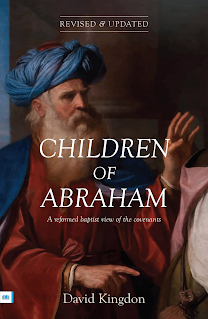
Children of Abraham: A reformed baptist view of the covenants, by David Kingdon

 
Grace Publications, 2021 edition, 256pp

Christmas Evans the Welsh Baptist preacher began his Christian life as a believer in infant baptism. He was outraged when he came across Baptists who contradicted his views. Evans set out to prove them wrong by reading the Bible from cover to cover and making a careful note of all the many references to the baptism of babies he discovered in holy writ. To his great disappointment he found none. Evans became a Baptist. The strength of the peadobaptist position, however, is not in its advocates' ability to produce killer proof texts in support of their position. Which is just as well. The case for infant baptism, rather, rests on elaborate biblical-theological arguments. Essentially it's all about the relationship between the old and new covenants, which is where David Kingdon rightly concentrates his considerable firepower. 

Paedobaptists hold that there is one overarching covenant of grace that is administered in different ways in the various biblical covenants. Under the old covenant, covenant membership was for Abraham and his offspring. Following on from that, paedobaptists contend that children of believers are also children of the covenant and should therefore be baptised. That is exactly the point that Kingdon sets out to dispute. 

Reformed Baptists certainly agree that there is one overarching covenant of grace. That covenant was first announced in the promise of Genesis 3:15 and was revealed with increasing clarity and fulness in the Abrahamic, Mosaic and Davidic covenants. They were not, however, administrations of the covenant of grace, the author argues. They were 'covenants of promise' (Ephesians 2:12). The covenants that God made with his people in the Old Testament period were earthly types and shadows of the blessings that would be granted under the new covenant. 

People were saved during the Old Testament period through faith in the promise of grace effected by Christ in the new covenant. In that sense the Saviour's death retrospectively atoned for the sins of old covenant believers, Romans 3:25-26, Hebrews 9:15. It was on that basis that 'Abraham believed God and it was accounted to him for righteousness' (Romans 4:3, citing Genesis 15:6). 

While it was true that all of Abraham's descendants were to be circumcised, not all of his offspring believed in the promise of salvation through Abraham's offspring, the Messiah. The Lord gave the Promised Land to the people of Israel, but not every inhabitant of the Land looked beyond it to the eternal inheritance of the new creation. In fact, it seems that only a remnant in Israel experienced the circumcision of their hearts to which circumcision in their flesh was but a sign, Deuteronomy 30:6, Romans 2:29). 

It is with that in mind that Paul could say, 'not all who are descended from Israel are Israel' (Romans 9:6). Belonging to God's covenant people by natural descent from Abraham was part and parcel of the earthly and temporary character of the the old covenant. That has now become obsolete since the Messianic offspring of Abraham has come, Galatians 3:16. Membership of the new covenant people of God is on the basis of 'believe and belong' whether Jew or Gentile, not natural descent (Galatians 3:29, 6:15-16). That is why baptism is only for those who have repented of their sins and believed in Jesus, for they alone are in Christ, Galatians 3:27. 

The old covenant distinction between outward membership of the people of God by descent from Abraham plus circumcision, and inward membership by circumcision of the heart and faith in the coming Messiah has been rendered null and void under the new covenant. In Jeremiah's promise of the new covenant (Jeremiah 31:31-34) all new covenant members of the people of God know the Lord, all have the law written on their hearts and all have their sins forgiven. Those things were only true for a godly remnant in Old Testament Israel. 

John the Baptist recognised the 'believing remnant' principle. The Baptist warned that Jewish people should not rest in the fact that they were descended from Abraham and circumcised, Matthew 3:9. He did not baptise the children of baptised adults, only repentant sinners who were waiting for Messiah to be revealed, Matthew 3:10-11. Christian baptism similarly is upon repentance and faith in accordance with the consistent witness of the New Testament, Acts 2:38-40, 8:36-38, 9:17-18, 10:44-48 etc. Church membership is for those who have made a credible profession of faith and have been baptised, Acts 2:41. 

David Kingdon originally published this work in 1973. This edition includes fresh maternal on the ministry of John the Baptist and the newness of the new covenant. Kingdon argues his case well, interacting throughout with representatives of the infant baptist tradition. In line with the Independent divine, John Owen, some Reformed Baptists have held that the old covenant was a republication of the covenant of works. Here Kingdon rightly lays stress on Paul's teaching that God's covenants with Israel were 'covenants of promise' that bore earthly and temporary witness to the spiritual and eternal blessings of the new covenant that are ours in Christ. 

Convinced paedobaptists will find much to chew on in his book as the writer calls into question some of their most cherished assumptions and points out weaknesses in their key arguments. Baptists will be helped to see that our position is rooted in sound theological reasoning as well as the plain teaching of the New Testament. As the author convincingly demonstrates, baptism is only for those who have repented of their sin and believed in Jesus Christ for salvation. Grace Publications are to be congratulated for publishing this revised and updated edition of Children of Abraham

Tuesday, December 15, 2020

The Mystery of Christ: His Covenant and His Kingdom by Samuel Renihan


The big problem with The Mystery of Christ: His Covenant and His Kingdom by Samuel Renihan is that it wasn't readily available in the UK. I managed to blag a review copy, but otherwise British readers would have needed to shell out a tidy sum in p&p to obtain a copy. You can see Part 1 of my review here. It is an excellent a treatment of covenant theology from a Reformed Baptist standpoint. The title traces the the broad sweep of redemptive history in terms of covenant and kingdom. It's rich in biblical insight and theological depth. The Particular Baptist perspective does justice to the lines of continuity and discontinuity between the old and new covenants. The 'mystery of Christ' shines through brightly, both in the 'covenants of promise' of the Old Testament and, of course in the new covenant in which the covenant of grace comes into its own. The good news is that Founders Press have now sorted out UK distribution, so you can buy it here. Just in time for Christmas.

Thursday, November 12, 2020

The Mystery of Christ: His Covenant & His Kingdom by Samuel Renihan (review part 3)

Founders Press, 2019, 217pp

See here for part 1 and part 2 of this review series. 

Constructive appraisal 

In The Mystery of Christ: His Covenant and His Kingdom, Samuel Renihan has admirably traced the grand plot line of the Bible in covenantal/kingdom terms. He has done justice both to the continuity and discontinuity of old and new covenants, as the mystery of Christ is progressively revealed. While the  writer draws on the riches of the Particular Baptist theological tradition, this is a fresh study in its own right and yields many valuable insights. That the Davidic kings were in effect the federal heads of the Mosaic covenant is one. The author admirably highlights the eschatological dimensions of Christ's covenant and kingdom. 

His characterisation of the Abrahamic and Mosaic covenants as 'covenants of works' is not quite so convincing. Renihan certainly does not take the Meredith Kline view that Sinai was a republication of the Adamic covenant of works based on strict merit (p. 111). But in some sense he holds that the Old Covenant operated as a covenant works, as least as far as appropriating the blessings of life in the Promised Land were concerned. 

If, however, threats of chastening judgement and promises of reward for obedient faithfulness constitute a covenant of works, then the New Covenant could arguably be construed as such. In the New Covenant the covenant of grace comes into its own, yet God's judgements upon Israel are taken as a warning to the church (1 Corinthians 10). Christians may also appropriate Old Testament promises of reward, but stripped of their shadowy form and seen in the light of eternity (Matthew 25:14-30, Ephesians 6:2-3). Note the many threats and promises in the Letters to the Churches in Revelation 2-3. To be clear, under both Old and New covenants, rewards were dispensed graciously by the Lord, rather than earned or merited. 

If the Abrahamic and Mosaic covenants were not covenants of works and neither can they be identified with the Covenant of Grace, what are they? Renihan is nearer the mark when he says, 'There is no covenant prior to Christ that reveals His covenant as directly as the Abrahamic Covenant does. The unilateral free gift of the earthly typical promises most clearly demonstrates the unilateral and free gift of the heavenly antitypical promises to the elect.' (p. 100). Further, he writes that 'the covenant of circumcision [made with Abraham] was a covenant of guardianship. It is a covenant that constitutes Abraham's descendants the womb of the Messiah.' (p. 101). 

The giving of the law at Sinai did not compromise the gracious character of the Abrahamic covenant, as Paul makes clear in Galatians 3:15-29. The law functioned as a guardian until Christ came. It 'increased the trespass' (Romans 5:20) by exposing the sinfulness of sin that those who were under the law might seek the righteousness of God by faith in Christ (Romans 10:3-4). 

The Abrahamic and Mosaic covenants were not recognisably covenants of works. They were 'covenants of promise'. Through their shadowy types and figures they spoke of the promised Messiah who would be born of Abraham's line. 'They are Israelites, to them belong the adoption, the glory, the covenants... and from their race, according to the flesh, is the Christ, who is God over all, blessed forever.' (Romans 9:4-5). 

This criticism should not detract from the work as a whole. For too long Paedobaptists have cornered the market in covenant theology, while Reformed or Grace Baptists have lagged behind. Renihan's title is an important contribution to covenant theology from a Baptist standpoint.  That said, readers will not find heated polemic here. The author makes his case in a gracious and winsome way, insightfully handling the text of Scripture and ensuring that doctrine leads to doxology before the glorious mystery of Christ. 

I am most grateful to Founders Press for sending me a complimentary review copy of this book. I would urge them to make it available more widely, as importing the title from the USA is prohibitively expensive for readers in the United Kingdom.  

Tuesday, October 06, 2020

The Mystery of Christ: His Covenant & His Kingdom by Samuel Renihan (review part 2)

Founders Press, 2019, 217pp

See here for part 1 and part 3 of this review series. 

The Kingdom of Christ

The Covenants of Redemption and Grace 

Christ came proclaiming the gospel of the kingdom and was himself the King who inaugurated God's saving reign. As with the earlier biblical kingdoms, covenants formed the legal basis upon which God dealt with man in the kingdom of God. Renihan gives attention to the Covenant of Redemption and the Covenant of Grace. The idea of the Covenant of Redemption is largely deduced from Isaiah's Servant Songs, where the Father and the Son make commitments to each other concerning the redemption of human beings from sin. The Holy Spirit is said to be 'everywhere present' in this covenant (p. 154), but he doesn't seem to be doing very much. This is a common feature in many accounts of the Covenant of Redemption, which tend to be bininatrian, rather than trinitarian in focus. The Spirit's role in this pre-temporal 'covenant' needs to be developed more fully. Partly for that reason Robert Letham prefers to speak of the eternal Trinitarian counsel, rather than a Covenant of Redemption, Systematic Theology, p. 431-438).  

According to Renihan the blessings of the Covenant of Redemption are bestowed upon sinners through the New Covenant of Grace. While the Covenant of Grace was disclosed in promissory form under the Old Covenant, it was not promulgated, or legally enacted until Christ had completed his mediatorial work, Hebrews 8:6, 9:11-15, 24-26. The types and shadows of the old then gave way to the substance of the new. The blessings of the New Covenant were detailed in Jeremiah 31:31-34 (see also Hebrews 8:8-13). These numerous blessings flow from union with Jesus Christ, the federal head of the covenant. They include justification, regeneration and sanctification, adoption and preservation, and resurrection and glorification. 

Unlike the Old Covenant, which Israel broke through her disobedience, the New Covenant cannot be broken because it is based on the obedience of Jesus Christ on behalf of his people. Even our saving response to Christ's work is bestowed by grace. Under the Old Covenant there were many physical descendants from Abraham who did not follow his faith and obedience. They were Israel according to the flesh, not according to the promise (Romans 9). The New Covenant abolishes any such distinction. Membership is not based on physical descent, but God's electing grace brought to realisation through saving faith in Christ, 2 Timothy 1:9, Ephesians 2:8-9). Covenant blessings are bestowed not on the grounds of our obedience, but due to the oaths the Father solemnly swore to his Son (Hebrews 6:13-20). 'We rest and rejoice in his faithfulness.' (p, 175).

The New Covenant and the Kingdom of God 

In the Covenant of Redemption the Father covenanted a Kingdom to his Son on completion of his redeeming work. Under the New Covenant of Grace that Kingdom is in turn covenanted to Christ's people. This is made explicit in Luke 22:29, which the author translates as, "And I covenant unto you, as my Father covenanted unto me, a kingdom." (p. 176, original emphasis). The Lord's Supper anticipates the consummated kingdom of God, where all of the Lord's people will gather in the new creation under God's gracious reign for all eternity. 

The people of the Covenant of Grace are those who were given to the Son by the Father in eternity according to his electing love. For them the Son shed his blood. His redeeming work is applied to them by the Holy Spirit. They constitute a new humanity in Christ, their federal head, the last Adam. The New Covenant completely reverses the corruption and condemnation of the broken Covenant of Works. Indeed, we are given more in Christ than we lost in Adam. In Christ we look forward to 'an eternal life of glory and perfect communion with God.' (p. 178). 

Israel and the Church 

Where does all this leave Israel, the Old Covenant people of God? They clearly had the unique privilege of belonging to the 'covenants of promise', according to which Christ would be born of the seed of Abraham and David. The great tragedy for Israel was that when Jesus came, only a remnant received him as their Messiah and in him the rich blessings of the New Covenant. Paul seems to hold out the hope that ethnic Israel will be recovered for the gospel once the 'fulness of the Gentiles has come in' (Romans 11:25). God is able to graft his people back into the covenant community when they turn to Christ in saving faith (Romans 11:23). 

The apostle reasons that if Israel's 'failure means riches for the Gentiles, how much more their will their full inclusion mean!' (Romans 11:12). Renihan understands the promise, 'all Israel will be saved' (Romans 11:26) to mean that the 'fulness of Jews and Gentiles' will be saved (p. 191). But by 'Israel' Paul consistently means ethnic Israel in Romans 9-11, 'my kinsmen according to the flesh' (Romans 9:3). There is good reason to think that Paul holds out the hope that there will be a great turning to the Lord among ethnic Israel before the Christ returns. 

The Law and Grace 

Speaking of Israel, as pointed out in part 1 the author regards the Abrahamic and Mosaic Covenants as covenants of works, (p. 98). The blessings of life in the land of Canaan were certainly dependent upon Israel's obedience. But Renihan distinguishes these covenants from the Covenant of Works in Adam. For Adam and us in him there was no way back to God after being expelled from Eden apart from God's promise of a deliverer, Genesis 3:15. Under the Old Covenant, however, the sacrificial system provided a means of atonement for sin if the people of returned to the Lord in genuine repentance and looked in faith for the coming Messiah. 

Contrary to what the writer says here, under the Mosaic Covenant the Lord did not simply require a civic obedience that 'an unbeliever could render' (p. 111). Israel was called to 'love the Lord your God with all your heart' (Deuteronomy 6:4), yet it was only as the Lord circumcised their hearts that Israel could obey that command (Deuteronomy 30:6 cf. Romans 2:28-29). When Israel rejected the way of faith in the promise and spurned their covenant obligations, the law became a code than condemned rather than a guide for life. 

All biblical covenants are 'based on grace, yet regulated by law.' (Robert Letham, see part 1). Yet, as Renihan argues in line with the Particular Baptist tradition, the Abrahamic and Mosaic covenants were not in themselves administrations of the Covenant of Grace. They had different federal heads in Abraham and David, and different members; physical descendants of Abraham, only a remnant of whom trusted and obeyed. The blessings of the Old Covenant were earthly and temporal, concerning life in the Promised Land. Christ mediates a better covenant enacted on better promises (Hebrews 8:6, 9:15).

Christ is the 'Lord our righteousness' (Jeremiah 23:6). He fulfilled the legal obligations of the Covenant of Works on behalf of his people. The types and shadows of the Old Covenant have also been realised in Christ, yet the moral law continues to apply to the Christian. But for them it is not merely an external code written on tablets of stone. The law is written on their hearts by the Spirit and is fulfilled by love (2 Corinthians 3:3, Romans 13:10). 

The Consummated Kingdom

In Christ the mystery of God's eternal purpose is revealed on the stage of history to the praise of his glorious grace. Those who are united to Christ by faith belong to his kingdom which finds visible expression in the church. Only those who show evidence of regeneration and profess faith in Christ may take their place as members of the church of Jesus Christ. Church membership should therefore be guarded through godly church discipline. Traitors to the covenant who turn from faith in Christ show that they never truly belonged to him and have no place in the church that bears his name. The sacraments of the kingdom are 'visible words', tangible expressions of the gospel. As such baptism and the Lord's Supper are only for those who have been savingly united to Christ by the Spirit. 

These signs are a foretaste of the heavenly realities of the consummated kingdom, in which the blessings of the New Covenant will be enjoyed when the King returns as judge of all humanity. Those who have rejected King Jesus will be raised to everlasting punishment. The people he came to save will be raised to life everlasting, a spotless bride for whom the bridegroom gave himself in love. They shall live in his presence in the new creation, where they shall gaze upon the glory of the Lamb and worship him for ever. 

In the final part of this review series I will attempt to offer a constructive appraisal of Renihan's work. 

Tuesday, September 08, 2020

The Mystery of Christ: His Covenant & His Kingdom by Samuel Renihan (review part 1)

Founders Press, 2019, 217pp

In his earlier title, From Shadow to Substance: The Federal Theology of the English Particular Baptists (1642-1704), Samuel Renihan set out to demonstrate that the federal theology of the seventeenth English Particular Baptists was a legitimate strain within Reformed covenant theology. A work of historical theology, in it the author compared and contrasted the views of Nehemiah Coxe and others with mainline Orthodox Reformed thought. The Mystery of Christ: His Kingdom & His Covenant is a fresh and original study in its own right. The focus here is on how the twin themes of covenant and kingdom disclose the 'mystery of Christ' as they unfold in biblical revelation. 

Methodology 

Renihan begins by clearing the ground, dealing with matters of methodology and defining key terms. He makes an important distinction between our obligation to God by virtue of creation and covenant-based relationships. As God's creatures, human beings are subject to 'natural law'. Keeping the law in that sense would not merit a reward, for God is due our entire obedience. In a covenant relationship, however, God may be pleased of his own free goodness to reward obedience with the promise of life. Covenants often involve 'positive laws' that go beyond the universal moral standards of natural law. The command that Adam should not eat of the tree of knowledge of good and evil is an example of positive law, as is the command that the descendants of Abraham should be circumcised. Positive laws are contingent on specific covenant relationships. They cannot of necessity be carried forward into different covenant dispensations. The positive rules and regulations of the old covenant no longer apply in new covenant era, as in Christ we have the substance to which they pointed. 

Another important distinction is made between the law and the gospel. In a stark sense law and gospel are polar opposites. The former demands perfect obedience to God's commands, the latter offers Christ's perfect imputed righteousness to the believing sinner. But in terms of the historic biblical covenants, law and gospel are both present. While the old covenant is often described as 'the law', it also held out the promise of life in Christ. While the new covenant underscores that salvation is by faith alone, the law is written on the hearts of believers and its righteous requirements are fulfilled in those who walk not according to the flesh, but according to the Spirit. As Robert Letham points out, all the biblical covenants are based on grace, yet regulated by law. (Systematic Theology, Robert Letham, Crossway, 2019, p. 364-365). 

The old covenant bore witness to Christ though it's types and shadows, but the full revelation of Messiah and his work was not yet made known. That is why Paul refers to the 'mystery of Christ' (Ephesians 3:4, Colossians 4:3). Biblical revelation is progressive. Covenant theology should be sensitive to history and mystery and not try to flatten the upward curve of God's self-disclosure in Christ. 

Renihan sees an intimate connection between the themes of covenant and kingdom. A covenant is a guaranteed commitment between two parties. Promises are attached to the fulfilment of covenant obligations. Sanctions or threats give the covenant arrangement legal sanction. In terms of the biblical covenants God promises blessing to those who are faithful to his covenant and threatens judgement upon those who break its terms. Remarkably, the Lord took the sanctions upon himself when formalising his covenant with Abraham, Genesis 15:9-10, 17-20. 

Three Kingdoms 

God contracts his covenants with federal heads, or representative figures. That was certainly the case with the covenants associated with Adam, Noah, David and Christ. Blessings or sanctions flow from the federal heads to those who belong to them. "Covenants function as the legal basis upon which God interacts with man in a given kingdom." (p. 54). This applies to the three kingdoms God established, each governed by their own specific covenants. The Lord governs the Kingdom of Creation by means of the Covenant of Works and the Noahic Covenant. The Kingdom of Israel is constituted by the Abrahamic, Mosaic and Davidic Covenants. Finally the Kingdom of Christ is the realisation of the Covenant of Redemption and Covenant of Grace. 

The Kingdom of Creation 
Although the word 'covenant' may not be used of God's relationship with humanity in Adam (but see Hosea 6:7), all the essential elements of a biblical covenant are present. By virtue of his creation, Adam was obligated to obey God, both in terms of 'natural law' and also his God-given task of exercising dominion over the creation. But beyond that, Adam was the recipient of covenantal promises and sanctions. He was promised access to the tree of life and the reward of entering God's rest once his work of subduing creation had been completed. He was threatened with the sanction of death and expulsion from the garden sanctuary of Eden if he disobeyed God by eating of the tree of the knowledge of good and evil. 

Adam did not deserve the blessings of life and rest. In his goodness God condescended to bestow these rewards upon him on the condition of obedience, This was a covenant of works. That Adam was the federal head of the covenant of works is evident from the fact that all humanity fell with him into sin and death according to the Genesis account. This is further spelt out in Romans 5:12-21 and 1 Corinthians 15:21-22.

The covenant of works has now been abrogated. There is no way back to Eden, no second chance to keep its command to refrain from eating of the forbidden tree. Humanity remains under the curse of this broken covenant, however. Sin reigns in death over all people in Adam. The moral law continues to demand obedience to God, but sinners cannot live up to its requirements and so attract God's condemnation and wrath for their transgressions. 

The promise of salvation through a deliverer immediately after the fall was the first revelation of the covenant of grace, Genesis 3:15. It was only by means of this covenant that the protology of the covenant of works would be brought to its eschatological fulfilment in Christ. As Isaac Watts sang, 'In him the tribes of Adam boast/more blessings than their father lost." 

Under the Noahic covenant, after the judgement of the flood the Lord promised to preserve the 'common kingdom' of sin-ruined creation until Christ came to make all things new. "The mystery of Christ will unfold in this theatre of preservation." (p. 82).

The Kingdom of Israel 
In common with the Particular Baptist tradition Renihan links the Abrahamic, Mosaic and Davidic covenants as variegated expressions of the old covenant. These covenants flowed from God's grace towards Israel, but they are not in themselves administrations of the covenant of grace. They were intended to serve as 'covenants of promise' through which Messiah would be born into the world and bring blessing to Israel and all peoples. While the promise of Messiah though the seed of Abraham entailed a further revelation of the covenant of grace, life in the Promised Land was conditional upon Israel fulfilling her covenant obligations. In that sense the old covenant was a covenant of works, but that does not mean it was a republication of the Adamic covenant. 

The laws associated with the Mosaic covenant elaborated upon the covenant obligations that the Lord imposed upon Abraham, Genesis 17:1, 9-11. But the people of Israel were not saved by keeping those laws. Rather, like Abraham, salvation was for those who believed the promise of blessing through Messiah, Genesis 15:6 cf. Romans 4. Not all of Abraham's descendants believed the promise that was revealed to them through the types and shadows of the old covenant, Romans 9. The law had no power to compel obedience. Israel was often wayward and rebellious. Their covenant breaking led to Israel being expelled from the Promised Land. 

The kings in the line of David acted as federal heads of the whole nation. The kingdom of Israel rose or fell according to the faithfulness of their earthly rulers, 2 Samuel 7, Psalm 89. 

The people of Israel were in a highly privileged position. From the descendants of Abraham and David would come the longed for Christ. But Israel broke the terms of the old covenant. Her kingdom lay in ruins. A new covenant and kingdom was therefore needed, Jeremiah 31:31-34. 

I think I'll leave it there for now. In part 2 of the review we will look at what Renihan has to say about the Kingdom of Christ and then move from an attempt to summarise his thesis to constructive appraisal. One critical point that I would make is that The Mystery of Christ isn't available in the UK, or can only be ordered if you are willing to pay a handsome price for p&p. Mine is a review copy courtesy  of Founders Press. I hope they soon are able to sort out a UK distribution deal. 

See here for part 2 and part 3 of this review series. 

Thursday, December 19, 2019

The Reformed Catholicity of Second London Baptist Confession: 'Of Christ the Mediator'

The authors of the Second London Baptist Confession of Faith, 1689 (LBC) were keen to identify themselves with mainstream Puritan theological orthodoxy. That is why their confession of faith was not a freshly minted expression of their beliefs, but a revision of the Independent's Savoy Declaration of Faith, 1658 (SDF), which was in turn an amended version of the Presbyterian Westminster Confession of Faith, 1644 (WCF). See this Tabular Comparison of the three confessions. In this post I want to reflect on Chapter 8 of the Second London Baptist Confession of Faith, 'Of Christ the Mediator', with a nod to the parallel statements in Westminster and Savoy. 

The Westminster Confession was an expression of Reformed Catholicity. The Independents and Baptists followed suit. Careful readers of the three documents will discern traces of earlier creedal formulae. Westminster's doctrine of the Trinity (Chapter 2, compare SDF & LBC) is that of the Nicene Creed; one God in three persons, with each person of the same divine essence. Its doctrine of Christ is that of the Definition of Chalcedon; the incarnate Son is one person with two natures, divine and human (Chapter 8, compare SDF & LBC). The soterological emphasis of the Presbyterian confession and its successors was positively Augustinian, with an emphasis on predestination, the total depravity of humanity in sin and salvation by grace alone. 

So far, so Catholic. But Reformed, not Roman Catholic. All three confessions make it clear that Jesus Christ is the 'only Mediator between God and man' 8:2. This rules out Roman Catholic claims of other mediators such as the pope, the saints, the priesthood, or Mary. The 1689 adds two more paragraphs to further underline the point, drawing on John Calvin's delineation of Christ in his offices of prophet, priest and king, 8:8-9: "This office of mediator between God and man is proper only to Christ, who is the prophet, priest, and king of the church of God; and may not be either in whole, or any part thereof, transferred from him to any other. (1 Timothy 2:5), 8:8" See also 8:9, which explains why sinners are in need of Christ in his threefold mediatorial offices. 

The Savoy and 1689 set Christ's person and work in the context of the Covenant of Redemption between the Father and the Son in eternity, 8:1 (compare). This doctrine was in an early stage of its development at the time of the Westminster Assembly, hence its omission from WCF. One feature of the LBC is the addition of biblical wording to its chapter on Christ the Mediator, which gives the confession more of a salvation-historical perspective. Especially paragraph 8:2 (compare). 

The confessions make it clear that it was "The Son of God, the second person in the Holy Trinity, being very and eternal God" who took upon himself man's nature, "being conceived by the Holy Spirit in the womb of the Virgin Mary" (8:2). The incarnation did not involve the Son becoming any less divine. Rather, "two whole, perfect, and distinct natures were inseparably joined together in one person, without conversion, composition, or confusion; which person is very God and very man, yet one Christ, the only mediator between God and man." This language closely reflects that of the Definition of Chalcedon. 

Section 8:7 of the three confessions is a statement on the 'communion of attributes' in the incarnate Son. This does not mean a transfer of properties from one nature to the other in the person of Jesus. His divine nature did not shrink to be enclosed in time and space when Christ took human nature. His human nature did not expand to transcend time and space when Christ was glorified. Any such constructions would fall foul of Chalcedonian orthodoxy. In Reformed theology the 'communion of attributes' is a hermenutical tool that helps readers of Scripture understand how the Bible can speak of the 'Lord of glory' being crucified (1 Corinthians 2:8), or how the risen Jesus is said to 'fill all in all' (Ephesians 1:32). The divine nature of Christ was not crucified. Nether did the human body of Jesus become omnipresent at his ascension. The confessions explain, "Christ, in the work of mediation, acteth according to both natures, by each nature doing that which is proper to itself; yet by reason of the unity of the person, that which is proper to one nature is sometimes in Scripture, attributed to the person denominated by the other nature." (8:7). This insight equips us to read Scripture's witness to Christ's person and work with appropriate theological awareness. 

Together with Westminster and Savoy the 1689 tells us why God became man in Jesus, "This office the Lord Jesus did most willingly undertake, which that he might discharge he was made under the law, and did perfectly fulfill it, and underwent the punishment due to us, which we should have borne and suffered, being made sin and a curse for us" (8:4, see also 8:5). Christ's death atoned for the sins of the people of God both prior to and since his redeeming work was accomplished (8:6). Having died for the people the Father had given him, "on the third day he arose from the dead with the same body in which he suffered, with which he also ascended into heaven, and there sitteth at the right hand of his Father making intercession, and shall return to judge men and angels at the end of the world." (8:4). 

One distinctive feature of the 1689 is the emphasis it lays on the believer's triple union with Christ the Mediator. Together with Westminster and Savoy the 1689 confesses that Jesus was united to his people before the foundation of the world. The Father "did from all eternity give a people to be his [the Son's] seed and to be by him in time redeemed, called, justified, sanctified, and glorified." (8:1). The Lord was further united with his people "when he took upon himself man's nature" (8:2). It was because he shared their nature that the Son was able redeem his people by the sacrifice of himself, satisfying the justice of God on their behalf (8:5). Then the 1689 makes explicit reference to the believer's union with Christ in relation to the application of redemption, "To all those for whom Christ hath obtained eternal redemption, he doth certainly and effectually apply and communicate the same, making intercession for them; uniting them to himself by his Spirit" [emphasis added]. Westminster and Savoy speak of Christ "effectually persuading them by his Spirit to believe and obey" at this point (compare 8:8). 

Giving careful attention to the Second London Baptist Confession's chapter 'On Christ the Mediator' will enable us to proclaim the wonder of God incarnate with biblical accuracy in the light of the creedal heritage of the Catholic Church. The Reformed aspect of Reformed Catholicty gives added clarity to the work the incarnate Son carried out on behalf of his people. He who was one with God as second person of the Trinity became one with us as man to redeem us by his own blood. Christ unites his people to himself by his Spirit that we may enjoy the rich benefits of his saving work.

'O come, let us adore him. Christ the Lord'.