Pages

Showing posts with label Ten things. Show all posts

Monday, May 09, 2022

Ten Points on Reformed Baptist Federal Theology

1. God made a covenant of life with Adam, whom he appointed federal head of all humanity. This was a covenant of works, under which if Adam obeyed the Lord he and all in him would live for ever and enter God's Sabbath rest. If Adam disobeyed, he and all in him would die under God's judgement. (Gen 2-3, Rom 5:12-21, 2LBC 7:1).

2. God made a covenant of grace with his elect people, who were chosen in Christ for salvation before the foundation of the world and redeemed by his blood in the fullness of time. The covenant of grace is made effective by the power of the Spirit, (Ephesians 1:3-14).

3. The Abrahamic, Mosaic and Davidic covenants were not administrations of the covenant of grace. They were 'covenants of promise' (Ephesians 2:12) in which the covenant of grace was progressively revealed 'until the full discovery thereof was completed in the New Testament' (2LBC 7:3).

4. The old covenant (the collective name for the Abrahamic, Mosaic and Davidic covenants) was not a republication of the covenant of works. The law 'was added because of transgressions, until the offspring should come to whom the promise had been made'. (Galatians 3:19). The law also served as a rule of life for Israel, setting out their covenant obligations to the Lord. In her idolatrous disobedience Israel broke the covenant and brought upon herself its terrible curses, Leviticus 26:14-39. Unlike the covenant of works with Adam, for Israel there was a way back to God from the dark paths of sin, Leviticus 26:40-45. The Lord's deliverance of his people from captivity was typical of the greater exodus accomplished by the redeeming work of Christ (Jeremiah 23:7-8, Luke 9:31, Colossians 1:12-14).

5. Abraham was the federal head of the Abrahamic covenant in whom blessing was received (Genesis 12:2-3, 17:1-8). Moses was the mediator of the Sinai covenant (Exodus 20:18-21, 33:12-17), of which David and his royal line served as federal heads. As went the king, so went the people for good or ill, (1 Kings 9:4-9).

6. While the old covenant foreshadowed the covenant of grace, it was only in the new covenant that the covenant of grace was fully enacted. (Jeremiah 31:31-34, Colossians 2:16-17, Hebrews 8, 9:15-22). Christ is both mediator and federal head of the new covenant, (1 Timothy 2:5-6, Romans 5:12-21).

7. During the Old Testament period people were saved by faith in the Christ who was yet to appear as mediator of a new and better covenant. (Hebrews 8:6, 9:15). Under the new covenant people are saved by faith in Christ who has come and accomplished the work of our redemption (Galatians 2:16, Ephesians 2:8).

8. The old covenant was with Abraham and his offspring, which is why all males descended from the patriarch were circumcised. But not all who belonged to Israel through descent from Abraham and circumcision believed and were saved (Romans 9:6, 27). Only a godly remnant knew 'circumcision of the heart' of which circumcision in the flesh was a sign (Deuteronomy 30:6, Romans 2:28-29).

9. As the historical enactment of the covenant of grace the new covenant is between God and the elect in Christ. The law is written on the hearts all new covenant people of God by the Spirit of Christ (Jeremiah 31:33, 2 Corinthians 3:3). All who believe in Jesus belong to the Israel of God, whether Jew or Gentile. Baptism is the sign that believers have been savingly united to Christ by the Spirit. (Galatians 3:27-29, 6:16). That is why according to the New Testament baptism invariably follows repentance and faith, and is linked to church membership. (Acts 2:38-39, 41-42).

10. As federal head of the new covenant, Jesus takes us not back to the beginning, but to the end of the road that Adam had to walk. (Herman Bavinck). In fact, we receive more in Christ than we ever would have had in Adam. For the riches of God's grace and the depths of his glory are  fully revealed only in Jesus, the last Adam, Romans 5:21, 1 Corinthians 15:42-49, Ephesians 1:7-10, Colossians 1:27. 

Tuesday, April 10, 2018

Ten things on the Son's submission and the Trinity

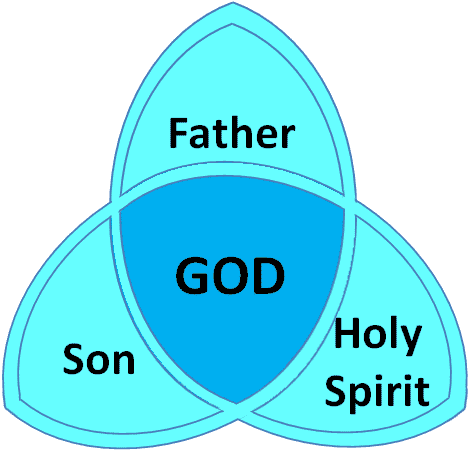
1. Father, Son and Holy Spirit are equal in divine being and glory.

2. Father, Son and Holy Spirit are not identical persons. Each has unique individualising properties. The Father is unbegotten as to his person, the Son as to his person is begotten of the Father, the Holy Spirit as to his person proceeds from the Father and the Son. No person receives the divine being from another; each is 'autotheos', or God in themselves. 

3. Each divine person indwells the others and is indwelt by the others in an eternal interchange of loving communicative action. 

4. According to the witness of Scripture there is an order of persons in the Trinity: Father, Son and Holy Spirit. This order is reflected in the external actions of the Three, by which all things are of the Father, through the Son and by the Holy Spirit. 

5. The persons are not reducible to their relations or their functions in the economy of redemption. The Son is not the Son because he submitted to the Father in becoming man. As the eternal Son he is of the Father as to his person, and God in his own right. 

6. The divine decree of redemption is an expression of the singular will of the Triune God. The Son became man in submission to the decree to which he himself was party, together with the Father and the Holy Spirit. 

7. In the covenant of redemption between the persons of the Trinity, the Son is the electing God with the Father and the Holy Spirit, the elect One who was appointed to be sent into the world as man by the Father and through the Spirit, and also the One in whom the elect were chosen for salvation. 

8. The economic Trinity communicates the immanent Trinity. If God as he is for us does not truly disclose God as he is in himself, we are left with an unknowable Deus absconditus. With that in mind, it was reflective of the order of persons in the Trinity that it was decreed that the Son as opposed to the Father, or the Spirit became incarnate. It seems especially fitting that it was the Son, as the image of the invisible God who became human in the image of God, in order to redeem us by his blood. 

9. The Son did not count equality with God as something to be grasped, but took the form of a servant and came in appearance as a man because he was in the form of God, not although he was in the form of God. For the God in whose form he was is the self-giving God of love and grace. In stooping to become one us that he might be lifted up on the cross to atone for our sins, the Son revealed the very heart of Yahweh, the God of the covenant, Exodus 3:14, John 8:28, Philippians 2:5-11. 

10. The Son's willing submission to the divine decree and humble obedience to his Father, even to the death of the cross, provide an example to believers as we seek to follow the Servant King in the whole of our lives; in the home, in church, and in the wider world. Submission leads to exaltation. Down is the only way up, Ephesians 5:22-33, Philippians 2:1-11, 1 Peter 5:5. 

Thursday, March 01, 2012

What have the Welsh done for you?


Especially for St. David's day:

1) Shown the English how to play rugby.
2) Invented cheese on toast, 'Welsh rarebit'.
3) Dylan Thomas
4) R. S. Thomas
5) Doubting Thomas - must have been Welsh with a name like that.
6) Ivor the Engine - better than Thomas the Tank Engine any day. Could Thomas (not Welsh because Thomas was his first name) sing Cwm Rhondda (see here)? Er, no.
7) The Severn Bridge that ensures England is not cut off from civilisation.
8) The bloke from The Alarm's mullet.
9) Majestically mournful minor key hymn tunes, Aberystwyth, Trewen, Llan Bagan.
10) Powerful preachers, John Penry, Vavasor Powell, Howell Harris, Daniel Rowland, William Williams, John Elias, Christmas Evans, D. Martyn Lloyd-Jones....

Need I say more?

Wednesday, December 16, 2009

Ten of my favourite things from 2009

1. Best doctrinal book: Words of Life: Scripture as the living and active word of God, by Timothy Ward, IVP, 2009.
2. Best book on the Christian life: Broken-Down House: Living Productively in a World Gone Bad, Paul David Tripp, Shepherd Press, 2009.
3. Best book on Mission: Paul the Missionary: Realities, Strategies and Methods, by Eckhard J. Schnabel, Paperback 519pp.
4. Best biography: John Calvin: A Pilgrim's Life, by Herman J. Selderhuis, IVP, 2009.
5. Best book on heresy: Risking the Truth: Handling Error in the Church, edited by Martin Downes, Christian Focus, 2009.
6. Best Christian radio programme: Premier Christian Radio's Unbelievable? with Justin Brierley.
7. Best album: 'The Resistance' by Muse.
8. Best film: UP!
9. Best blog: Helm's Deep
10. Best Exiled Preacher moment: Blogging in the name of the Lord interview with Dan Phillips.

Friday, April 03, 2009

Why I'm a rubbish blogger (and I don't even care)

ImageChef Word Mosaic - ImageChef.com

1. Far too many embarrassing typos. The other day someone kindly pointed out that writing on Synod of Dort, I had typed "Irresistible Grave" rather than "Irresistible Grace". I changed it so that "Grave" became "Grace", and death was swallowed up in victory. But what a howler!
2. Some of my posts are a bit too long for a blog.
3. Some of my posts are so short as to be pointless.
4. I insist on posting my musings on music even though it really annoys some people.
5. Quite a bit of my material is recycled stuff rather than made to measure blog posts.
6. I 'discovered' David Sky and Dai Corleone.
7. I often can't be bothered to respond to comments.
8. My Facebook page is composed almost entirely of blog feed headlines. How sad is that?
9. I only have a few blogs in my Google Reader, which speaks volumes for the interest I take in other blogs.
10. But despite all that, I quite enjoy blogging so I won't be sounding the Last Post just yet.

Wednesday, June 04, 2008

Between Scylla and Charybdis (Part 1)

In Homer's The Odyssey, the hero Odysseus is forced to choose between two monsters poised on opposite sides of the narrow Strait of Messina. Scylla dwelt on a rock. She had six heads and would gobble up any sailors within range. The sea monster Charybdis had a single gaping mouth that sucked in huge quantities of water and belched them out, creating deadly whirlpools. Odysseus had a terrible choice to make. To avoid Charybdis he would have to confront Scylla, knowing that some of his crew would certainly be eaten alive. But to avoid Scylla would mean sailing too close to Charybdis's swirling whirlpool and possibly lose his entire ship. He opted for the lesser of two evils, faced Scylla and only lost a few men. So the saying "Between Scylla and Charybdis" means to face two extreme dangers. Here are some extreme dangers in theology. Unlike Odysseus, we don't have to choose between them, as God has provided a safe passage for us in his Word.
1. Legalism and antinomianism. Strong legalism teaches that salvation is by works or that works make a contribution to our salvation in some way. A weaker form of legalism tends to see the Christian life in terms of keeping a set of rules that are not necessarily biblical. Antinomianism holds that as we are saved by grace, God's commands are irrelevant to Christian believers. Antinominanism is therefore detrimental to the life of holiness. We are saved by grace alone apart from the works of the law. But Jesus says, "If you love me, keep my commandments." (John 14:15).
2. Intellectualism and emotionalism. Intellectualism stresses that faith is mainly assent to biblical propositions. But this can lead to a cold, unfeeling approach to the Christian life. "True religion is more than a notion, something must be known and felt." True faith is exercised when the whole person; mind, heart and will trusts in God. Emotionalism virtually disregards biblical truth for the sake of exciting experiences. This can leave the believer at the mercy of fleeting moods and feelings. Christian emotions should arise in response to the truth of God applied to our lives by the Spirit. We must rejoice in the Lord rather than rejoice in the feeling of joy as an end in itself.
3. Pseudo-scholarship and anti-intellectualism. By pseudo-scholarship I mean scholarship that is not subject to the authority of Scripture. The task of Christian scholarship is to engage in serious biblical and theological study. The aim must be to help the church confess the biblical gospel more clearly, not to undermine the teaching of the Bible. Men who claim to acknowledge the authority of Scripture also become pseudo-scholars when their work ceases to be of any real use to the people of God. Anti-intellectualism has little time for biblical scholarship and theological study. But the Bible demands in-depth study if we are to understand and apply its message properly. The work of theologians and biblical scholars is to be treasured by the Church. God uses people with great intellectual ability like the apostle Paul, Augustine and Calvin for the building up of the body of Christ. The hand that works must not despise the eye that sees.
4. Ecumenism and isolationism. The aim of the ecumenical movement is to create one worldwide institutional church. In practice this means that the Protestant and Orthodox Churches would have to reunite with the Roman Catholic Church under the authority of the pope. Ecumenism minimises doctrinal differences for the sake of institutional unity. But the historic disagreements between Evangelical Protestants and the Roman Catholic church concern matters that are essential to the gospel such as justification by faith alone and that Jesus Christ is the sole mediator between God and men, not to mention the supreme authority of Scripture. In the ecumenical movement, serious theological differences are often relativised and regarded as mere matters of emphasis. Consistent Evangelicals cannot allow the biblical gospel to be treated as an "insight" that is no more or less valid than Liberalism or Roman Catholicism. The integrity of the gospel demands that Evangelicals separate themselves from the Ecumenical Movement. But some Evangelicals have gone to the opposite extreme. They become isolationists, moving in ever decreasing circles. Secondary issues like Bible versions or premillenial eschatology are made the basis for fellowship between churches. But the basis for fellowship is the gospel and it is scismatic to separate from other believers over secondary matters. Isolationists show scant regard for the true unity of the visible church for which Christ prayed, John 17:20 & 21.
5. Traditionalism and trendiness. Traditionalists tend to elevate their traditions to the level of Scripture. This is certainly the case with the Roman Catholic Church, but Protestants too can become traditionalists. Some churches demand that preachers pray to God in "Thees and Thous". But such a requirement cannot be justified from Scripture, where human beings and the devil as well as God are addressed (at least in the AV) as "thee" or "thou". Traditionalists almost invariably think that old is better than new. But Scripture, not time is test of truth. A tradition may simply be an old error, while new insights into the meaning of the Bible may be perfectly valid. Traditionalists risk consigning themselves to a cultural black hole by failing to relate the everlasting gospel to the contemporary world. On the other hand, trendies don't have a lot of time for tradition. They appreciate what is new and fresh. But Christians are part of the historic Church and we should value what the Spirit has taught believers in the past. We are not the first generation of Christians to interpret Scripture. The ancient creeds and confessions help us to read the Bible faithfully, avoiding blind alleys. Familiarity with church history helps us to identify when a "new insight" is really no more than a recycled heresy. Trendies can be so obsessed with "relevance" that they may be tempted to downplay aspects of the gospel that are especially problematic in the postmodern world. The exclusive claims of Christ do not seem too appealing to easy going relativists, so we had better not mention John 14:6 or Acts 4:12. The Emerging Church is an example of the triumph of trendiness over faithfulness. Christians are called to be faithful to the historic gospel and meaningfully engaged in the contemporary world.
More extreme dangers coming soon...

Thursday, March 27, 2008

My Top Ten Radiohead Songs

I got into Radiohead by downloading their "pay what you like" album, In Rainbows. I enjoyed that offering so much that I invested in most of their back catalogue. Here's a list of my favorite songs at the moment:

1. Paranoid Android (OK Computer)
2. Fake Plastic Trees (The Bends)
3. Idioteque (Kid A)
4. Pyramid Song (Amnesiac)
5. Reckoner (In Rainbows)
6. Street Spirit (The Bends)
7. Nude (In Rainbows)
8. No Surprises (OK Computer)
9. How To Disappear Completely (Kid A)
10. Lucky (OK Computer)

Monday, January 28, 2008

Ten things on Christian spirituality

1. The essence of Christian spirituality is communion with the Triune God. It springs from the communicative love of the Father, who has elected us for fellowship with himself through the sacrificial death of the Son and the sanctifying presence of the Spirit.

2. Christian spirituality is in fact Spirituality with a capital "S". The Holy Spirit is the agent of true Spirituality. He brings those who were dead in sin and cut off from the life of God to new birth by his sovereign and gracious power. The believer has been made holy to God by the definitive action of of Spirit. This leads to a Spirit-empowered life of holiness, characterised by the mortification of sin and the vivification of righteousness, in obedience to God's commands. Christian spirituality is holy Spirituality.
3. Christian spirituality is rooted in the believer's union with Christ. We participate in the fruits of his atoning death and mighty resurrection. In Christ, we are forgiven and put right with God. The believer has been crucified with Christ to the old life of sin and raised with him to the new life of holiness. The risen Christ dwells in the hearts of his people by the power of the Holy Spirit. The Spirit's task is not to draw attention to himself, but to glorify Christ and communicate his life-transforming presence. The goal of Christian spirituality is that the believer should be conformed to the image of God's own Son.
4. Christian spirituality is sustained by constant prayer. Through the blood of Christ, we are given access to the Father by the Spirit. Prayer involves worship, praise and communion with God as well as petition and supplication. The Father is pleased to answer the prayers of his people in Jesus' name, in accordance with his abundant mercy and sovereign will. The believer should make time each day for sustained prayer and meditation.
5. As God's authorised self-revelation, the Scriptures play an essential role in Christian spirituality. The Spirit who gave the written Word bears witness to the truth and authenticity of Scripture in the mind, heart and life of the believer. The Scriptures disclose the Triune God of the Gospel and reveal the basis for Christian spirituality in his saving acts. The Word of God read and preached is a means of grace that promotes the development of spiritual growth and maturity - Psalm 1. There can be no true spirituality apart from Scripture.
6. Christian spirituality develops in the context of the communion of the saints. It is not a privatised quest for self-fulfilment, but is expressed in love for the people of God. The Church exists to foster a spiritual life of compassion, service, witness and worship. She does this by exercising the ministry of the Word and prayer, and administering baptism and the Lord's Supper. Any spirituality that sidelines involvement in church life is a travesty of the Gospel.
7. Many versions of spirituality are focused on self-realisation and self-discovery. Not so Christian spirituality, which is primarily concerned with self-denial and the realisation of God's glory. An encounter with the Holy One will bring us to see the wickedness of our selfish pride that refuses to let God be God. Authentic self-awareness will bring us to cry out, "Lord, have mercy upon me, a sinner." Only those with a humble and contrite spirit will really be able to appreciate God's amazing grace. Such will give him all the glory for saving us from sin. Soli Deo gloria.
8. The spiritual life is shaped by biblical doctrine and theological reflection. But true Christian spirituality is also deeply experiential. As the old hymn put it, "True religion is more than a notion/ something must be known and felt." The Spirit of truth makes us existentially aware of our sin and need of Christ. God's love is shed abroad in the hearts of believers by the Holy Spirit whom he has given us. By the Spirit, we cry "Abba, Father", as we sense God's fatherly love embracing us. We have assurance of our adoption as the Spirit bears witness with our spirits that we are the children of God. We know Jesus Christ as a living reality. He is Christ in us, the hope of glory. Though we have not seen Jesus, we love him and believing, we rejoice with glorious and inexpressible joy. Communion with the Triune God means having distinct, experiential fellowship with each person of the Trinity. Now, our union with God in Christ is constant and fixed, while our communion with him is subject to change and fluctuation. But experiential Christian spirituality will be content with nothing less than being strengthened by the Spirit, that we may know the love of Christ that passes knowledge, that we may be filled with all the fullness of God.
9. Christian spirituality leads to practical action. The most "spiritual" Christians, like William Wilberforce, have also been those who have done the most good for their fellow human beings. Christians have been saved to serve by doing good works for the glory of God. Our faith works by love. Yes, that primarily means love for the saints, but we are to show love and practical concern for all men, even our enemies.
10. Christian spirituality is eschatological. Our communion with God in this present world is an anticipation of our fellowship with him in glory. Even now we have been raised with Christ to newness of life. The Spirit is the "earnest" or down-payment of our inheritance. We hope for the coming of the Lord, the resurrection of our bodies and the renewal of the universe. We look forward to being rid of all vestiges of the sin that mars our communion with God. Then we shall be made like our Lord Jesus and he will be glorified in us. The distinction between heaven as God's dwelling place, and the earth as our home will be rendered void as God comes down to dwell among his redeemed people. He will wipe all tears from our eyes. We will rejoice in the Spirit and see the Lamb in all his glory, world without end.

Thursday, December 20, 2007

My 2007 Top Ten

2007 marked the 200th anniversary of the abolition of the slave trade

Here's a list of stuff that I've especially enjoyed over the last twelve months:
1. Album: In Rainbows by Radiohead here
2. Biblical Doctrine: The Gospel of Free Acceptance in Christ, An Assessment of the Reformation and the New Perspective on Paul, by Cornelis P. Venema, Banner of Truth Trust, 2006 here
3. Biography: The Man Who Went Into the West, The Life of R. S. Thomas, by Byron Rogers, Aurum, 2006 here
4. Christian Life: Free of Charge, giving and forgiving in a culture stripped of grace, by Miroslav Volf, Zondervan, 2005 here
5. Church History: 2000 Years of Christ's Power, Part One: The Age of the Early Church Fathers, by N. R. Needham, Grace Publications, 2002 revised edition here
6. Film: Amazing Grace here
7. Historical Theology: John Calvin's Ideas, by Paul Helm, Oxford, 2006 here
8. Popular Theology: The Hand of God, The Comfort of Having a Sovereign God, by Frederick S. Leahy, Banner of Truth Trust, 2006 here
9. Systematic Theology: Always Reforming, Explorations in Systematic Theology, edited by A. T. B. McGowan, IVP, 2006 here
10. TV: Spooks, Series 6, BBC here

Saturday, November 03, 2007

My Top Ten Songs (for now)

1. PARANOID ANDROID- Radiohead
2. YOUR LOVE ALONE IS NOT ENOUGH - The Manic Street Preachers
3. SOMETIMES YOU CAN'T MAKE IT ON YOUR OWN - U2
4. GOING UNDERGROUND - The Jam
5. ALL OR NOTHING- The Small Faces
6. CHASING CARS - Snow Patrol
7. STILL ILL- The Smiths
8. HAMBURG SONG - Keane
9. FIX YOU - Coldplay
10. OVER MY HEAD (CABLECAR) - The Fray

Tuesday, October 09, 2007

Ten things on limited atonement

John Owen, author of The Death of Death in the Death of Christ
In a recent post, Defining Heresy, Chris Tilling reflected on David Bentley Hart's statement on 'the heresy of "limited atonement", which has so dreadfully disfigured certain streams of traditional Reformed thought' (The Doors of the Sea). Is limited atonement really a heresy? Here are some points to consider:
1. Universalists believe that Christ died for all and therefore all will be saved. I cannot argue the point now, but in my view this stance fails to take into account what the Bible says about the reality of hell for those who die in their sin (see here). Most other theological positions teach a form of limited atonement. For some, the cross is limited in its effectiveness because Christ died for all, but not all are saved. For others the cross is limited in its scope because Christ died only for the the elect, whose salvation he secured.
2. The biblical basis for limited atonement is found in texts that specify that Christ died for his people in particular. For example, in John 10, Jesus says "the good shepherd gives his life for the sheep" (vs. 11). The "sheep" are defined as those whom the Father gave to the good shepherd (vs. 29). These "sheep" will most certainly be saved, "I give them eternal life, and they shall never perish" (vs. 28). Christ makes a clear distinction between his "sheep" for whom he died and who will never perish and those who were not his "sheep", "But you do not believe because you are not my sheep" (vs. 26). Christ's "sheep" hear the voice of the good shepherd and follow him (vs. 27). Similarly, Paul wrote that "Christ loved the church and gave himself for her that he might sanctify and cleanse her by the washing of water by the word." (Ephesians 5:25 & 26). It is specifically for the church that Christ gave himself. His self-giving at the cross secures her sanctification and cleansing.
3. Denial of limited atonement undermines the link between Christ's substitutionary death and the salvation of the people of God. If Christ died for some who are not saved, then his death failed in its purpose. This is inconceivable. In him we have redemption through his blood (Ephesians 1:7). Those whom Christ has redeemed are saved by grace through faith (2:8) and therefore know forgiveness of sins according to the riches of God's grace (1:7). Limited atonement is better described as definite atonement because the cross actually and definitely achieved salvation for the people of God. Jesus died in the place of those whom the Father gave him in eternity. He bore their sins and took the punishment they deserved in his substitutionary death. Christ's cross did not make salvation a possibility for any who wished to be saved. He saved us by his blood. According to Jim Packer, "It is Calvinism that understands the Scriptures in their natural, one would have thought, inescapable meaning; Calvinism that keeps to what they actually say; Calvinism that insists on taking seriously the biblical assertions that God saves, and that he saves those whom he has chosen to save, and that he saves them by grace without works, so that no man may boast, and that Christ is given to them as a perfect Saviour, and that their whole salvation flows to them from the cross; and that the work of redeeming them was finished on the cross." (From an introductory essay to The Death of Death in the Death of Christ, John Owen, Banner of Truth Trust, 1983. p. 9)
4. The believer's union with Christ demands a definite atonement. God's elect people were chosen in Christ before the foundation of the world (Ephesians 1:4). Christ came into this fallen world as man to save those who were united to him in God's electing grace. When he died, he died for us and by our union with him, we died with him to sin and condemnation. This becomes an existential reality when we are united to him by the Spirit. We are baptised into Christ's death. The old man (in Adam) is crucified and we are raised to new life in Christ. (Romans 6:1ff). Those who have been united to Christ must, "reckon yourselves dead indeed unto sin, but alive to God in Christ Jesus our Lord." (vs. 11). Christ's cross achieved his people's death to sin so that all for whom he died will be united to him in his death and resurrection. In Romans 6, definite atonement is the dynamic of the Christian life of holiness. This focus on union with Christ ensures that the effectiveness of the cross does not rest upon man's response to the gospel. Yes, we must believe to be saved. But even the faith that receives salvation is given to us by God's Christ-mediated grace.
5. The commercial theory of the atonement - that Christ's suffering was proportionate to the number of people whom he redeemed is not the mainstream Reformed doctrine. To make this clear, the Welsh Calvinistic Methodists added an explanatory statement to their 1823 Confession of Faith, "we think it necessary to call attention to the truth concerning the infinite sufficiency of the atonement... as it its it forth in the writings of Thomas Charles of Bala, 'None will perish because of insufficiency in the atonement, but all because they will not come to Christ to be saved; and these men will have not excuse for their neglect of Christ.'" (Article 18: Redemption, 2004 reprint, Heath Christian Trust).
6. Holding to definite atonement should not hinder the free offer of the gospel. Christ is to be preached as an all sufficient Saviour who saves all who trust in him. All sinners may be assured that by his blood, Christ is able to cleanse the foulest sinner and put them right with God. John Owen writes, "There is enough in the remedy it [the cross] brings to light to heal all their diseases, to deliver them from all their evils. If there were a thousand worlds, the gospel of Christ might, upon this ground, be preached to them all, if so be they will derive virtue from him by touching him by faith; the only way to draw refreshment from this fountain of salvation." (The Death of Death op. cit. p. 185). God loves all people. Through the preaching of the gospel, God graciously offers Christ to all who will come to him for forgiveness and new life.
7. Biblical texts that teach Christ died for the "world" or for "all" do not contradict definite redemption. By the word "world", the Bible often draws attention not to human demography, but the sinfulness of mankind. Christ died for a sinful world. B. B. Warfield comments on the meaning "world" in John 3:16, "It is not here a term of extension so much as a term of intensity. Its primary connotation is ethical, and the point of its employment is not to suggest that the world is so big that it takes a great deal of love to embrace it all, but that the world is so bad that it takes a great kind of love to love it at all, and much more to love it as God has loved it when he gave his Son for it." (The Saviour of the World, Banner of Truth Trust, 1991, p. 120-121). John also wrote of Christ, "he himself is the propitiation for our sins, and not for ours only but also for the whole world." (1 John 2:2). John draws attention to the ethical meaning of world in 2:15-17 of this letter. But in the text quoted, the apostle wanted to show that Christ did not die for a privileged minority among the people of God, but for a whole world of lost sinners. This does not necessarily mean that he died for all human beings inclusively. But that Christ was the propitiation for the whole world extensively - for all peoples in this fallen world. Those who hold to limited atonement should glory in such statements rather than be embarrassed by them. This is our message, "And we have seen and testify that the Father has sent the Son as Saviour of the world." (1 John 4:14).
8. Limited atonement does not necessarily mean that only a very limited number of people will be saved in comparison with those who will be lost. According to W. G. T. Shedd, "But when Christ shall have "seen of the travail of his soul" and been "satisfied" with what he has seen; when the whole course of the gospel shall be complete, and shall be surveyed from beginning to end; it will be found that God's elect, or church, is "a great multitude which no man can number, out of all nations, and kindreds, and peoples, and tongues," and that their voice is as the voice of many waters, and as the voice of mighty thunderings, saying, "Hallelujah, for the Lord God omnipotent reigneth," Rev. 7:9, 19:6." (Dogmatic Theology, Volume II, , p. 712).
9. Definite atonement provides a sure ground for the assurance of faith. There can be no doubt that those for whom Christ died will perish. His death has saved us. We can never be lost. An indefinite atonement cannot give believers this assurance, as not all for whom Christ died will be saved. God's elect can never be condemned because the Saviour has died in our place, "Who shall bring a charge against God's elect? It is God who justifies. Who is he who condemns? It is Christ who died, and furthermore is risen, who is even at the right hand of God for us, who also makes intercession for us." (Romans 8:33-34).
10. If you have tended just to dismiss "limited atonement" as a Calvinistic aberration, or even a "heresy" and I have not convinced you otherwise, why not read a couple of classic books on the subject? The most in-depth work is John Owen's The Death of Death in the Death of Christ, already referred to in the post. See also Redemption Accomplished and Applied, by John Murray, 1979, Banner of Truth Trust.

Tuesday, September 25, 2007

On chairing the church member's meeting

In the Congregationalist and Baptist tradition, church officers meet with members several times a year to discuss the life of the church. In this members only meeting, new ventures are proposed, fellowship matters are discussed in confidentiality, the church accounts are made available and building repairs considered. When appropriate, applications for church membership are approved and new church officers elected. The seminary I attended gave very little attention to the matter of chairing this meeting, a task which usually falls to the pastor. If I remember rightly, we did have one talk on the subject, given by an experienced minister, but I was ill at the time and so missed his wise counsel. Our people probably regret my illness on that occasion! But for anyone who finds themselves having to chair a member's meeting, here's a little bit of advice:
1. Discuss the agenda for the member's meeting at a church officer's meeting a week or so before the event. Your bright ideas may not really be so bright. It is best to talk over your proposals with the officers rather than suffering the embarrassment of having them pulled apart by the members. Also your officers may well have valuable suggestions concerning additional matters for the agenda that you will not have thought about. If you have to put a controversial issue before the members, it is good to thrash it out with your officers first, so you know that they are behind you when it comes to the crunch. Agreeing the agenda with church officers will help ensure that you to lead the church with confidence. Make the officer's meeting a time of fellowship. Start with a Bible reading and pray through the agenda.
2. Make it a rule that if member's want to raise a matter at the church meeting, that they must first put it in writing for the church officers to discuss. Member's meetings should not be like Prime Minister's Questions in the UK, where the Leader of the Opposition tries his best to score points against the PM. Controversial or sensitive issues deserve careful thought and discussion. (See point 1).
3. Don't think of the member's meeting as a "Business Meeting" that is concerned primarily with finance and building repairs. Make it a real time of fellowship. Start with prayer, Bible reading and a hymn before you get to the agenda. After the formalities of "Apologies" and "Approval of Previous Minutes" Set out the agenda in a way that reflects gospel priorities:
Evangelism
Mission
Fellowship
Finance
Buildings
Ask the people to pray about what has been proposed and considered as you work your way through the main sections on the agenda. End the meeting with a hymn of praise to God.
4. Emphasise the confidentiality of the meeting. Sometimes highly sensitive matters have to be discussed. It will lead to a breakdown of trust if members gossip about such things to others.
5. Many items on the agenda may be put to the members simply for their feedback and reflection. But big issues should be formally proposed, seconded and then put to the vote. As chairman, the pastor will usually have the casting vote. If you have to use that, you've got problems!
6. Always be patient with your people, even when they disagree with what you say. Allow everyone to voice their opinion. It is better that members say what they think in the meeting rather than grumble about things later.
7. Try not to allow discussions to get sidetracked and never waffle. Meetings should not go on for hours and hours. Keep things as brief and to the point as possible.
8. Be flexible enough to have your proposals modified by church members. They may have fresh ideas that the church officers did not take into account. Never belittle anyone for for coming up with a rather silly suggestion.
9. Little things like colour schemes for building redecoration can become big issues if members aren't consulted. Trying to get a committee to agree on a colour for the Sunday School room isn't aways easy, but it's better than the grief you may get for not consulting.
10. When it comes to matters of principle, be guided by the Scriptures. Also bear in mind the church's constitution and confession of faith. The task of the church is to perform the Bible faithfully, not modify or disobey its teaching. The members' meeting gathers under the authority of our Lord Jesus. He, not the pastor, or the most vociferous member is head of the church. When the members follow God's Word we may say of our agreed programme, "It seemed good to us and to the Holy Spirit".

Tuesday, September 04, 2007

Ten reasons to read Calvin's Institutes

1. It is a key Reformation text. If you would know what the Reformation was all about, read the Institutes.
2. The Institutes are readily available in a older and quite cheap English translation (here) and a more modern edition (here). You can even access them online (here). Why not give 10 minutes every day to reading Calvin's great work? Keep at it and you will be sure to make good progress.
3. The Institutes were written as theology for the people of God. You don't need to be a pastor or theologian to read this work. Calvin's intention was to give the Reformed churches a clear and deep understanding of biblical doctrine.
4. The practical sections of the Institutes are very helpful. Calvin's teaching on self-denial and prayer are outstanding. This is a work of theology that will change your life.
5. While Calvin builds on the insights of scholastic teaching, his approach to theology is refreshingly biblical. The work is full of Scripture references and considered exegesis.
6. In the Institutes, the doctrine of the Trinity is the doctrine of God. The Reformer insisted that the Son of God does not derive his divine essence from the Father. He is autotheos - God in his own right. For Calvin the language of begetting with regard to the Son is to be understood in relational rather than causal terms. Calvin's whole system of theology is thoroughly trinitarian. The Father reveals himself in the Son whom we know through the Spirit's witness to the Word of God.
7. The God-centeredness of the Institutes is a welcome corrective to "me and my needs" centred evangelicalism.
8. Unlike some works of Reformed theology, Calvin gives due attention to both the cross and the resurrection of Christ.
9. For Calvin union with Christ is the key to understanding the Christian life. Those who are united to him are both justified and sanctified. The Reformer taught that God declares the believing sinner righteous in Christ apart from works. But those who are united to Christ are also sanctified and called to do good works. Calvin thus avoids both legalism and antinomianism.
10. Read the Institutes for knowledge of God and yourself.

Wednesday, July 18, 2007

Ten things on reading

As my LibraryThing panel testifies, thanks to a generous gift from a church, I've recently bought some new books. Here are some thoughts on reading (with pastors especially, but not exclusively in mind):
1. Read the Scriptures. With the M'Cheyne scheme, you can read the whole Bible in a year, Psalms and the New Testament twice.
2. Read widely, with a variety of biblical studies, theology, Church history, biography, apologetics, fiction poetry and other interests.
3. Read critically, test what you have learned by the Scriptures.
4. Read the theological classics such as Calvin's Institutes and Augustine's Confessions.
5. Read cutting edge works like Kevin Vanhoozer's The Drama of Doctrine.
6. Read passionately to be built up and challenged not professionally for information.
7. Read meditatively, give yourself time to think about and reflect on your reading.
8. Read books that will stretch you beyond your 'comfort zone'.
9. Read with discrimination, go for quality over quantity.
10. Read a list of things about reading on this blog.

Monday, July 16, 2007

Ten books on revival

According to Don Carson, Western Europe is the only place on earth where the gospel is not advancing. No doubt there are many reasons for this and revival cannot be seen as a panacea. But a mighty outpouring of the Spirit would breathe new life and power into the churches. Here are ten titles that will simulate us to pray for revival. Some look at the subject historically, others biblically and theologically. Publication dates are based on the editions in my library.
1. Revival: Can we make it happen? D.M. Lloyd-Jones, Pickering and Inglis, 1986.
2. Revival and Revivalism: The Making and Marring of American Evangelicalism 1750-1858, Iain H. Murray, Banner of Truth Trust, 1994.
3. Pentecost Today? The Biblical Basis for Understanding Revival, Iain H. Murray, Banner of Truth Trust, 1988.
4. Thoughts on the Revival of Religion in New England, Jonathan Edwards, Works Volume 1, repr Banner of Truth Trust, 1984.
5. Revival: A People saturated with God, Brian H. Edwards, Evangelical Press, 1990.
6. Revival Comes to Wales: The Story of the 1859 Revival in Wales, Eifion Evans, Evangelical Press of Wales, 1986.
7. The Welsh Revival of 1904, Eifion Evans, Evangelical Press of Wales, 1984.
8. Fire on the Altar: A history and evaluation of the 1904-05 Welsh Revival, Noel Gibbard, Bryntirion Press, 2005.
9. Fire in the Thatch, Eifion Evans, Evangelical Press of Wales, 1996.
10. Historical Collections of Accounts of Revivals, John Gillies, repr Banner of Truth Trust, 1981.

O Lord, revive your work
in the midst of the years!
In the midst of the years
make it known;
In wrath remember mercy.
(Habakkuk 3:2)

Tuesday, July 10, 2007

My top ten Christian biographies

I have counted two-volume biogs as one choice. The order reflects my personal preference.

1. D. Martyn Lloyd-Jones: The First Forty Years 1899-1939 (Banner of Truth Trust, 1982) & The Fight of Faith 1939-1981 (Banner of Truth Trust, 1990) by Iain H. Murray.

2. Jonathan Edwards: A New Biography (Banner of Truth Trust, 1987) by Iain H. Murray.
3. Daniel Rowland and the Great Evangelical Awakening in Wales (Banner of Truth Trust, 1985) by Eifion Evans.
4. George Whitefiled: The life and times of the great evangelist of the 18th century revival (Banner of Truth Trust, Volume 1 1970, Volume 2 1980) by Arnold Dallimore.
5. Here I Stand: Martin Luther (Lion, 1978) by Roland Bainton.
6. Spurgeon: A New Biography (Banner of Truth Trust, 1984) by Arnold Dallimore.
7. John Calvin (Lion, 1975) by T.H.L. Parker.
8. William Grimshaw of Howarth (Banner of Truth Trust, 1997) by Faith Cook.
9. Howell Harris: From Conversion to Separation 1735-1750 (University Press of Wales, 2000) by Geraint Tudur.
10. Wilberforce (Lion, 1977) by John Pollock.
On compiling this list, I see that I'm especially partial to biographies of men who were prominent in the 18th century Evangelical Revival. Also, the Banner of Truth Trust is to be congratulated for publishing so many excellent works of Christian biography. Which Christian biographies have you most enjoyed?

Thursday, June 21, 2007

Ten things on Biblical inerrancy

With Chris Tilling at it again (here) and the issue coming up in the Mike Bird interview (below), I thought I'd devote a "ten things" to Biblical inerrancy.
1. The Bible is inerrant because it is the Word of God. The Holy Spirit enabled the authors of Scripture to so write that their words were both fully human and the Word of the Lord. For example, what David said in Psalm 16 is also what God said. Compare Acts 2:25ff with Acts 13:34-35. What David wrote with his poetic skill and spiritual insight, is also the revelation of God.
2. Inerrancy means that the Scriptures as originally given were totally without error. The Bible is true and reliable in whatever if affirms.

3. Inerrancy does not mean that the Bible uses the language of scientific precision and we should not expect it to. Generalisations and approximations are not mistakes.

4. The Bible contains many different types of literature: poetry, proverbs, history, prophecy, letter and apocalypse. Inerrancy will function in different ways according to the literary genre of Scripture. Richly metaphorical poetry speaks of truth in a different way from sober history.

5. A commitment to inerrancy means that the Bible should be interpreted as a coherent whole that does not contradict itself. There is a rich diversity in Scripture, but it is a diversity in unity.

6. The term "inerrancy" was coined in the heat of controversy between evangelicals and liberals in the early 20th century. But the idea that the Bible is without error has been the default position of the church throughout history. The liberal attack on the Bible lead evangelicals to develop a clearer doctrine of Scripture as God's inerrant Word. It is often the case that the church has come to a deeper and more accurate understanding of doctrine in response to error and heresy.

7. Those, like Warfield who defended the inerrancy of Scripture, did not do so primarily because of their commitment to rationalistic "common sense" philosophy. It has been pointed out that liberals who opposed inerrancy also shared that basic philosophical outlook. It was not rationalistic on the part of Warfiled and others to insist that the Bible is true in whatever it affirms. Historically, the church has held that the Bible is without error independently of philosophical undercurrents.

8. Psalm 19:7-11 describes the Word of God in all its diverse forms as, "perfect", "sure", "right", "pure", "true and righteous altogether" etc. The Psalm also insists that God's speech has perlocutionary effects - it "coverts", "enlightens" etc. The Bible is the theodramatic script that the people of God are to perform. If inerrancy is affirmed, but Scripture is not performed, then God is dishonoured. Indeed a commitment to Biblical inerrancy should make believers approach the Word of God with special reverence with a view to living out its teaching.

9. It is not necessary to have resolved all the problems and supposed errors in Scripture to believe in inerrancy. Christ taught that the "Scripture cannot be broken" (John 10:35). He is the truth (John 14:6). His testimony to the veracity of the Bible together with the witness of the Spirit are sufficient to convince the believer that God's Word is without error.

10. The most important thing that may be said about Scripture is not that the Bible is inerrant. The primary task of Scripture is not to witness to its own veracity, but to testify of Christ. But we do need a reliable witness to the person and work of Jesus.

Sunday, June 03, 2007

Ten things on assurance of salvation

1. Every believer should aim for full assurance of faith (Hebrews 10:22).
2. Assurance is not of the essence of saving faith. One may truly believe and yet lack assurance.
3. True Christians may sometimes doubt the truth of the gospel. Genuine believers may question whether they are truly saved.
4. The objective basis of assurance is that God accepts believers as righteous on the basis of the obedience, blood, resurrection and intercession of Christ. "It is God who justifies. Who is he who condemns?" (Romans 8:33 & 34).
5. We know that we are the children of God because we love him and keep his commandments. If we love God, we will love his people as our brothers and sisters. (1 John 2:3, 5:2 & 3). We must, therefore examine ourselves to see whether we are in the faith.
6. The Holy Spirit gives believers assurance of salvation by enabling us to cry to God, "Abba Father". He makes us consciously aware of our adoption into God's family by pouring his love into our hearts. (Galatians 4:6, Romans 5:5).
7. The Spirit himself bears witness with our spirits that we are the children of God. (Romans 8:16). In "our spirits" we may believe in Christ and be persuaded of the truth. We may be able to detect evidences of a transformed life as we reflect on our love for God and his people. Above the witness of our spirits, the Holy Spirit himself testifies that we are God's children. This direct witness of the Spirit gives assurance at its fullest and deepest.
8. Assurance of salvation will bring forth great delight and gladness in the heart of the believer so that we rejoice in Christ with inexpressible and glorious joy (1 Peter 1:8).
9. By sinful attitudes and actions, we grieve the Holy Spirit by whom we were sealed until the day of redemption (Ephesians 4:30). This may lead to a loss of the witness of the Spirit and undermine the believer's assurance. When this happens, we should ask God to forgive us for Christ's sake and seek him until we know his fatherly smile again.
10. All Christians should pursue full assurance of salvation and be content with nothing less. The Puritan Thomas Goodwin boldly urged believers to "sue God for the witness of the Spirit". For more on this Puritan see my Thomas Goodwin, His Life, Times and Quest for Assurance here.

Thursday, May 31, 2007

Ten things on Fundamentalism & the Reformed Faith

1. Fundamentalism began as a reaction against theological Liberalism. The Reformed faith started as an attempt to bring the Catholic Church back to the doctrine and practice of Scripture.
2. Fundamentalists tend not to respect tradition. The Reformed hold to the supreme authority of Scripture, but value what the church has taught about God's truth in the past.
3. Fundamentalism has a minimalist approach to creeds and confessions of faith. The movement can be suspicious of theological scholarship. The Reformed faith is expressed in elaborate, all-embracing documents such as The Westminster Confession, The Savoy Declaration and The 1689 Baptist Confession. Typically, Calvinists have a high regard for theological study.
4. Fundamentalism makes little distinction between secondary issues and foundational gospel truth. This can make the movement unnecessarily divisive and sectarian. The Reformed insist on the essential gospel truth of God's saving grace in Christ. But they allow for liberty of conscience on adiaphora (things indifferent).
5. Fundamentalism is often stridently dispensationalist and premillenialist in its eschatology. The Reformed faith teaches covenant theology and is usually amillenialist. But some prominent Reformed theologians are postmillenialists and even premillenialists. It should be noted that Calvin said of Chilialism (premillenialism) "This fiction is too puerile to need or deserve refutation." Institutes III:XXV:5. (Sorry, John "All self-respecting Calvinists are premill" MacAthur and followers, but there it is).
6. Fundamentalsim reads the Bible in a literalistic way. Reformed expositors hold that Scripture should be interpreted in the light of the analogy of faith, taking into account grammatical, literary and contextual concerns.
7. Fundamentalism tends to be legalistic, teaching that the Christian life is largely about keeping the rules. Reformed theology has sought to develop a Biblical doctrine of sanctification that is rooted in the believer's union with Christ and the work of the Spirit. The law is a guide to right conduct, but the dynamic of the Christian life is the Spirit of Christ in the life of the believer.
8. Fundamentalism often has a very negative view of culture and the arts. Reformed teaching recognises that all human life is affected by sin, but God, in his "common grace", blesses society with many good things. These good aspects of culture and the arts are to be valued and enjoyed to the glory of God.
9. Fundamentalism is usually allied to right-wing politics. Reformed believers may be found supporting many different political parties. Reformed Christians have campaigned against slavery and racial intolerance. They have worked for a better society, including improved conditions for workers and free education and healthcare for all. The Reformed theologian, Francis Schaeffer was an early advocate of ecological concerns.
10. Fundamentalists share many important truths in common with Reformed believers such as a commitment to the authority and inerrancy of Scripture and salvation through Christ alone. Theological liberalism is a much greater danger to the church than fundamentalism. We may disagree with Fundamentalists, but we should respect and love them as fellow-Christians.

Saturday, May 26, 2007

Ten things for Whit Sunday

1. Pentecost was an act of the risen, glorified Christ.
2. The Spirit came to replace Jesus' physical presence among his people. His task is to enlighten, teach, rebuke, sanctify and guide Christ's disciples.
3. The gift of tongues on the day of Pentecost was an indication that the language confusion of Babel will be overcome by the kingdom of God. The Spirit gives differing gifts to all believers for the building up of the body of Christ.
4. The Holy Spirit came as a witness to Christ and to enable the church to bear witness to him.
5. The outpouring of the Spirit at Pentecost was the fulfilment of Old Testament prophecies such as Joel 2:28-32. As Peter said, "This is that which is spoken by Joel". (Acts 2:16).
6. The Spirit has come to convict the world of sin so that people see their need of Jesus.
7. The Holy Spirit was active under the old covenant, but Pentecost represents an abundant intensification of his work.
8. Through the Holy Spirit, believers are given experiential assurance that they are God's children as the love of their Father is poured into their hearts.
9. The coming of the Spirit at Pentecost was a unique event that inaugurated the new age of spiritual blessing. But Pentecost is a model for all subsequent outpourings of the Spirit. The Acts of the Apostles shows that the early church was repeatedly filled with the Spirit subsequent to Pentecost. Believers today should pray for an outpouring of the Spirit that will revive the church and awaken the world.
10. The great task of the Spirit is to glorify Christ. It is by the Holy Spirit that Jesus is revealed as Saviour and Lord. The acid test of the presence of the Spirit is not unusual phenomenon, but the exaltation of Jesus by the ministry of the Word of God.