Pages

Showing posts with label Tom Holland. Show all posts

Sunday, November 12, 2023

When dinosaurs roamed the earth

‘The past is a foreign country: they do things differently there', wrote L.P. Hartley. Just how foreign and exotic is the past was brought home to me the other week. My wife and I went to hear the author Tom Holland give a talk on his new book, Pax: War and Peace in Rome’s Golden Age (see report here). In the opinion of Edward Gibbon, the era covered by this work (69-138AD) was ‘the period in the history of the world, during which the condition of the human race was most happy and prosperous’. Not so much, perhaps, if you were a woman.

These days there is widespread outrage if allegations are made that a powerful man has exploited his position to gain sexual favours. #MeToo scandals have engulfed the words of politics, business, entertainment and the police. All that would have made no sense in ancient Rome. It was the expectation that rich and powerful men were entitled to pounce on anyone they pleased. 

As a boy Holland was fascinated by the heroes of Rome. To him they were the awe-inspiring apex predators of history. But as he grew up and immersed himself in the ancient world, the author found himself appalled by the monstrous cruelty and depravity of Rome’s overlords. Holland realised that he was viewing the mighty emperors of old from the perspective of someone who lived in a culture that was steeped in the Christian faith. He tells that story in his previous work, Dominion: The Making of the Western Mind.

In his preface to Pax, the author describes Christians living in the period of Rome’s ‘Golden Age’ as ‘Mesozoic animals in an ecosystem dominated by dinosaurs’. Those tiny Christian ‘mammals’ seemed pretty insignificant as they scurried  around at the feet of towering T-Rex figures like the emperors Trajan and Hadrian. But they sparked a revolution that still affects the way we think today.

Christians held that men as well as women are made in the image of God. That is the basis of equal rights. Christ is pictured as a husband who loved the church as his bride and gave himself up for her on the cross. In the light of that the church upheld the importance of marriage and men were forbidden to use women just as they pleased. The #MeToo movement only makes sense in that context. 

In Paul’s Letter to the Galatians we discover the meteorite that destroyed the dinosaurs. The impact of that meteorite is still sending shockwaves around the world centuries later: ‘There is neither Jew nor Greek, there is neither slave nor free, there is no male and female, for you are all one in Christ Jesus.’ (Galatians 3:28)

*For November editions of various local parish magazines 

Friday, September 22, 2023

Tom Holland on Pax: War and Peace in Rome's Golden Age


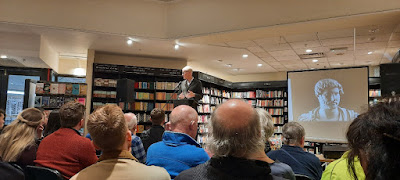
Last night we headed for Waterstones in The Galleries, Bristol to hear the author Tom Holland give a captivating talk on his latest tome, Pax: War and Peace in Rome's Golden Age. I received the book as a birthday present from my son and have just started to dip into it. The last time we heard Holland speak at the same venue he was promoting his previous work, Dominion: The Making of the Western Mind (see a report here). 

The speaker began by taking us to Hadrian's Wall, which marked the northernmost point of the Roman Empire. The Emperor Hadrian liked to visit the outposts of his vast domain, which stretched from Scotland to Arabia. The point of Hadrian's Wall was not so much to keep the barbarous Scots at bay, as to rub their noses in the fact that they had been excluded from the vast cultivated garden that flourished under Roman rule. 

Nero was the last Emperor to have descended from the great Augustus. His demise triggered the 'Year of the Four Emperors' in 69AD. Wannabes Galba, Otho and Vitellius failed to maintain their hold on power. Those who followed such as Vespasian, Domitian, Trajan and Hadrian ruled for long enough to ensure stability. That stability was the product of good PR as much as the might of the legions at the Imperial overlord's command.

The Emperors had statues erected in their honour across their domains. Coins bore the stamp of the Emperor's face. These images depicted how the Emperors wished to be seen, whether as aged throwbacks to antique virtue, or eternally young and virile rulers. Roman noblemen were usually clean shaven, but Hadrian affected a soldierly beard, which also gave him the aspect of a Greek philosopher. Holland had a suspiring amount to say about imperial barnets and beards. Otho's toupee made him an altogether unsuitable candidate for Emperor. No wonder he only lasted three months and a day in office. 

The writer described the Roman Emperors as the 'apex predators' of history. They ruled unhindered by any Christian notion of what constitutes right and wrong. After the death of his wife Poppaea, Nero spotted a slave boy who bore a passing resemblance to his dear departed Mrs. He had 'Sporus' castrated and married him. Following Nero's death, Vitellius sought to win the approval of the masses by having Sporus gang raped at a gladiator show. The poor lad only avoided this public humiliation by committing suicide. The short-lived rule of Vitellius ended when he was slaughtered by his successor Vespasian's troops. 

Holland described Christians of the time as 'Mesozoic mammals in a ecosystem dominated by dinosaurs.' But it was the little Christian mammals who won the day. The reason why we are appalled at the blood-soaked deeds of the mighty Emperors is that the 'Christian Revolution' totally transformed the moral landscape of the ancient world. How that happened is the story told in Dominion.    

Monday, March 27, 2023

Cultural Christianity


Several years ago we spent our summer holidays in Carmarthen, West Wales. Disaster struck. I ran out of books to read. But ever the intrepid traveller I endeavoured to remedy the situation by popping into a local bookshop. Browsing the history section, a book with an orange and gold cover caught my eye. It was Rubicon by Tom Holland, who was originally from Salisbury. The book told the story of the rise of Julius Caesar. It was a bloodthirsty tale of ambitious men jostling to become top dog in Rome.

Caesar made a name for himself when leading the campaign to subdue Gaul. It is said that in pursuit of that goal he slaughtered a million Gauls and enslaved a million more. Today we would call him a war criminal and demand he be tried for his atrocities at the Hague. But the people of Rome hailed Caesar as a hero. The glittering prize of being appointed ‘dictator for life’ was bestowed upon him in 49 BC. Although his life was cut short when Caesar was assassinated on the Ides of March in 44 BC. (This is discussed on The Rest is History podcast with Tom Holland and Dominic Sandbrook, 13 February 2023). 

At first Holland admired the heroes of ancient Greece and Rome, but the more he immersed himself in that world, the more he was disturbed by their casual cruelty. The author realised that he was viewing the actions of the likes of Julius Caesar from the perspective of a culture that was deeply steeped in the Christian faith. Christianity teaches that all people are made in the image of God and are therefore worthy of dignity and respect (even Gauls!). That was the basis of modern day human rights. Jesus said, ‘blessed are the meek, for they shall inherit the earth’. Caesar wouldn’t have agreed with that. But today we champion the underdog and demand that the poor receive the help they need.

Tom Holland doesn’t claim to be a personal follower of the Lord Jesus, but he does recognise that some of our most cherished values derive from the Christian faith. His book Dominion: The Making of the Western Mind shows how the faith has shaped our culture. But it is one thing to admire ‘Christian values’ and another to actually be a Christian

The Christian believes that Jesus is the Son of God who died upon the cross for our sins and rose again from the dead. Jesus promises those who believe in him a place in his everlasting kingdom. Cultural Christianity may admire the faith for its benefits, often picking and choosing the bits it likes, while rejecting the rest. But the kingdom of heaven is not to be selectively admired from outside, but entered as a person is transformed on the inside. As Jesus said, "Unless a man is born again, he cannot see the kingdom of God.”

* For the March edition of various local parish magazines 

Wednesday, November 11, 2020

Glen Scrivener interviews Tom Holland: How Christianity Gained Dominion

I enjoyed Glen Scrivener's interview with Tom Holland when we saw it on Sunday evening, although much of the ground they covered was familiar to anyone who had read Dominion: The Making of the Western Mind, or watched other conversations with the author.

Holland's rehearsal of the argument advanced in Dominion was interesting enough. His thesis being that enlightened liberalism owes more to its Christian heritage than is often admitted. Ideas of equality, universal human rights and secularism didn't just spring from nowhere. They are rooted in the Bible and Christian theology. 

It was also fascinating to hear Holland commenting on how his book on the origins of Islam, In the Shadow of the Sword was received rather differently in the Muslim world to Christian reaction to Dominion. The author received death threats for subjecting origin myths of Islam to historical scrutiny. Christians have by and large welcomed Dominion, giving it warm reviews. Certainly no death threats. Tellingly, secular humanists have been most critical of this work because it shatters their origin myth that the Enlightenment rejected everything based on Christian superstition in order to usher in a new age of reason. Not quite. 

One of the key features of Dominion is Holland's ability to spot where a moral position that is so common in the West that it might seem like part of the natural order of things, is in fact rooted in Christianity. Take a concern for the poor and disadvantaged, for example. That concern lies at the heart of Black Lives Matter, however much the movement might disavow the Bible in favour of Marxism. As Holland points out, however, BLM and other identitarian causes have failed to take on board the Christian doctrine of original sin that chastens our claim to moral superiority. Hence the shrill denunciation of anyone who has the temerity not to 'take the knee', even if they are black. Go woke, go Pelagian.

Towards the end of the interview Scrivener asked Holland where he was when it came to a personal commitment to faith in Christ. He acknowledged that he had lost his faith in liberalism as a system of universal values supposedly derived from pure reason. But his comments on believing in and following Jesus were rather opaque. Holland spoke of 'surrendering to the story' of the Bible, irrespective of whether that story is grounded in history. He was willing to take that existential leap of faith because the Christian story offers him a compelling moral and spiritual vision.

Scrivener doesn't press Holland on this, even though the Christian faith is based on the great historical claim that Jesus rose from the dead. If that isn't true, 'we are of all men to be pitied', as Paul put it. Reflecting further on why he has not yet made a personal commitment to Christ, the historian commented that he was not impressed by the pronouncements of church leaders during the pandemic. To him their message was one of health and safety, not heaven and hell. Disappointingly, they seemed to make little attempt to draw upon centuries of theological reflection on plagues and pestilence to help us discern what God might be saying to us in these Covid-stricken days.

He may have a point, although at least some of us have been trying to apply the message of God's Word to men and women living in darkness and the shadow of death. It turns out that Holland has been playing cricket over the summer, rather than attending church, where he might have heard the urgent call to repent and believe the gospel. 

In Dominion Holland demonstrated that the 'Christian Revolution' transformed Western society in ways that we do not always appreciate. But Christianity is not primarily an agent of cultural change. It proclaims the way of salvation through faith in Jesus who died for our sins that we might be put right with God and rose from the dead to give us the hope of everlasting life. 'Cultural Christianity' wants some of the societal and existential benefits of the faith, but resists Jesus' costly call to 'follow me'. It's just not cricket. 

Here's the interview: 


Tuesday, January 21, 2020

Dominion: The Making of the Western Mind by Tom Holland

Little Brown, 2019, 594pp

When Paul arrived in Corinth sometime in the early 50s AD, the apostle was aware of the intellectual pretensions of that great city. The rock stars of the day were not musicians, but orators. Public speakers could command a handsome fee for their highfalutin disquisitions on aspects of philosophy.  'Greeks seek wisdom' (1 Corinthians 1:22). Paul's approach was very different. "And I, when I came to you, brothers, did not come proclaiming to you the testimony of God with lofty speech or wisdom. For I decided to know nothing among you except Jesus Christ and him crucified." (1 Corinthians 2:1-2). The apostle's message was scandalous to the Jewish inhabitants of the city and utter folly to the cultured Greeks. Everyone knew that there was nothing more shameful and degrading than crucifixion. The idea that a crucified man was the Son of God and Saviour of the world was utter nonsense. Yet some believed, and a church was gathered in Corinth. The churches Paul planted and the letters he wrote to them changed the course of history.  

Dominion is the story of how this message of "Jesus Christ and him crucified" had a transforming effect on Western culture. As a boy Holland was fascinated by ancient Greek and Roman history. In their overweening power and brutality heroes of that age seemed more like terrifying dinosaurs than mere men. Holland went on to author several bestselling books on the period,  Rubicon,  Persian Fire, and Dynasty  But as he wrote these histories the writer found himself strangely repelled by by the enormities of the great men of Greece and Rome. The Spartans despised weakness and would expose sickly babies. Julius Caesar slaughtered a million Gauls and enslaved a million more to get a name for himself and was duly acclaimed as a hero of Rome. We think, 'not so nice'. 

It dawned on the writer that he had viewed ancient Greece and Rome through Christian spectacles, or at lest through lenses that had been ground into shape by two millennia of Christian history. The Christian faith inverted the values of antiquity. Suffering not slaughtering was heroic, weakness was strength, shame was glory. For at the heart of the Christian faith was 'Jesus Christ and him crucified', the belief that the Son of God took the form of a slave and died for the sins of the world. The cross, which had been a brutal token of Roman power was transformed into a symbol of redemptive love. For Christians this Jesus, risen and ascended, not Caesar was was world's true Lord. Those who suffered with him would also share his glory. This world-upending message brought down the lofty from their thrones and exalted the lowly.

Dominion is not a work of theology. Neither is it a conventional church history. Rather, Holland has sought to identify ways in which the Christian faith reconfigured what he calls 'the Western Mind'. Fittingly enough, his account is structured to reflect the Bible's own numeric symbolism, where the numbers three and seven are of special importance. The work is divided into three main parts, Antiquity, Christendom and Modernitas, each part having seven chapters, which, in turn have three sections a piece. The chapters begin with a vignette that sets up the theme about to be explored. While Holland is an admirer of the Christian faith, he doesn't shy away from depicting occasions when believers failed to live up to their best principles. Rightly so. Reading his previous books I'd always enjoyed the author's sweeping, cinematic style and eye for telling (usually gory) detail. I sometimes wondered what it might be like if he turned his hand to Christian history; the origins of the faith and its impact on the world. Well, here goes. 

The gospel

In setting out the key elements of the Christian faith Holland doesn't begin with the Gospel accounts, but the writings of the apostle Paul. His letters, were, after all the earliest New Testament documents. For the apostle the crucifixion of Jesus was not an embarrassment to be hushed up, but the fact that he placed literally at the crux of his teaching, 'the Son of God loved me and gave himself for me' (Galatians 2:20). This was deeply personal, but also of universal significance. As a Jew who was steeped in Old Testament Scriptures, Paul believed that all human beings were made in the image of God. As a Christian he taught that Jesus had died for people of all nations. Through Jesus the God of Israel would become the God of all peoples and all peoples would become one in Christ, (Galatians 3:28).

The teaching of Paul's New Testament letters sent seismic shocks rippling around the world and down the centuries to this present day. Paul explained that the old covenant in which the Ten Commandments were engraved on tablets of stone had gone. Jesus had ushered in a new covenant in which the law was written on the hearts of believers by the Spirit, 2 Corinthians 3:3. Even non-Christians had the 'works of the law' written on their hearts, giving them a sense of right and wrong, Romans 2:14. Paul helped develop the idea of the conscience as an inbuilt moral arbiter, Romans 2:15. Unlike in Islam Christian's didn't demand a direct divine command for every rule and regulation in society. Man-made rules based on 'the light of nature' would suffice. This helped to pave the way for Church lawyers to develop the concept of natural law and human rights in the Medieval period. Which, in turn helped to pave the way for Western secular states, subject to the rule of human law.

Freedom for the captives 

If all human beings are made in the image of God, each with unique dignity and value and 'in Christ there is neither slave nor free' (Galatians 3:28), that makes the institution of slavery highly problematic. Yet slavery was regarded as a normal part of life in ancient times. It was rife in Greece and Rome. The Church Father Gregory of Nyssa preached against slavery in the strongest terms.  But it wasn't until the 18th century that Christians more widely began to grasp that slavery was an intolerable evil that had to be stamped out.  Did not Christ die the death of a common slave to redeem us from slavery to sin? Quakers and Evangelicals threw themselves into the campaign for the abolition of slavery, championed by William Wilberforce. 

Protestant England persuaded Catholic France to follow suit, arguing not so much from biblical principles as did the Evangelicals, but by appealing to the Roman Catholic idea of 'human rights'. This universalising tendency was extended further as British imperialists sought to pressurise Islamic countries to abolish slavery, this time appealing (with little basis) to Muslim texts. And so the idea of culture-transcending universal human rights, beloved of liberals and neo-conservatives alike was born.

Husbands love your wives 

A Roman nobleman felt himself entitled to have sex with any socially inferior woman (man or child) he pleased. Repeated rape and sexual assault was the lot of female slaves. Christians taught that women as well as men were created in the image of God and that women should therefore be treated with dignity and respect. Men and women were of equal spiritual standing in Christ, for in him there was 'neither male or female' (Galatians 3:28). Men were not to impose themselves on women, but restrain their sexual urges. Sex should only be enjoyed within the confines of marriage. Marriage between a man and woman was intended to be a picture of Christ's love for his bride, the church, Ephesians 5:22-33.

Following on from this, the Puritans of the 17th century insisted that men treat women with the utmost propriety. They took delight in the loving intimacy of marriage, but frowned on sex outside of that context. Christians held family life in high honour and regarded having and bringing up children  to be a noble calling. Weakly infants were to be cherished and cared for, not exposed and left to die. The Medieval noblewoman Elizabeth of Hungary devoted herself to rescuing abandoned babies. Apart from the value attached to women by the Christian faith it is unlikely that the struggle for women's rights would ever have got off the ground.

Reform 

The abolition of slavery and the better treatment of women are but two examples of Christians attempting to reorder the world in line with their faith. Throughout Christian history the church has been swept by reformatio movements, the aim of which was to purify the church of corruption and turn the world upside down. Pope Gregory VII was concerned that the church had come too much under the sway of earthly rulers. He asserted the spiritual power of the church over and against the secular realm. Holy Roman Emperor Henry IV made the mistake of offending Gregory, who promptly excommunicated him, thus absolving the Emperor's subjects of their loyalty. Henry had to head across the Alps to Canossa, groveling for the pope's forgiveness.

Separation between the religious and the secular can be traced back to Augustine. When the Roman Empire fell, people worried that the kingdom of God would fall with it. This prompted Augustine to write The City of God, in which he distinguished between the shifting world of the secularia, of which earthly empires were a part, and religio, devotion to God of which the church was an expression. The separation of church and state in modern democratic societies is a development of this deeply Christian way of viewing the world.

The Reformation was one of the most convulsive reformatio episodes. In this instance, rather than the papacy reforming abuses in the church, the pope himself was charged with presiding over a corrupt and ungodly system. Famously Martin Luther refused to back down at the Diet of Worms, his conscience was bound by the word of God and he would accept no other authority. The church had to be reformed according to the teaching of Scripture. Romish superstitions; indulgences, relics and masses had to go. Paul's gospel of salvation by faith alone in Christ alone was brought to light and proclaimed afresh to the people. The religious life of devotion to God was not now the preserve of priests, monks and nuns. All the Lord's people were priests and were called to serve God faithfully in their daily callings. This had the unintended effect of privitising faith as a purely spiritual matter, leaving little room for religious expression in the secular realm. It also enabled English Protestant empire builders to make a distinction between the Hindu 'religion' of India and disagreeable cultural practices, like widow burning.

Enlightenment 

Drawing upon the Reformation teaching on the witness of the Spirit to the truth of the Bible, Evangelicals in the 18th century would speak of the enlightenment of the Spirit that gave them fresh insight into Scripture. This enlightenment had a transforming effect on their personal lives and led to attempts at reforming society, the abolition of slavery being one example. A line can be traced from Medieval reform movements, to the Reformation, to the Evangelical Revival. But these were attempts to reshape the church and the world in line with the Christian faith. 

In the 18th century others proclaimed a new age of Enlightenment, not because they understood the Bible in a new way, but because they rejected it in favour of science and reason. The object of their reforming zeal was an overmighty church that had to be cut down to size so that people could be set free from oppression and religious superstition. As Holland points out, the irony was that Enlightenment rationalists had bought into the Christian idea of pulling the lofty from their thrones and exalting the lowly. They took that a little too literally in Revolutionary France. Similarly, today's woke lefties with their hierarchy of oppressed victims are, consciously or not, drawing upon a faith that has Jesus 'crucified in weakness' at its heart.

Post-Christianity 

Dominion is a meditation on the transformative effects of Christianity on Western culture. But it also exposes the dangers inherent in 'cultural Christianity', where the moral imperatives of the faith are uncoupled from the theological indicatives of the gospel of Christ. You end up with a selective appropriation of Christian morality that is devoid of spiritual power. The result both for the church and wider society is often disastrous. Holland gives the example of Elizabeth of Hungary in the Middle Ages, who submitted to horrific abuse at the hands of churchman 'Master Conrad' in an attempt to save her soul. Luther would have told her to trust in Christ. Witness also the 'Great Terror' of the French Revolution. Unwittingly #MeToo feminists are busily demanding a return to the old Puritan emphasis on respect for women and male self-restraint. The Puritans, however, would have deprecated woke identity politics with its virtue signalling and self-righteous denunciation of opponents. The old Puritans were too conscious of their own sins and too aware of their need of God's grace for that.

More troubling even than 'cultural Christianity' is 'post-Christianity'. Frenchman Marquis de Sade and German Frederich Nietzsche both despised the Christian faith with its bias towards the weak and downtrodden. They favoured the stance of the ancient Greeks and Romans, 'let the weak be crushed and the strong dominate'. Nietzsche pronounced, 'God is dead'. In his place was the 'will to power' that brooked no opposition from Christian scruples. Charles Darwin's theory of evolution put the accent on the 'survival of the fittest' in the natural world. Eugenicists applied the same insight to the human race. Nazi Germany put these 'post-Christian' ideas into practice. The disabled and people regarded as morally degenerate were marked out for elimination to preserve the purity of the Aryan race. Millions of Jews were consigned to the gas chambers. Against this backdrop J. R. R. Tolkien wrote his Lord of the Rings as a warning against man's urge to seek power at all costs, 'One ring to rule them all and in the darkness bind them'.

The audacity of the cross 

Holland's cinematic sweep of Christian history is full of interest as he zooms in on key characters in the unfolding drama and zooms out again to reveal big themes that recur throughout the book. The cast includes Paul, Augustine, Gregory VII, Martin Luther and Martin Luther King, John Calvin and John Lennon. Paul McCartney may have dismissed Christianity as 'goody-goody' stuff, but in singing, 'All You Need Is Love', The Beatles betrayed the their Christian influences. No other faith tells us "God is love", "God shows his love for us in that while we were sinners, Christ died for us", and "love is the fulfilling of the law" (1 John 4:8, Romans 5:8, 13:10).

The historian concludes his brilliantly written account on a personal note. He confesses to having a rather fluctuating Christian faith, with perhaps one breakthrough moment. When making a film on Islamic State, Holland was close to an area where the Islamists had crucified their enemies, much as did the Romans. The cross in that context was an instrument of terror, the threat of which cowed people into submission. It was totally devoid of any Christian connotations as a symbol of self-giving love and forgiveness. That seemed to speak to Holland in a deep way, but I sense he's not quite there yet in terms of personal faith in Christ.

As the writer himself says, "To be a Christian is to believe that God became man, and suffered a death as terrible as any mortal has ever suffered. This is why the cross, that ancient instrument of torture, remains what it always has been: the fitting symbol of the Christian revolution. It is the audacity of it - the audacity of finding in a twisted and defeated corpse the glory of the creator of the universe - that serves to explain, more surely than anything else, the sheer strangeness of Christianity, and of the civilisation to which it gave birth'. (p. 524). Which takes us back to the apostle Paul and his determination to make the cross the heart of his message, "I decided to know nothing among you except Jesus Christ and him crucified." 

Dominion 

Jesus called his followers to be the 'salt of the earth' and the 'light of the world'. By their words and actions believers are meant to make a difference. But Christianity is not ultimately a project of cultural transformation. Its scriptures herald a new Dominion, the kingdom of God. This dominion is different to the kingdoms of this world. It advances not by military or political power, but by the preaching of the cross in the power of God's Spirit. The American edition of Holland's work has on its cover Salvador Dali's painting, Christ the King. It depicts Jesus ruling the world from his cross. His is a kingdom in which the King was crucified in weakness, but now lives by the power of God. Cultural Christianity admires the faith for its benefits, often picking and choosing the bits it likes, while rejecting the rest. But the kingdom of God is not to be selectively admired from outside, but entered as a person is transformed on the inside. As Jesus told the Pharisee Nicodemus as recorded in the Gospel of John, "Unless a man is born again, he cannot see the kingdom of God." (John 3:3).

Friday, January 10, 2020

Dominion: The Making of the Western Mind by Tom Holland [mini review]


As a child the historian Tom Holland was fascinated by the ancient Romans and Greeks. Holland, who hails from Wiltshire, went on to author several bestselling books on Roman and Greek history, Rubicon, Persian Fire and Dynasty. But the more he got into the ancient world, the more morally repellent he found the ‘heroes’ of that age. It was said that Julius Caesar slaughtered a million Gauls and forced another million into slavery. Rather condemning Caesar as a genocidal war criminal, the citizens of Rome hailed him as a mighty leader whose exploits redounded to the glory of the Empire.

Holland became increasingly aware that his perspective on life was vastly different to that of the old Romans and Greeks. He realised that his idea of what’s right and wrong had been formed by a culture that had been deeply influenced by the Christian faith. In his most recent book Dominion: The Making of the Western Mind, Holland shows how our commonly accepted moral values were shaped by Christian teachings. We take it as self-evident that all people should be treated with dignity and respect. But that belief didn’t come from nowhere.

The Bible insists that all human beings are made in the image of God and are deserving of love and care from womb to tomb. The value of human life is underlined by the belief that in Jesus our Creator became one of us. He came to suffer and die on the cross that we might be forgiven and be put right with God. “It is the audacity of it”, writes Holland, “the audacity of finding in a twisted and defeated corpse the glory of the creator of the universe”.

We went to hear the author give a talk on Dominion towards the end of last year and I’ve just finished reading the book. It’s a brilliantly written account of the impact of the Christian faith on Western culture and values, covering everything from the Bible to The Beatles, Monasteries to #MeToo. Holland is not a personal believer in Jesus Christ. He calls himself a ‘cultural Christian’. But he recognises that the ‘molten heart’ of the Christian revolution is the cross of Jesus. The message of the cross turned the world upside down, exalting the lowly and humbling the mighty.

For the Romans, crucifixion was a symbol of brute power, ‘this is what you get if you mess with us’.  Since Jesus the cross has an altogether different message, ‘God shows his love for us in that while we were still sinners, Christ died for us.’ The love of God that streams from the cross changed the course of history and is still transforming lives today.

*Write-up for local publications: White Horse News, Trinity Magazine and News & Views. A full review can now be found here

Wednesday, September 18, 2019

Tom Holland on 'Dominion' at Bristol Festival of Ideas

A few years ago when our children (now twenty somethings) were still children, we holidayed in Carmarthen. We saw Toy Story 3 in the cinema, so it must have been summer 2010. I'd finished my 'holiday reads' and was on the look out for another book. On the shelves of history section at Waterstones I spied a bright orange volume with gold lettering, Rubicon: The Triumph and Tragedy of the Roman Republic by Tom Holland. I'd never heard of him, but there was something about the subject  that grabbed me. The schoolboy Classical Studies O Level student was evidently the father of the man who bought and then devoured, Rubicon. And after that, Persian Fire, Millennium and Dynasty, all by Holland. 

I enjoyed the author's sweeping, cinematic style and eye for telling (usually gory) detail. I sometimes wondered what it might be like if he turned his hand to Christian history; the origins of the faith and its impact on the world. So it was that yesterday evening the wife and I found ourselves in a Bristol branch of Waterstones to hear Tom Holland give an interview on his new publication, Dominion: The Making of the Western Mind. And the thing that according to Holland shaped the Western Mind was the Christian faith.

I say 'interview, ' it was more like a highly animated freestyle talk, with the flow interrupted and then redirected in its course by an occasional question. Holland explained how he came to write  Dominion and expanded on some of the key ideas in the book.

As a boy Holland was fascinated by the ancient Greeks and Romans. In their overweening power and brutality the Caesars seemed more like terrifying dinosaurs than men. But as he wrote Rubicon he found himself strangely repelled by their enormities. Julius Caesar slaughtered a million Gauls and enslaved a million more to get a name for himself and was duly acclaimed as a hero of Rome. We think, 'Not so nice.'

But why? It dawned on Holland that he viewed ancient Rome through Christian spectacles, or at lest through lenses that had been ground by two millennia of Christian history. The Christian faith inverted the values of antiquity. Suffering not slaughtering was heroic, weakness was strength, shame was glory. For at the heart of the Christian message was the belief that the Son of God took the form of a slave and was crucified for the sins of the world. The cross, which had been a brutal symbol of Roman power was transformed into a symbol of redemptive love. Christians proclaimed that this Jesus, risen and ascended, not Caesar was was world's true Lord. Their message brought down the lofty from their thrones and exalted the lowly.

The foremost exponent of the Christian faith was the apostle Paul. He grasped the universal implications of faith in Jesus. Through him the God of Israel would become the God of all peoples and all peoples would become one in Christ, Galatians 3:28. Holland thinks that Paul is a little ambiguous on how Jesus should be understood in relation to the God of Israel. I'd say that inserting him into the Jewish Shema (Deuteronomy 6:4), as he does in 1 Corinthians 8:6 makes it pretty clear that for the apostle Jesus should be included in the divine identity. (See God Crucified: Monotheism and Christology in the New Testament, by Richard Bauckham). 

The teaching of Paul's New Testament letters sent seismic shocks rippling around the world and down the centuries to this present day. Paul explained that the old covenant in which the Ten Commandments were engraved on tablets of stone had gone. Jesus had ushered in a new covenant in which the law was written on the hearts of believers by the Spirit. Even non-Christians had the 'works of the law' written on their hearts, giving them a sense of right and wrong. Paul helped develop the idea of the conscience as an inbuilt moral arbiter. Unlike in Islam you didn't need a direct divine command for every rule and regulation in society. Man-made rules based on 'the light of nature' would do. This helped to pave the way for Western secular states, subject to the rule of human law. 

As we were in Bristol it seemed fitting that slavery got a mention. Slavery was regarded as a normal part of life in ancient times. It was rife in Greece and Rome. Vikings used Bristol to transport the English slaves they had captured. The city made its wealth as port for the Transatlantic Slave Trade. Nowadays slavery is regarded as an abominable infringement of human freedom and dignity. Such is the taint of association with the slave trade that there are calls for Bristol's Colston Hall to be renamed. How do we account for this change in attitude towards slavery? 

The Church Father Gregory of Nyssa preached against slavery in the strongest terms.  But it wasn't until the 18th century that Christians more widely began to grasp that slavery was an intolerable evil that had to be stamped out. Are not all men made in the image of God? Did not Christ die the death of a common slave to redeem us from slavery to sin? Quakers and Evangelicals threw themselves into the campaign for the abolition of slavery, championed by William Wilberforce. 

Protestant England persuaded Catholic France to follow suit, arguing not so much from biblical principles as did the Evangelicals, but appealing to the Roman idea of 'human rights'. This universalising tendency was extended further as British imperialists sought to pressurise Islamic countries to abolish slavery, this time appealing (with little basis) to Muslim texts. And so the idea of culture-transcending universal human rights, so beloved of liberals and neo-conservatives alike was born. 

Drawing upon the Reformation teaching on the witness of the Spirit to the truth of the Bible, Evangelicals would speak of the enlightenment of the Spirit that gave them fresh insight into Scripture. This enlightenment had a transforming effect on their personal lives and led to attempts at reforming society, the abolition of slavery being one example. A line can be traced from Medieval reform movements, to the Reformation, to the Evangelical Revival. But these were movements to reshape the church and the world in line with the Christian faith. 

In the 18th century others proclaimed a new age of Enlightenment, not because they understood the Bible in a new way, but because they rejected it in favour of science and reason. The object of their reforming zeal was an overmighty church that had to be cut down to size so that people could be set free from oppression. As Holland pointed out, the irony was that Enlightenment rationalists had bought into the Christian idea of pulling the lofty from their thrones and exalting the lowly. They took that a little too literally in Revolutionary France. Similarly, today's woke lefties with their hierarchy of oppressed victims are, consciously or not, drawing upon a faith that has Jesus 'crucified in weakness' at its heart.

I mentioned seeing Toy Story 3.  Apart from the Christian faith would we even have the Toy Story series, shot through as the films are with key values such as love and self-sacrifice? The Romans would have had Woody and Buzz slaughter all the 'enemy' toys, and then  each other as the vied for supremacy.

In the interview Holland made many more fascinating links between Christianity and the contemporary world, taking in figures as diverse as John Lennon, Nelson Mandela, and Richard Dawkins. But I'll leave it there, otherwise this report will end up as a book review before I've even read the book. I duly purchased a signed copy after the talk, so watch this space. [See here for the review]. 

One last thing. On a personal note, Tom Holland confessed to having a rather fluctuating Christian faith, with perhaps one breakthrough moment. When making a film on Islamic State he was close to an area where the Islamists had crucified people, much as did the Romans. The cross was an instrument of terror, the threat of which cowed people into submission. Under IS the cross had none of its Christian connotations as a symbol of self-giving love and forgiveness. That seemed to speak to Holland in a deep way, but I sensed he's maybe not quite there yet in terms of personal faith in Christ.

I was reminded of the time recounted in the Acts of the Apostles when the King Agrippa had Paul address his assembled court with Roman governor Porcius Festus in attendance. Paul, bound in chains, gave a well-argued defense his faith and conduct. Agrippa responded (in the Authorised Version at least), "Almost thou persuadest me to be a Christian." I think I can hear Paul's response echoing down the centuries and addressing Tom Holland, "I would to God, that not only thou, but also all that hear me this day, were both almost and altogether such as I am, except these bonds." (Acts 26:28-29). 

Friday, August 26, 2016

Dynasty: The Rise and Fall of the House of Caesar by Tom Holland

Abacus, 2016, 512pp 

More summer holiday reading. Still on the theme of our Rome/Venice half term break.

Ever read the second half of Romans 1 and thought, 'Hey, Paul, that's laying it on a bit strong'? I mean, all that stuff about idolatry, sexual immorality, hatred, murder and the like. Surely those old Romans weren't that bad? Worse, actually. The apostle was sparing his readers' blushes. Holland doesn't.

In his latest historical blockbuster the historian tells the tale of the House of Caesar. Put simply, they weren't very nice people. What Senneca said regarding the worst of them, Caligula, might well be applied to the rest in some measure, 'Nature produced him...to demonstrate just how far unlimited vice can go when combined with unlimited power.'

Holland unfolds the story of Augustus' dynasty with his customary flair for writing a well researched historical account that is borne along by a surging narrative flow. Full of detail and drama.

By his victory at the decisive battle of Philippi, Gaius Octavius brought an end to the civil wars that followed the assassination of Julius Caesar. He then  claimed for himself the  ultimate prize in Rome. While Augustus (as Gaius became) paid lip service to the traditions of the Republic, he accrued to himself the powers of an absolute monarch. Anyone who stood in his way was eliminated. Plotters and would-be rivals were ruthlessly dispatched. Those who succeeded him; Tiberius, Caligula, Claudius and Nero followed suit.

You think the jostling for position among leading Tories after the Brexit vote was sharp elbowed; Gove and Johnson and all that? Playground fisticuffs compared with the deadly goings on in the House of Caesar.

Holland's work could be read as a meditation on human nature. An extended commentary on the saying, 'Power corrupts, absolute power corrupts absolutely.' That certainly rings true for the Caesars. Not even their nearest and dearest were spared. Brothers had their sisters murdered, uncles their nephews and nieces. In the case of Nero, he had his own mother bumped off and in a fit of temper battered his pregnant wife, Poppaea to death. To say nothing of how they treated their enemies.

Ovid, for ever wanting to push the boundaries of taste and decency said, 'We always want what we're not allowed'. A profound commentary on human nature. Augustus passed a law against adultery, and yet demanded that his sexual appetites be sated by a steady supply of nubile young women. Tiberius posed as an upstanding embodiment of old Roman virtue, yet spent his last days living out his depraved sexual fantasies. Caligula openly reveled in excess of all kinds. Nero tried to replace the wife he murdered with a male eunuch.

Ovid was right. In his Letter to the Romans Paul wrote, "Now the law came in to increase the trespass" (Romans 5:20). The divine 'thou shalt not' provokes the response 'why shouldn't I?' Paul testified to own experience of this, "Yet if it had not been for the law, I would not have known sin. For I would not have known what it is to covet if the law had not said, 'You shall not covet.'” (Romans 7:7).

But hang on a minute. Augustus and co didn't exactly have the Ten Commandments inscribed on their villa walls. How can they be said to be deliberately transgressing the law? A clue may be found in Ovid's statement cited above. His 'allowed' suggests moral force. Paul in Romans 1:18-32 argues that pagans knew right from wrong, and yet deliberately chose what was wrong; idols over God, unrighteousness over righteousness, what was unnatural over the natural etc.

The apostle elaborates in Romans 2:12-16. God had 'by nature' written the law on the hearts of Gentiles and their consciences bore witness to that law, accusing or excusing them accordingly. The problem wasn't that Ovid and Caligula didn't know any better when it came to immoral conduct. Rather, the very prohibitions of the 'light of nature' provoked them to want what they were not allowed. That is part and parcel of the perversity of human sinfulness. The history of the House of Caesar, indeed all human history bears witness to that sad fact.

That is why placing too much power into the hands of one person is always a recipe for disaster. Political systems need checks and balances in order to rein in the worst excesses of human nature. The period of the Roman Republic was hardly a Golden Age of love and peace, but at least the system that Augustine and his line supplanted had some checks and balances.

Dynasty is great background reading for the New Testament period. Holland references Jesus and his teaching and describes the persecution of Christians under Nero. The text is sprinkled with Bible references. Spookily, Holland brings his account to a conclusion with a nod to Revelations 17, which sprung to mind when reading Peter Ackroyd's Venice.

This is not a book for the faint hearted. Sometimes you feel like you are wading through blood and guts. Holland doesn't flinch at detailing the seamier side of Roman life either. A kind of 'Horrible History' for grown-ups, 'The Dreadful Dynasty'?

What made Augustus and his line so dreadful was the rampant power of human sinfulness let loose. The Caesars styled themselves as lords of their people and sons of a god. They attained their elevated status by ruthlessly grasping for power and keeping hold of it at all costs. Paul visited Philippi, site of the famous battle and planted a church there. Roman soldiers were given the right to settle in the city, which became a colony of Rome. Members of the church were both citizens of Rome and citizens of heaven. As citizens of heaven they acknowledged another Son of God, Lord and Saviour, Jesus Christ, Philippians 3:20-21. Jesus showed an altogether different attitude to power and prestige to that of the Caesars, Phil 2:5-11. He who was in the form of God took the form of a slave to die for his people. Therefore God exalted him to the highest place of honour in the universe.

The apostle wrote to the believers in Philippi that they were to, 'Let this mind be in you which was also in Christ Jesus'. They were to eschew selfish ambition and seek honour through humility and service, Philippians 2:3-4. For the Caesars, especially Caligula and Nero, overweening pride came before a terrible fall. The Christian gospel turns the world upside down by teaching that down is the only way up. As Jesus taught, "The meek shall inherit the earth." (Matthew 5:5).

As he wrote his letter to the Romans, Paul sensed the vulnerability of the Christian community under Nero. What chance did they have against the brutal princeps of Rome? Yet he assured them they they were held in the grip of something more powerful than the spite of the Emperor. Nero might label them as enemies of mankind and have them thrown to the lions, doused in pitch and set alight, but nothing would be able to "separate them from the love of God which is in Christ Jesus our Lord." (Romans 8:35-39).

The House that Caesar built lies in bloodsoaked ruins. Its legions have long perished. Its monstrous deeds stand condemned by history. The kingdom of the wolf is no more. The Lamb is in the midst of the throne. 

Thursday, August 15, 2013

Millennium by Tom Holland

Millennium: The End of the World and the Forging of Christendom,
 by Tom Holland, 2008, Abacus, 476pp

Tom Holland's Millennium was my 'big read' for the summer hols. I managed to stow the weighty tome in my EasyJet hand baggage without exceeding the airline's limits. Most of the book was read airport departure lounges or on one or another of the Algarve's wonderful beaches between dips in the sea to cool off after baking in the heat. 

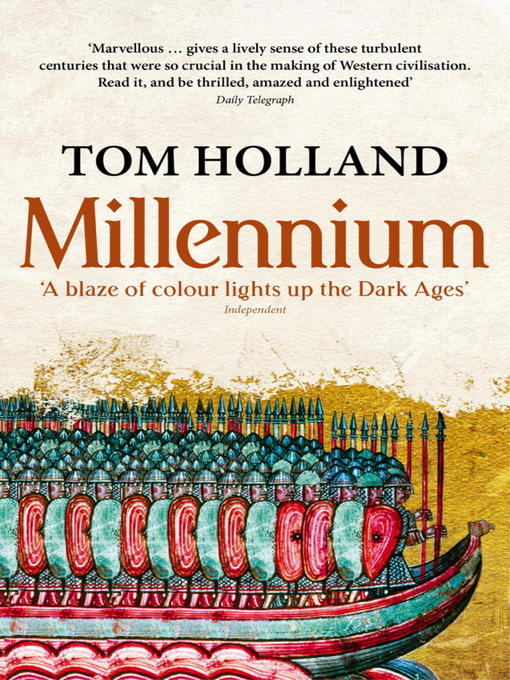
Holland is an acknowledged master of narrative history and his skills were well deployed in telling the story of what happened in the period that spans a hundred years either side of 1000 A.D. He traces the development of Christendom from the conversion of Constantine in 312 to the capture of Jerusalem in the First Crusade in 1099.  Along the way he describes the repeated attempts on the part of rulers from East and West to recreate the glories of the old Roman Empire, and the rise of the papacy as the dominant force in Christendom. Holland introduces his readers to some of the big players of the time including Charlemagne, Rollo the bloodthirsty Viking 'convert' to Christianity, Fulk Nerra, the Godfatherish Count of Anjou, an assortment of Ottos and Henrys. Then there's 1066 and all that. All the familiar elements of Medieval history are here. Want to know how knights first won their spurs? Why power hungry potentates started building castles? Maybe it's blood-spattered battle accounts that you're after? Look no further. 

Now, in the period leading up to the end of the first Millennium, folks in Christendom weren't looking forward to big parties and fireworks displays, all set to a Robbie Williams soundtrack to mark the advent of the year 1000. Rather, it was feared that the dawning of the 1000th anniversary of Christ's birth might mark the end of the world, or at the very least, the coming of the Antichrist. When neither happened, attention was fixed instead on 1033 A.D., the 1000th anniversary of Christ's death and resurrection. Augustine of Hippo (not to mention the Bible) warned believers of the folly of predicting when the End will come, but people will never learn. That apocalyptic visions had such a hold on the Medieval imagination is only one of the ways that makes the so-called Dark Ages seem so different from our own. However, as Holland points out in his preface, we who live at the beginning of the third Millennium are not without our secularised doom laden scenarios, such as the threatened devastation of human life by global warming. 

There is much that could be said in response to reading Holland's work, but what especially struck me was just how spectacularly wrong-headed the was the whole notion of 'Christendom'. It began with the conversion of Constantine, with the Roman Emperor attempting to Christianise his realm. In its origins Christendom was Erastian. Yeah, yeah, that's an anachronism. Thomas Erastus was a sixteenth century man. But it's the Swiss theologian's name that's associated with the view that the church should be a servant of the state. After Constantine successive 'Holy Roman Emperors' meddled in church affairs, appointing bishops, removing popes and so on. Figures such as Charlemagne, the Ottos and the Henrys believed that they had been specially  anointed as priestly-kings to defend Christendom and rightly order the church in their domains. But over time the papacy developed big ideas of its own. Gregory VII claimed that the Bishop of Rome had absolute power not only over the church, but also the right to remove emperors'should the need arise. And when it did, Henry IV had little option but to grovel before him a Canossa.

In the preface, Holland argues that Canossa was a watershed moment in history, when church and state first began to divide into distinct realms in the West. The thought is not developed later in the book and I'm not sure that it can be justified by the evidence. If anything Canossa represented at attempt by the church control the world of politics. But having the pope lord it over the emperor was as bad as the church being treated as the plaything of earthly potentates. Church and state are two distinct institutions, ordained by God for two very different ends. The two should not be confused or conglomerated. The power of the state is political and may legitimately include the use of force to uphold the law and in defence of the realm. The power of the church is solely evangelical. State power must not be used to advance the mission of the church. Her weaponry is not carnal but spiritual, a lesson that the Medieval Church tended to forget. And so to the crusades, an account of the first of which brings this book to an end. 

Not even the Magisterial Reformers were clear on this point, hence their title, meaning that they were willing to utilise the power of the Magistrate to further and defend the cause of Reformation. English Separatists such as John Greenwood and Henry Barrowe had a better insight into the New Testament's teaching on the relationship between church and state. Rather than waiting for the Elizabethan state to reform the church Erastian-style, they argued for Reformation Without Tarrying for Anie and paid for their principles with their lives. The church may be called upon to die for it's beliefs, but she should never be prepared to kill for them, or ask others to do so on her behalf. Christendom with its 'Holy Roman Emperors' bearing their 'sacred lances' into battle and lordly popes preaching up the crusades tragically ignored the words of the Prince of Peace before Pontius Pilate, 'My kingdom is not of this world.' (John 18:36). I'm not saying that the Church of the Middle Ages was totally devoid of gospel light, but as Holland's narrative of the period demonstrates, there was far too much of 'this world' and far too little of Christ in Christendom.

To conclude, Millennium is an absorbing and instructive read. But the book also served another vital purpose when we were on holiday. I used it to squish the pesky mosquito that had been greedily gorging itself on my blood during the night, leaving me covered in nasty bites. Kind of a fitting use for a book oozing with the guts and gore of ancient battles.

Highly recommended. Mosquitoes beware.  

Wednesday, July 31, 2013

My summer hols reading list


We're off to the Algarve tomorrow. Like the PM we're flying by EasyJet, but probably unlike him it's hand luggage only for us. Surprising how much you can fit into a small wheelie suitcase. But not that much. However, one must make room for essentials such as smellies, clothes and of course, books. Yep, I've got an Android Tablet with a Kindle app, but, sadly it isn't solar powered and the battery only lasts for around 2-3 hours before needing a recharge. Not much use for a four hour flight, or a day spent lazily reading on the beach. Nothing for it other than to take a couple of those papery, printy things called books. A bit primitive, I suppose, but there we are. The Tablet's coming too, mind you. Good for evening reading at the apartment, within reach of an electric socket.

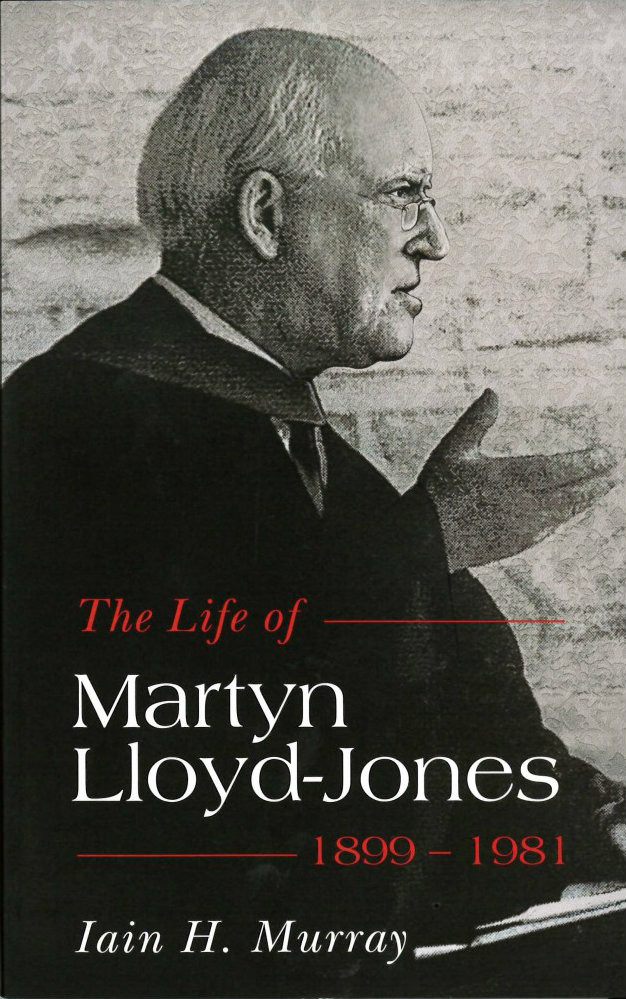
Which books to take, then? In a previous post I mentioned Tom Holland's Millennium. In addition, Evangelical Times kindly sent me a review copy of The Life of Martyn Lloyd-Jones 1899-1981, by Iain H. Murray. Now, being a proper Lloyd-Jones aficionado I've read Murray's two volume biog of the good Doctor. But let's face it, with Vol 1 a 394pp sizeable hardback and Vol 2 a hefty 831 pager, they are hardly EasyJet hand luggage fodder. Together they might even take up the whole of my bag weight allowance. I mean, I read Vol 2 during the summer of 1991 when it was first published and managed to break a deckchair. Seriously. Sitting by a swimming pool reading, The Fight of Faith, the stripy canvas split and I ended up in an undignified tangle on the floor. Not good. Murray's 476pp paperback abridgement seems just the thing, then. Apparently it's got some new material in it too, as well as leaving quite a bit of stuff out. 

Kindle-wise I'm hoping to make some more progress on The Idiot by Fyodor Dostoevsky

That's me done with blogging for a bit, then. See ya! 

Friday, July 26, 2013

Persian Fire by Tom Holland

Persian Fire: The First World Empire and the Battle for the West, 
by Tom Holland, Abacus, 2005, 418pp. 

And for my next trick I shall attempt to review a book that I finished reading in the summer of 2011. Why bother now? Well, since reading Tom Holland's Rubicon a few years ago it's been my habit to have one of his historical blockbusters on my summer hols reading list. I plan to take his Millennium with me when we head for the Portugal next week. Thinking about Millennium jolted my memory that I'd not posted a review of Persian Fire on the blog. A bit of an omission really, because I so enjoyed reading it.

I first became fascinated with the classical period in school, where I did a Classical Studies O Level. Mr. Hamlet's lessons were probably the only ones to which I especially looked forward. He was a brilliant teacher, bringing Homer's Iliad and Odyssey to life. Mr. Hamlet wielded his board ruler as if it were Achilles' spear. He could throw his board rubber with pinpoint accuracy at any pupil who failed to give him their full attention, leaving a wide chalky stripe on their blazer.  I was something of a schoolboy socialist and proudly sported a non-regulation CND badge on the lapel of my blazer. Mr. Hamlet was the only teacher who praised rather than scolded me for wearing it. 

Anyway, in Persian Fire Tom Holland, narrative historian par excellence gives an immersive account of the Persian invasion of Greece, led by the mighty Xerxes. With high frame rate clarity the author charts the build up of the invasion. He tells the story of the rise of successive middle eastern empires; Assyrian, Babylonian and Medio-Persian. We're introduced to a cast of ambitious, ruthless and bloodthirsty empire builders, including Cyrus, Darius, Nebuchadnezzar and, of course, Xerxes himself. 

Meanwhile, Holland takes us back to ancient Greece and the Millibandian sibling rivalry that existed between Sparta and Athens. The historian recounts renowned battles between Greek and Persian forces; the Athenian hoplites crushing their opponents at Marathon, the Spartan Immortals heroically holding the pass at Thermopylae, and the eventual defeat of the Persian invasion force at Eurymedon. All told with gripping, cinematic detail. 

All this is interesting enough in itself, but the period also forms the backdrop to Old Testament history. Holland occasionally gives a nod to the Scriptures, referencing Isaiah's prediction that Cyrus would give the Jews permission to return to Jerusalem and rebuild the Temple after the Babylonian captivity, Isaiah 45:1-3, cf. Ezra 1:1-4.  Daniel, who served in the court of Nebuchadnezzar spoke of the coming of a kingdom that would never be destroyed, Daniel 2:44. The once mighty empires of old now lie in ruins, yet the kingdom of God still endures. It's only weapon is not a hoplite's spear or a revolutionary's Kalashnikov, but the 'sword of the Spirit', which is the word of God. The truth spoken in love. David Bentley Hart has deonstrated how the 'Christian Revolution' transformed the moral and spiritual values of the ancient world in his Atheist Delusions: The Christian Revolution and Its Fashionable Enemies, which I read alongside Persian Fire. Reflecting on the latter title brings to mind the words of David Charles' (1762-1834) great hymn, translated from the Welsh by Edmund Tudor Owen,

Great providence of heaven--
What wonders shine
In its profound display
Of God's design:
It guards the dust of earth,
Commands the hosts above,
Fulfils the mighty plan
Of his great love

The kingdoms of this world
Lie in its hand;
See how they rise or fall
At its command
Through sorrow and distress,
Tempestuous storms that rage,
God's kingdom yet endures
From age to age