Pages

Monday, September 24, 2012

That was the weekend that was


On Saturday morning we had our autumn morning of prayer at Providence Chapel, using Psalm 145 as a template for praise, intercession and petition. That our 'Bright Sparks' parent and toddler group was due to begin today gave our prayers added urgency.

In the afternoon Sarah and I headed for Southwick Country Park near Trowbridge. Wiltshire being landlocked and all that's not it in the image above. My mobile is on the blink so I couldn't take photos anyway. Although it's nearby we'd not been to the Country Park before. It was nice to wander around and take in the sights on what may have been the last warm and sunny day of the year. We finished up eating a tub each of locally produced Marshfield Farm ice cream in the grounds of the Squirrels tea-room. The photo is of the beach at Weston-Super-Mare, taken a few weeks ago. 

Then it was off to Halfords to buy 'L' plates so I could take our son, Jonny driving around a Westbury Industrial Estate. He's had some 'proper' lessons, but this was the first time I'd taken him driving. Didn't go too bad, actually. Considering. 

On Sunday I preached at Ebenezer Baptist, West Lavington. We had visitors to both the morning and evening services, which was encouraging. In the morning I preached on Genesis 37 and in the evening on Galatians 5:1. After the evening service a number of friends from both churches met for a time of fellowship in the home of a couple who are members of Providence Church. The question of how we might rejoice in God's judgement was discussed. 

'Bright Sparks' went well this morning, with a good number of mums, with their babies and toddlers coming along, which was an answer to prayer. 

The Lord is good and his steadfast love endures for ever. 

Wednesday, September 19, 2012

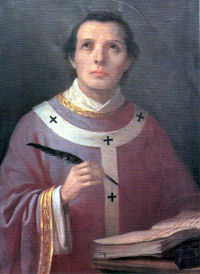
Anselm on faith seeking understanding of the Trinity


The other week I posted some thoughts on Anselm's treatment of God's justice and mercy in his Proslogion (here). I mentioned that I also wanted say something about his thinking on the Trinity in the same work. I thought it might be interesting to contrast Anselm's approach to the subject with that of John Calvin in the Institutes (Book I:XIII). Like Anselm, the Reformer begins with the essential unity of God and then discusses his tripersonality. But even here, methodological differences are evident. Anselm cites Scripture in the Proslogion, and the God who is 'something-than-which-nothing-greater-can-be-thought' is clearly the God of the Bible. But his work is not sufficiently grounded in the self-revelation of God in Holy Scripture. Human reason rather than divine revelation to the fore as Anselm elaborates his argument for the existence of God.

What Calvin has to say both on the the essence of God and his triunity is more explicitly rooted in the Scripture. He has less faith in the power of human reason to explore the divine essence. What the Bible says regarding the immensity and spirituality of God's essence "checks the audacity of the human mind" (I:XIII:1). This is quite unlike Anselm's approach in the Monologion, a meditation on God's essence where "nothing whatever be argued on the basis of the authority of Scripture, but [by] the constraints of reason" (Anselm of Canterbury: The Major Works, OUP, 2008, p. 5). While Calvin believed that reason and philosophy had a place in theological work, he would not have shared Anselm's confidence in human thought processes to search out the divine. For him faith seeks understanding in the Bible not in elaborately constructed arguments that sit loose with Scripture. 

In the Monologion, Anselm devotes a large number of sections to the Trinity (29-66). He seeks to explore the doctrine in accordance with "the constraints of reason". However, he has to cheat a little. Were Anselm's thinking not already informed by biblical revelation, he would have known that the One God exists in three persons, Father, Son and Holy Spirit. While the doctrine of the Trinity is not irrational, it could not have been discovered by the human mind apart from Scripture. 

The Proslogion devotes only one section to the Trinity (23). In this brief compass Anselm offers a distillation of his teaching on the triunity of God that was more fully developed in the Monologion. His handling of the subject is highly influenced by Augustine. The Church Father posited that in the One God there is Lover (the Father) Loved (the Son) and Love (the Holy Spirit). Similarly, Anselm argues that God's Word is God speaking. The Word therefore cannot be anything less than God. As God's essence is simple, nothing can be born from God that is not God.  The Love that proceeds to and from the Father and the Son/Word is the Holy Spirit. The Spirit  is not different in being from the Father and the Son, as he proceeds from the simple unity of the divine essence. 

Anselm's account of the doctrine of the Trinity owes more to Augustine's psychological model (God as Lover/Loved/Love) than biblical revelation. As a result Anselm offers a rather speculative account of the Trinity, especially in the MonologionThe actions of the Trinue God in the drama of redemption as disclosed in Holy Scripture are not given a determinative enough role in theologian's treatment of this most important teaching. 

This is exactly the point where Calvin  differs from Anselm. The Reformer does not shy away from the use of philosophical terminology such as 'person', and 'essence' in formulating his doctrine, but he wants to rein in speculation as much as possible. He does not begin with the simple divine essence and posit that God's Word must be God and that the Love between God and the Word must also be divine. He appeals to divine revelation, "While he proclaims his unity, he distinctly sets it before us as existing in three persons" (I:XIII:2). The tripersonality of God is not arrived at by a process of reasoning, 'he proclaims...he distinctly sets it before us.'  And God reveals this truth about himself because he does not simply want us to believe that there is a divine being, even One who is 'something-than-which-nothing-greater-can-be-thought', but that we might know him personally. "These we must hold [God's unity and three persons], unless the bare and empty name of Deity merely flutter in our brain without any genuine knowledge." (I:XIII:2). 

Calvin justifies the use of extrabiblical terms in with reference the doctrine of the Trinity in order to safeguard the meaning of biblical truth which was under attack from heretics. But he would much rather a minimalist approach that sticks as closely to the language of Scripture as possible. "I wish, indeed, that such names were buried, provided all would concur in the belief that Father, Son and Spirit, are one God, and yet that the Son is is not the Father, nor the Spirit the Son, but each has his peculiar subsistence." (I:XIII:5). 

Notwithstanding, Calvin is insistent that the word 'person' is appropriately used of the Three. This is important, because although Anselm also speaks of one God in three persons, his account of the intertrinitatian relations tends to undermine the distinct personhood of the Son and the Spirit. As noted earlier, he refers to the Word/Son as God's truth, which cannot be anything other than God, and the Spirit as the Love that proceeds from the Father and the Son. This is to confuse attributes and persons. The Son is not simply God's truth. He is a person with the same essence as  the Father, sharing all the attributes of his divine being. The Spirit is a person who loves the Father and the Son and is loved by them, not merely the Love that proceeds from the Father and the Son. Anselm knows this saying, "whatever each is singly, that the whole Trinity is together, Father, Son and Holy Spirit" (p. 100). He was certainly no modalist, but his Augustinian psychological model of the Trinity does not do justice to the full personhood of the Son and Spirit. That failing can in part be traced to the fact that he seeks to deduce the three persons from the simple divine essence rather than giving proper attention to the communicative action of the triune God disclosed in the Scriptures. Calvin is more in tune with the trinitarian dimensions of the drama of redemption, "But as God has manifested himself more clearly by the advent of Christ, so he has made himself more familiarly known in three persons." (I:XIII: 16). The Reformer cites the baptismal formula issued by Christ is a case in point (Matthew 28:19). 

Another thing. In the Monologion, Anselm claims that "The Son...has his essence from the Father as well as having the same essence as the Father." (p. 58). It is proper that the Father as supreme spirit begets the Son and that the Son was begotten of him (p. 52). But this introduces an element of subordination into Anselm's doctrine of the Trinity. The Father's essence was unbegotten and therefore without origin or derivation, but the Son's essence was derived from the Father. Calvin will have none of this. He dismissed as "an absurd fiction" (I:XIII:29) the more speculative scholastic teaching on the eternal generation of the Son. Instead, he proposed that "the Godhead is absolutely of itself [autotheos]. And hence also we hold that the Son, regarded as God, without reference to his person, is also of himself [autotheos]; though we also say that, regarded as Son, he is of the Father. Thus his essence is without beginning, while his person has its beginning in God". (I:XIII:25). He is the only begotten Son of the Father, but he is God because he is God. According to B. B. Warfield with Calvin's "firm and unwavering assertion of the autotheos of the Son...the  homoousios of the Nicene Fathers at last came into its full right, and became in its fullest sense the hinge of the doctrine". (Calvin's Doctrine of the Trinity, in Calvin and Augustine. p. 283 & 284, P&R, 1980).

Much work has been done in recent decades to show that it is simplistic to drive a wedge between the 'speculative scholasticism' of the Medieval Church and the 'pure biblical theology' of the Reformers. Calvin drew on the insights of scholastic theology, while deprecating its excesses. But Calvin's handling of the doctrine of the Trinity seems a world away from that of Anselm. He has less confidence in the power of human reason and his teaching is more explicitly shaped by the drama of redemption as revealed in Holy Scripture. He is respectful of the theological heritage of the Church, but he does not simply repeat Augustine's psychological 'Lover, Loved and Love' account of the Trinity. He offers a corrective to the subordinationist strain in Western theology, with his emphasis on the autotheistic  character  of the Son's divine essence. He recognises an order of persons in the Trinity, but this is not based on derivation of essence, but the personal relations of Father, Son and Holy Spirit. 

God has revealed himself as a Trinity in order to bring his people into union and communion with himself. True knowledge of God in his three persons does not 'flutter in our brain'. We believe in order to understand. And understanding should lead to the worship our triune Creator, Redeemer and Perfecter. In in the words of Gregory of Nazinus that 'vastly delighted' Calvin,
No sooner do I conceive of the One than I am illumined by the Splendour of the Three; no sooner do I distinguish Them than I am carried back to the One. When I think of any One of the Three I think of Him as the Whole, and my eyes are filled, and the greater part of what I am thinking of escapes me. I cannot grasp the greatness of That One so as to attribute a greater greatness to the Rest. When I contemplate the Three together, I see but one torch, and cannot divide or measure out the Undivided Light. (Gregory of Nazianzus' (ca. 330-391) Orations 40.41)

Monday, September 10, 2012

Bristol: an unexpected journey

Last Saturday we headed for Bristol. Although the city isn't too far from where we live, we don't often go there. In fact we only went to Bristol on Sagturday morning to drop our teenage children off at a youth conference at Philip Street Baptist Church. After that was done we intended to return home only to pick them up later in the evening. However, having made the effort to get there (it took about an hour), Sarah and I decided that we may as well stay in Bristol for the day. 

On the spur of the moment I thought it might be a good idea if we went to see the ss Great Britain and afterwards have a wander around the city centre. As a boy I remember being taken to see Isambard Kingdom Brunel's mighty propeller-driven steam ship, which is moored in Bristol docks. I can't remember much about the visit, or when it was, but I don't think I was that old. The liner was brought from the Falkland Islands to Bristol in 1970, when I was 4 years of age. 


One problem. Unusually for me I had forgotten to bring my mobile phone. The ship is a major tourist attraction and was bound to to have a website from which I could get a postcode for the SatNav. No phone, no Google. But then  I remembered that our Nuvi Sat Nav has a Places of Interest search thingy. I tapped in "ss Great Britain" and up came the coordinates. A closed road confused matters a little, but we got there eventually and found that we could park all day on a Saturday for £1.10, which isn't bad. 

The ss Great Britain is brilliantly exhibited. It is surrounded by a glassy sea (which sounds kind of biblical). Beneath the "sea" you get to see the liner's  iron hull, which is badly corroded in places. A state-of-the art de-humidifying system helps keep further corrosion to a minimum. 

The old transatlantic liner has been painstakingly restored and looks great. It was fascinating to explore the ship below decks. The First Class accommodation looked pretty cramped and basic until compared with even more Spartan Steerage living quarters. The large dining room was suitably plush and grand. An informative audio commentary, together with wax figures of passengers and crew helped bring it all to life. Not to mention the sometimes all too authentic smells of life on board. Including a faint whiff of seasick. Nice. 

If that doesn't put you off your lunch, the nearby Dockyard  Café  Bar does some decent paninis and serves good coffee. We bumped into a couple of friends at the café, who, unbeknown to us were also spending the day in Bristol while their daughter was at the conference. 

After lunch we went for a walk into the city centre and enjoyed wandering around Bristol Harbour, with its many shops and restaurants. Looking for somewhere we could grab an an evening meal, before collecting our two from their conference we came across Lloyds Bar and made a mental note. Two meals for just over £8. Later we returned and had steak and kidney pud, chips peas, and gravy. Not bad too.

But before that we headed for the "west end" shops, wandering past the Cathedral and ended up taking a look at Bristol Museum. The art gallery was pretty good. The more modern installations didn't do much for us, but there was a decent portrait of Martin Luther and an amazing Wafer Throne carved out of wood.

The ss Great Britain serves as an apt metaphor for the country after which it was named. Above the waterline all looks well. Especially after the triumphs of the summer's Olympic and Paralympic Games. But peer beneath the waterline and the ship of state is in danger of rusting to pieces.

Far-called our navies melt away—
On dune and headland sinks the fire—
Lo, all our pomp of yesterday
Is one with Nineveh and Tyre!
Judge of the Nations, spare us yet,
Lest we forget—lest we forget!

(Rudyard Kipling)

Monday, September 03, 2012

Only connect!


John Donne the seventeenth century preacher/poet famously wrote, “No man is an island entire of himself.” In a culture that prizes the rights of the individual over our responsibility to the community, Donne’s words need to be heard once more. Christians are not immune to the individualistic spirit of the age. We can see ourselves as consumers rather than servants. As such we are more interested in what we may get out of church life than what we might contribute by serving the Lord among his people. This attitude encourages a loose connection to the local church, or perhaps no meaningful connection at all. We have forgotten that the church of the New Testament was a connected church.

Connected to God in Christ

God unites us to Christ by his Spirit in order to bring the believer into fellowship and communion with the Trinity. Father, Son and Holy Spirit are one in divine being and glory. The three Persons dwell within each other in loving communicative action. God’s triune life is the model and dynamic for church life.[1]

This is the most important connection – union with God in Christ. Individuals need to be united to Christ and receive all the blessings of salvation in him. But on being personally united to Christ, we also become members of his body, the church, of which Jesus is head. Coming to him we become living stones in the temple in which God dwells by his Spirit. The Good Shepherd calls his sheep by name and gathers them into his flock. Apart from being connected to him we can do nothing.[2]

Connected to each other in local churches

We do not loose our personal identity when we are united to Christ and his people, but our identity as Christians is realised in the context of church life. Living stones find their niche in the temple. Body parts belong in a body, sheep in a flock.

All true Christians are joined to the invisible and universal church the moment they believe. But the Jesus has ordained that the ‘one holy catholic and apostolic church’ should find expression in gatherings of believers in particular localities[3]. Those who were converted and baptised on the Day of Pentecost were added to the church at Jerusalem[4].

By and large, the New Testament letters are not addressed to individuals, but to churches. They were written to be read to the gathered church[5]. Paul had a deep and abiding concern for local congregations. He wrote to establish churches in the gospel and warn against false teaching. He wanted the people of God to be united in their love for one another and in their witness to the world.

The means of grace are deployed in the context of the local church. The Word is preached and read, corporate prayer is offered to God, hymns and psalms are sung in praise of the Lord's name. Baptism and the Lord's Supper are administered. God has ordained all these things to enable his people to grow in grace and equip us for his service. With the wonders of modern technology people can stay at home and listen to sermons on the internet rather than go to church. But to take the Lord’s Supper, you have to meet with the gathered people of God to eat bread and drink wine together as Jesus commanded. It is an expression of our connectedness in the body of Christ, that “we though many are one bread and one body” (1 Corinthians 10:17). You can't download the Lord's Supper.

Connected to other local churches

With the publication of Engaging with Martyn Lloyd-Jones[6], fresh attention is being given to ‘the Doctor’s' call for Evangelical unity in 1966. Most tend to focus on the preacher’s controversial call for Evangelicals to come out of the theologically mixed denominations, but the burden of his 1966 address was not ‘come out’, but ‘come together’. He wanted Evangelicals to “stand together as churches, constantly together, working together, doing everything together, bearing our witness together.”[7] Many have heeded the call to separate, but have we realised Lloyd-Jones’ vision of local church-based Evangelical unity?

Readers of this newspaper will largely belong to fellowships that are not in Churches Together. Rightly so. The gospel must define the extent and limits of inter-church fellowship. But that doesn’t mean that instead we should subscribe to an isolationist Churches Not Together mentality. On biblical grounds I believe in the independency of each local church. But I don’t think that independency, properly understood precludes a measure of interdependency and connectedness[8]. Read Paul’s greeting to the church at Rome in Romans 16[9].

Many of our congregations will belong to a Grace Baptist fellowship of churches, the FIEC, an Evangelical Presbyterian grouping, or Affinity. That’s all well and good. But unless we work hard at fostering links between gospel churches in our locality, belonging to one or more of these groups will mean little more than a snazzy motif on our church notice boards.

In West Wiltshire a number of FIEC and Grace Baptist churches have been working together in holding open air preaching meetings in town centres. Within our larger FIEC area we have created three small clusters of churches to facilitate deeper fellowship between local congregations. It is still early days, but we have already seen some encouraging developments.  We want to stand together, pray together and work together for the advance of the gospel in our locality. 

Connected to the community

Jesus has charged each local congregation to play its part in fulfilling the Great Commission[10]. We cannot make disciples by keeping ourselves at a safe distance from non-Christians. We must go to where the people are and proclaim the word of life to them. Through literature distribution, door-to-door work, open air witness, children’s meetings, Christianity Explored courses and in other ways too let us endeavour to reach the lost with the good news of Jesus.

Beyond the organised activities of the church, every Christian is to be a witness to Christ in their daily lives. Believers can get involved in their communities by visiting residential homes for older folks, by becoming school governors, or simply by offering a helping hand to those in need.

When non-Christians come along to our meetings, let us make sure that their spiritual blindness is the only barrier to them understanding the gospel. We have been called to be the church in 21st century. That fact should be reflected in the Bible translation we use, the prayers we offer, the sermons we preach and the hymns we sing. By all means let us sing older hymns. They bear witness to the fact that the church is not a ‘here today, gone tomorrow’ fad. But we should not neglect the best contemporary hymns that show that our God is the God of today as well as yesterday.

Our churches must make every effort to connect with the local community for the gospel’s sake.

Connected to the nation

The New Testament teaches that Church and State are separate institutions with distinct roles and goals. That is one reason why the Free Churches do not believe in a national Established Church such as the Church of England. But that does not mean that the Church has no connection to the nation, or has no concern for the wellbeing of society. The church not to meddle in party politics, but part of making disciples is teaching Christians to be good citizens[11]. Believers like William Wilberforce and Lord Shaftesbury and Elizabeth Fry had a powerful impact on our national life. The clear stand of Christians on the issue of ‘Gay Marriage’ has made some government ministers openly question whether changing the law should be a priority.

Connected to the world

John Wesley famously said, “I look upon all the world as my parish”. The vision of the local church is to be wider than the neighbourhood, or even the nation. Our God-given task is to reach all peoples for Christ[12]. No single fellowship is large enough to do that all on its own. But our churches should have a lively, prayerful and financially generous interest in the cause of world mission. Mission societies don’t exist to do mission for the churches, but they enable local churches to pool their resources for the evangelisation of the world. Concern for mission can be fostered by devoting the midweek Prayer Meeting to prayer for the worldwide spread of the gospel on a regular basis. Operation World is a helpful resource for encouraging prayer for world mission. Preachers can incorporate the intercession for the nation that is featured on the Lord’s Day into their prayers. Let us pray, give, send and go that God’s salvation may be known among all nations.

Only connect!  

The New Testament church was a connected church. In the words of E. M. Forster’s novel, Howards End, “Only connect! Live in fragments no longer.” How connected are you?

* An edited version of this article appears in September's Evangelical Times


[1] See John 17:20-22, also 1 Corinthians 12:4-6 and Ephesians 4:4-6.
[2] Ephesians 1:22-23, 4:15-16, 1 Peter 2:4-5, Ephesians 2:19-22, John 10:11, 16, 27, John 15:1-8.
[3] 1 Corinthians 1:2, 1 Thessalonians 1:1 see also Romans 1:7 and Phippians 1:1.
[4] Acts 2:41.
[5] 1 Thessalonians 5:27, Colossians 4:16.
[6] Engaging with Martyn Lloyd-Jones, Edited by Andrew Atherstone and David Ceri Jones, IVP/Apollos, 2001.
[7] Knowing the Times, D. M. Lloyd-Jones, Banner of Truth Trust, 1989, p. 256.
[8] The Savoy Declaration of the Independents and the Second London Baptist Confession of Faith reject the Presbyterian connexion-based model of church life found in the Westminster Confession of Faith. But both documents have sections on the communion of the saints that finds expression beyond the confines of the local church. See Chapter 27 of the Second London Baptist Confession of Faith, 1689.
[9] Also note the close fellowship between the churches in Colosse, Laodicea and Hierapolis, Colossians 4:12-13.  
[10] Matthew 28:18-20.
[11] Jeremiah  29:7, Matthew 5:13-16, Romans 13:1-7, 1 Timothy 2:1-4.
[12] Genesis 12:3, Isaiah 49:6, Luke 24:46-47, Revelation 7:9-10. 

Thursday, August 30, 2012

Anselm on faith seeking understanding of God's justice and mercy

In fits and starts I've been reading my way through Anselm's Proslogion. I finished it yesterday. In this work Anselm sought to put forward a convincing argument for the existence of God. Although he deploys rational arguments for God's existence, he is well aware that faith is indispensable for the right understanding of God and his ways. "I do not seek to understand so that I may believe; but I believe so that I may understand." (Anselm of Canterbury: The Major Works, OUP, 2008,  p. 87). 

The Proslogion is an exercise of 'holy reason', faith seeking understanding. Anselm begins by rousing his mind to the contemplation of God and prays, "Come, then Lord my God, teach me where and how to seek You" (p. 85). Something like Augustine's Confessions, the work is carried out in dialogue with God and is interspersed with frequent prayer. 

Unlike the earlier Monologion, wher"nothing whatever be argued on the basis of the authority of Scripture" (see here), Anselm frequently appeals to the Bible at various points in the Proslogion. That said, his use of Scripture tends to be allusive and devotional rather than anything else. Most of what he has to say is biblical in content, but it is not explicitly rooted in reflection on God's self-revelation in Holy Scripture. More specifically, the work is not sufficiently shaped by the Bible's unfolding drama of God's redemptive action in Christ. I'll return to that point in a moment. 

Anselm's key argument for the existence of God is that he is "something-than-which-nothing-greater-can-be-thought" (p. 87). Even the atheistic fool who says in his heart "there is no God" (Psalm 14:1, 53:1) has an idea in his mind of One who is "something-than-which-nothing-greater-can-be-thought", otherwise why would he deny that such a being existed? And if God exists in the mind, then says Anselm, he must also exist in reality, which is greater than existing only in the mind. If God is truly "something-than-which-nothing-greater-can-be-thought" then he must exist both in the mind and in reality (p. 87-88). That's basically it, anyway. 

Anselm goes on to work this out in detail, showing that God is the perfect being, eternal, all powerful, just and good, who dwells in unapproachable light. For now I simply want to focus on two aspects of the Proslogion: Anselm's construction of the relationship between the justice and mercy of God and his account of the doctrine of the Trinity. I suggest that in both cases the theologian's treatment of these subjects is suffers from a lack of orientation to the drama of redemption. 

Anselm contemplates "How the all-just and supremely just One spares the wicked and justly has mercy on the wicked" (p. 91-94). After some discussion of this point, the theologian attempts to resolve this conundrum by appealing to the sovereign will of God, "For that alone is just which You will, and that is not just which You do not will. Thus, then your mercy is derived from your justice since it is just that You are so good and since it is just that You are so good that You are good even in forgiving." (P. 94).

Anselm's proposal is not altogether satisfactory for a couple of reasons. He seems to come perilously close to 'divine command theory', i.e. the view that what is good is good simply because God wills it so. For example, God has decreed that telling the truth is good, but he could conceivably have decreed that lying is good. That would make God's will capricious and goodness arbitrary. It is better and more biblical to think of God's will as expressive of who he is as a good and just Deity. In other words, what he wills is good because he could not have chosen to do otherwise and be consistent with himself. Contrary to what Anselm appears to be saying here ('that alone is just which You will'), justice is not the product of the divine will, but is expressive of God's character.

The theologian returns to this theme is his great treatise, Why God Became Man. He discusses whether it would have been fitting for God to forgive sin out of mercy alone without requiring restitution. Boso, Anselm's interlocutor appeals to a form of 'divine command theory' to argue that God is free to forgive without restitution if he so wills, as whatever he wishes is right and proper (p. 285). Anselm objects to this and finds himself having to qualify his own words in the Proslogion,
A statement that, 'What God wills is just and what he does not will is unjust', is not to be understood as meaning that, 'If God wishes anything whatsoever that is unfitting, it is just since it is he who wills it....[I]t does not belong to his freedom and benevolence or will to release unpunished a sinner who has not repaid to God what he has taken away from him. (p. 285-286).
Anselm has to clarify what he said in his earlier work to justify his thesis that God became man in Christ because it was only on the basis of his atoning work that sins could be justly forgiven by God. Despite the impression given in the Proslogion, he is not, in fact a 'divine command theorist' after all. But that leaves us with another question regarding Anselm's handling of the relationship between God's mercy and justice in the Proslogion. Why should God's mercy be 'derived' from his justice? Is God good because he is just, or is he just because he is good?

The Bible is clear that the Lord our God is righteous and just in all his ways (Deuteronomy 32:4, Psalm 145:17). He always acts in a way that is consistent with himself. In relation to human beings that means God will justify the righteous and condemn the wicked. As all have sinned and fallen short of the glory of God, we all stand condemned before him, and the wages of sin is death. On the basis of justice alone God cannot save us, unless we resort to some kind of  'divine command theory', where whatever he wills is therefore just. If as Anselm suggests, God's mercy is the product of his justice, then words have little meaning, because strictly in terms of in justice sinners deserve no mercy.

Anselm is wrestling with the problem, "How the all-just and supremely just One spares the wicked and justly has mercy on the wicked". This cannot be resolved simply by appeal to the divine will or by speculation on which of the divine attributes is derived from the other. If God wills to spare the wicked that is an act of sheer mercy, but the demands of his justice must be satisfied.  This apparent dilemma can only be resolved by allowing the drama of redemption to shape our thelogy. In other words, the Proslogion needs to factor in Why God Became Man. There is nothing about the Cross of Jesus in the former work. Yet it is on the basis of  Jesus' substitutionary death that God graciously and justly justifies the ungodly (Romans 3:24, 4:5). That is how the all-just and supremely just One spares the wicked and justly has  mercy on the wicked; "Christ died for our sins, the just for the unjust to bring us to God", (1 Peter 3:18).

The cross of Jesus is the supreme revelation of the One who is "something-than-which-nothing-greater-can-be-thought". God's perfect being is disclosed in his redemptive act. "The Word became flesh and dwelt among us, and we beheld his glory" (John 1:14). He is God with us as one of us. Jesus stooped to take the burden of our guilt at Calvary. Such things angels desire to look into and they should never cease to astound us and leave us gasping with amazement. The drama of redemption is so gloriously divine. The God of the Gospel is not simply "something-than-which-nothing-greater-can-be-thought". He is far greater-than-we-ever-could-have-thought, 1 Corinthians 2:9. 

Well, I'll leave it there for now and return to Anselm's account of the Trinity in the Proslogion in another post.

Wednesday, August 22, 2012

More than Gold


We all no doubt hoped that Team GB would perform well in the Olympics. But who’d have thought that we would win 29 gold medals and end up third in the medal table, just behind the sporting superpowers of China and America? 

The London Olympics was a great sporting spectacle, in the words of IOC President, Jacques Rogge, a “happy and glorious games”. Who could forget witnessing (albeit on the telly) Jessica Ennis’ triumph in the heptathlon, or Mo Farrow’s double gold in the 10,000 and 5,000 metres, or Usain Bolt winning his three gold medals? Not to mention the exploits of Bradley Wiggins, Chris Hoy, and our own Wiltshire golden boy, Ed McKeever.

The Opening Ceremony included the playing of Vangelis’ score from Chariots of Fire. The film featured the story of Eric Liddell winning the 400 metre race in the 1924 Paris Olympics. He was a 100 metre man really, but he famously withdrew from that event because the heats were on a Sunday. Liddell, a devout Christian believed that Sunday should be kept as a day of rest and worship. Inspired by the bible text, “for those who honour me I will honour” (1 Samuel 2:30), the athlete not only won the gold medal, but broke the world record.

What is not so well know is that after his sporting success Liddell became a missionary in China. Someone once asked him if he regretted giving up athletics for the mission field. He replied, "It's natural for a chap to think over all that sometimes, but I'm glad I'm at the work I'm engaged in now. A fellow's life counts for far more at this than the other."

But this was to be a costly commitment. When Japan invaded China in World War II, Liddell was held in an internment camp, where conditions were harsh. The former athlete gave himself to helping those in need. In a prisoner exchange negotiated between the British and Japanese, Liddell was given an opportunity to leave he camp, but he gave up his place to a pregnant woman. Shortly afterwards he died of a brain tumour. His condition was probably exacerbated overwork and malnutrition.

Liddell’s act of costly sacrifice reminds us of the Lord Jesus Christ who laid down his life to bring us back to God. For Eric Liddell the joy of knowing and serving Jesus was worth more than gold. 

* For September's News & Views, West Lavingon Parish Magazine. 

Monday, August 20, 2012

Aber 2012 report

Conrad Mbewe
So, that was Aber 2012. Another year, another rich time of ministry and fellowship for which to thank God. 

On the Sunday we heard two messages by Geoff Thomas on the mortification of sin. Helpful stuff, rooted in sound theology, well structured and searchingly applied. Not without humour too, especially the preacher's impression Usain Bolt's 'lightning' gesture. 

Conrad Mbewe gave four stirring expositions of 1 Timothy 3:16 (Tuesday-Friday). Some African preachers tend to be rather anecdotal rather than textual and theological in style. Not Mbewe. His preaching was characterised by a fine mix of exegetical insight, theological clarity and doxological passion. His final sermon on Christ being 'believed on in the nations and received up into glory' raised us to the heights. How we sang, Great is the gospel of our glorious God!

The evening sessions were pretty good too. Aber veteran Neville Rees kicked things off on Monday evening with a well-delivered evangelistic message on Mark 5:15. All singing, all dancing Art Azurdia III (no wonder he's lost weight) gave two messages on Matthew 5:10-12 (Tuesday) and Matthew 5:13 (Thursday) respectively. What he had to say on facing persecution and being the 'salt of the earth' was timely and challenging. Lindsay Brown spoke on Psalm 73 (Wednesday). His sermon was full of anecdotes and stories, maybe a few too many, but he succeeded in explaining and applying the main message of the psalm in  pastorally helpful way. Brian Edwards brought things to a fitting conclusion on Friday night with a panoramic sermon on Revelation 21:22. Great stuff, despite his sub-Reformed counsel that unbelievers should ask God to write their names in the Lamb's Book of life, only then to find that he already had. As Calvin insisted, Christ is the 'mirror of our election'. We can only know that our names are written in the Book of Life once we have believed in Jesus. That Edwards had us sing two hymns from 'his' book, Praise! seemed a little indulgent, but they were great hymns none the less (numbers 906 & 968 in P!). 

Aber is a 'no frills' conference that thrives on the powerful proclamation of the Word, the heartfelt singing of God's praises and warm fellowship between friends old and new. All is grounded in a deep spirit of prayerful dependence upon the Lord. Aside from the main meetings in Aber Uni's Great Hall there was  full programme of 'extras' for people of all ages, young and old. As in previous years open air witness meetings took place on Sunday and Tuesday afternoons at the seafront, with an extra session on Thursday. Encouragingly, a man who stopped to ask questions at Tuesday's open air came along to the evening meetings in the Great Hall.  There was even a 'Pastors' Wives Lunch', which Sarah attended and enjoyed, especially the free chocolate.

But there is nothing flash or glitzy about Aber. The only gaudy and outlandish things about the conference were the brightly coloured shirts sported by Geoff Thomas as he attended the main meetings. If you are after 'preaching pure and simple' that will do your soul good, then Aber's for you. Next year's dates are 10-17 August 2013, main  speaker Alistair Begg. 

You can order recordings of the week's ministry (DVD, CD & MP3 from EMW, here). 

Thursday, August 02, 2012

Hols & Aber 2012

Soon we'll be off on holiday for a couple of weeks. First we're heading to Carmarthen for a family break. Then it's the Aber Conference.  Reading-wise I'm hoping to finish Dickens' A Tale of Two Cities and make a start on Millennium by Tom Holland. Also, I recently received a review copy of Paul Brown's biography of Earnest Kevan (Banner of Truth). That spurred me on to read Kevan's The Grace of Law (Soli Deo Gloria), which has been gathering dust for far too long. 

Monday, July 30, 2012

Bitesize Biographies: Francis Schaeffer by Mostyn Roberts

Bitesize Biographies: Francis Schaeffer,
Mostyn Roberts, EP Books, 2012, 144pp

As a young believer I would often make my way to the Evangelical Movement of Wales’ Christian Bookshop that sat in Wyndham Arcade, Cardiff (now closed). That was when Amazon was simply the name of a  river and books had to be bought from retail outlets in shopping centres. The old EMW bookshop was a like a lush, palm strewn oasis to my knowledge-thirsty soul. Many of the books that helped shaped my developing theological outlook were bought there. It was from that shop I purchased The Complete Works of Francis Schaeffer. I can't remember what possessed me to invest in Schaeffer. Maybe it was reading Christopher Catherwood's Five Evangelical Leaders (Hodder and Stoughton) that put me on to him.  Francis Schaeffer was one of the 'Big Five' alongside Martyn Lloyd-Jones, John Stott, J. I. Packer and Billy Graham. 

Anyway, in my lunch breaks at British Steel Orb Works, Newport I began to make my way through the five brightly coloured volumes. Volume 1 contained the seminal trilogy, The God Who Is There, Escape From Reason and He Is There and He Is Not Silent. In these writings Francis Schaeffer offered a penetrating and far-sighted analysis of Western culture, exposing trends in philosophy, science and the arts to the scrutiny of biblical truth. His apologetic method involved giving honest answers to honest questions and showing the absurdity of unbelief when taken to its logical conclusion.

At a time when Evangelicals tended to be rather pietistic, with little interest in politics, the arts and culture, Schaeffer developed a rigorously biblical worldview that enabled him to engage with the world with critical, yet gracious honesty. He was no narrow-minded Fundamentalist, yet he robustly defended the inerrancy of the Bible and championed supernatural Christianity. Schaeffer was a stern critic of theological liberalism and the neo-orthodoxy alternative advocated by Karl Barth.

Those who know little of Schaeffer might think that he was a somewhat remote pointy-headed, goatee-bearded intellectual, who lacked knowledge of the real world. He did sport a goatee beard, but the rest of the caricature is deeply unfair. Roberts gives us an illuminating glimpse of the man behind the books and films. Amongst other things, Schaeffer experienced the stresses and strains of married life, a baby daughter’s exploding nappy and car crashes. Sometimes, much to his irritation, all at the same time.

Schaeffer’s life was dedicated to ‘speaking the truth in love’. But this involved more than words. He endeavoured to live out the truth by trusting in God and caring for other people. Francis and his wife, Edith pioneered work among children. They were interested in reaching the ordinary man and woman for Christ as well as academic types.  L’Abri, where their work was based in Switzerland was a not only a place for study and theological discussion, it was also a refuge for drug addicts and others whose lives had been broken by the destructive power of sin.

Mostyn Roberts, (who blogs at Harp from the Willows), has given us an insightful and gripping biography of Schaeffer, who he describes as a ‘pastor and evangelist’, rather than a ‘Christian philosopher’. He offers a well-judged account of Schaeffer’s thought. The writer is honest about his subject’s faults and failings, while appreciative of his achievements as a Bible teacher and apologist for the Christian faith. He shows us why today’s Evangelicals need to listen afresh to what Francis Schaeffer had to say.

Sadly, my copy of The Complete Works of Francis Schaeffer isn’t so complete. Years ago I leant Volume 1 to a mate’s girlfriend and haven’t seen it since. I hope she read it and found it helpful, but every time I glance at the set I pine for that missing book, containing as it does the key trilogy mentioned above. Never mind. The brightly coloured volumes have faded with time, but Schaeffer’s message still endures: 'God is there and he is not silent'.

* Reviewed for Evangelical Times