Pages

Showing posts with label Banner Conference. Show all posts

Monday, April 23, 2018

Banner of Truth Ministers' Conference 2018

Later today I'll be setting off for the Banner Ministers' Conference. I started to go when I was a student at the London Seminary (1988-90). Back then I was young enough to attend the Youth Conference and then stay on for the Ministers' one. Wouldn't get away with that now. 

I love the blend of exegetical rigor, theological depth and experiential warmth that Banner represents. Together will a willingness to learn afresh the lessons of history that we might serve the Lord more faithfully and fervently in the present day.

Last year's move from the University of Leicester to Yarnfield Park, Staffordshire seems to have paid off. Excellent facilities. Apparently, this year's event sold out a weeks ago and some people had to be added to a waiting list for cancellations. 

I'm looking forward to renewing fellowship with old friends and meeting some new people too. 

Monday, April 24, 2017

Banner Ministers' Conference


Off to this later. Looking forward to what promises to be a good time of ministry and fellowship. Will hopefully post a report when I get back. 

Saturday, April 11, 2015

Banner Ministers' Conference 2015


I'm very much looking forward to next week's Banner Conference. Always a great time of fellowship and ministry. Here's the rather appetising 'menu':

Monday, 13th, April

  • 5.15pm – Opening Sermon – Christ, Precious to Believers – Gary Brady
  • 8.15pm – Jesus, Our Hope and Example in the Midst of Injustice (Mark 15:16-32) – Kevin DeYoung

Tuesday, 14th April

  • 7.25am – United Prayer
  • 9.15am – Yes, it is hard, sometimes very hard, but . . . Paul’s testimony (2 Corinthians 11-12) – Stuart Olyott
  • 11.15am – The Puritan theology of suffering – Michael Reeves
  • 5.00pm – Reports Session
  • 8.15pm – Praying in Pain (Mark 14:32-52) – Kevin DeYoung

Wednesday, 15th April

  • 7.25am – United Prayer
  • 9.15am – Ten Minute Address
  • 9.30am – Yes, it is hard, sometimes very hard, but . . . Paul’s counsel (2 Corinthians 4) – Stuart Olyott
  • 11.15am – The Impassibility of God, the Sufferings of Christ and Good News for the Christian Hebrews (Hebrews 2:5-18) – Kevin DeYoung
  • 5.00pm – ‘To proclaim my name; to suffer for my name’ – Alan Davey
  • 8.15pm – Faith amid suffering in the life of Charles Spurgeon – Michael Reeves

Thursday, 16th April

  • 7.25am – United Prayer
  • 9.15am – The Bruised Bride – Jeff Kingswood
  • 11.00am – Closing Sermon – The Plight of Man and the Power of God – Geoff Thomas

Tuesday, April 08, 2014

Banner Ministers' Conference 2014


After the Easter Hols (not that we're going away anywhere) I'm looking forward to the Banner Ministers' Conference. Unusually it's a three dayer this year rather than the customary four. Looks like a good line-up:

Tuesday, 22 April

  • 3.30pm – Opening Sermon – Andrew Davies
  • 5.00pm – Preaching Sin in the Contemporary World – David Meredith
  • 8.00pm – Semper Reformanda – Garry Williams

Wednesday, 23 April

  • 7.25am – United Prayer
  • 9.00am – The Church: The Theatre of God’s Glory – Norman McAuley
  • 11.00am – The Flow of the Psalms [1] – O. Palmer Robertson
  • 3.30pm – Metaphors for Ministers – Garry Williams
  • 5.00pm – Biographical Sketch – Iain Murray
  • 8.00pm – Preaching Christ in the Contemporary World – David Meredith

Thursday, 24 April

  • 7.25am – United Prayer
  • 9.00am – The Church: God’s Witness to the World – Norman McAuley
  • 10.30am – The Flow of the Psalms [2] – O. Palmer Robertson
  • 12.00pm – Closing Sermon – Andrew Davies
See here for more info. 

Monday, April 15, 2013

Off to the Banner of Truth Minsters' Conference

Later this morning I'll be off to this year's Banner Conference. I first started going when a student at the London Theological Seminary, (1988-1990). Back then I was so wet behind the ears that I was able to attend the Youth Conference and then stay on for the Ministers' event. From my early years I vividly remember hearing Al Martin speak on conversion, Sinclair Ferguson on sanctification and Ted Donnelley on the temptation of Christ. Great stuff.

I  stopped going for several years when in between pastorates, but have been attending on a regular basis for  the last seven or eight years. I'm looking forward to the ministry, fellowship and maybe a game of football. I used to return from Banner with bags full of discounted books, but I don't tend to buy so much these days. I have too many unread volumes of Puritan theology to warrant buying any more. Apart from that, freebie review copies and Kindle e-books are enough to keep me going for now. 

Not sure whether I'll be taking notes of the various addresses for a blog report, or not. If not, some hazy recollections will have to do. Anyway, I've a church Men's Meeting to attend and some packing to do before I go, so over and out. 

Monday, April 16, 2012

Off to Banner

Soon I'll be heading north up the Fosse Way for the Banner Ministers' Conference in Leicester. I'm looking forward to four days of fellowship and ministry. 

I first went to Banner in the late 1980's, when I was a student at the London Theological Seminary. Back then I was young enough to attend the Youth as well as Ministers' conferences. Wouldn't get away with that now. 

Highlights include Sinclair Ferguson on Sanctification and Genesis 3:15, Ted Donelley on the Temptation of Christ and Jeremiah, Al Martin on 1 Timothy 4:16, and Geoff Thomas' biographical sketches - Howell Harris was one and  another on a chap nicknamed 'Rip Van Winckle', whose real name escapes me. 

This year I don't plan on making notes on the messages for blog reports. I simply  want to listen to the ministry and take it all in without the distraction of typing stuff on my mobile, which is a bit fiddly anyway. I'll either do a rather impressionistic report when I get home, or maybe try posting something at the end of each day, using my phone's blogger app. We'll have to see how it goes.

I was toying with taking Bavinck's RD Vol 3 with me for some conference reading, but looking up   lots of proof texts with a paper Bible is a chore compared with using Bible Gateway on my PC. Not to worry. The other day Evangelical Times kindly sent me a review copy of Iain Murray's latest, Archibald Brown: Spurgeon's Successor, published by the Banner. I enjoyed Murray's talk on Brown at last year's Banner, so the book is packed and ready to go. 

I may grace the football field on Tuesday afternoon, but certainly not Wednesday as well. There is only so much hanging back in defence a man in his mid-40's can do. Especially one who can't really play the game in the first place. There might be a reason why I was usually last to be picked at school. No home goals this year would be nice. 

Tuesday, April 26, 2011

Banner Ministers' Conference 2011 Episode IV


I know that these reports have been coming out in dribs and drabs over the last couple of weeks, and what happened at Banner is hardly hot news now, but there we are. In the olden days before the invention of blogging you'd have to wait for a month or so for reports of the event from ET or EN, so think yourself lucky providentially favoured. This last report has some notes on  Martin Holdt's addresses on the Ministry and the work of the Holy Spirit, and some other odds and ends.

I. The Holy Spirit in Preacher's Personal Life

 There is an urgent need for movement of the Spirit these days. The work of the Holy Spirit is to glorify Jesus, John 16:14. We need the Spirit's power in to make our  ministry more effective. Given the depravity and obstinacy of people in sin, they will not believe the gospel. Only the Spirit can change that. History needs to be repeated. We need another reformation and revival, Psalm 119:126.

It is will of God that men in ministry be filled with the Holy Spirit. Now we will consider our own relationship with the Spirit.

1. New birth

We are the temple of the Holy Spirit. We were sealed by the Spirit and baptised by spirit into Christ. This is an instantaneous work.

2. The need for filling with Spirit

This is a command, Ephesians 5:18, but what does it mean? A relationship, see  John 14. We may please or grieve the Spirit. We pronounce the benediction, 2 Corinthians 13:14, but what do we know of the communion of Spirit?

On this point, I think we should make a distinction between the command to be filled with the Spirit in Ephesians 5:18, which has to to with character formation and being filled with the Spirit for ministry. The latter is not so much a command to be obeyed as a promise to be sought, Luke 11:13, Acts 4:29-31.

3. We need to know how the Spirit thinks

2 Peter 1:21. Puritan teaching was full of Scripture. Scripture is all about Christ, Luke 24:25-56. Paul's desire, Philippians 3:10. To seek Christ it to be filled with the Spirit.

4. Practice

Ephesians 4:1-3. We need to beware of disunity and tensions between ministers and cultivate the  fruit of the Spirit, Galatians 5:22-23, also James 3:17-18.

5. Do not quench him

Be concerned to please him.

6. Walk humbly before him

God resists the proud but gives grace to the humble, James 4:6, Galatians 6:3.

How much do we know and love the Spirit? Know the Trinity and love each person. Listen to and obey the Spirit speaking in the Scriptures.

II. The Holy Spirit and Preparation for Preaching

This is where battle for pulpit begins. Preaching with anointing is costly. Spirit empowered preaching was never  more necessary.

 1. Takes time

Acts 6:4, 7. Don't be lazy pastors. Fight for your mornings in study.

2. Prayer before during and after

 Psalm 119:18, Ephesians 1:15-19. We will need enlightenment until our dying day. Pray Scripturally, show god his own handwriting. Seek Christ in all scriptures.

3. Read Scripture widely and well

The more we read the more we are aware of our ignorance. 2 Timothy 3:16, the Bible is sufficient for every good work. Every Bible book a purpose. Romans 15:4, Joshua 1:8. The Bible is about God. Someone once complained that D. L. Moody's preaching lacked power. He gave himself to wide and deep Bible reading and his preaching was empowered.

Other books are also helpful, 2 Timothy 4:13. God gives gifts to commentators, e.g. Calvin. Books are to us what Philip was to the Ethiopian eunuch. Spurgeon read 6 volumes per week. John Wesley, rebuked a preacher for his lack of reading.

John Piper suggests that preachers read in 20 minute blocks. Then we we may read 15 average sized books a year. In 20 x 3 minute blocks more may be read. John Stott recommended reading for an hour a day. Read a book on the atonement a year.

With help of the Spirit prepare adequately. You will feel like preaching straight away. When helped respond by thanking God.

III. The Holy Spirit and Preaching.

Some key points:

1) Scripture is God's vital and living Word.

2) We need to pray for the empowering presence of the Holy Spirit.

3) We must not preach from paper. Don't be over reliant on notes.

4) Preach the second coming.

 True revivals are about Bible-centred, convicting preaching.

1. Preach biblically

At Pentecost as a result of Peter's sermon, 3000 were converted.

But it would not do simply to repeat Calvin's/Lloyd-Jones'/Whitefield's sermons. The effect would not be the same. What made difference with these men? The sacred anointing.

Acts 2:4 14. The fullness of Spirit and preaching of the Word. 1000's Converted by Spirit empowered preaching. What was preached?

1) Peter preached extempore

He did not preach from prepared notes, but spontaneously.

2) Scripture

Peter explained the outpouring of the Spirit in fulfilment of Joel 2 in Acts 2:17-21. He preached the resurrection of Christ from Psalm 16 in Acts 2:25-28, and his exaltation from Psalm 110 in Acts 2:34-36. Peter wielded the sword of the Spirit in power of Spirit.  Sermons which lack biblical content will not be owned by the Spirit.

3) Christ

Acts 2:22-24,  29-33, 36.

4) Sin

Acts 2:23, 37 cf. Micah 3:8

See also Acts 6:10 and Stephen's address in Acts 7:55 and you will see the same pattern:  Scripture, sin, Christ. And Paul's message in Acts 13:  Scripture, sin, Christ.

We must preach evengelistically to the lost and relate the evangel to all areas of the Christian life.

5) Preach Christ from all scripture

2. Make a personal plea to God for the power of the Holy Spirit

Luke 11:13. Entreat the Lord for Spirit. As Spurgeon ascended the pulpit steps at the Met Tab, he recited the words of the creed, "I believe in the Holy Ghost".

3. Teach our people to pray for us

The believers prayed before Pentecost, Acts 1:14, See also Paul's requests for prayer in Romans 15:30-33, Ephesians 6:18-20, Colossians 4:2-4, 2 Thessalonians 3:1, 2 Corinthians 9:12-14.

In Luke 4:18-27, we see that Christ needed anointing of the Spirit in order to preach. Jesus said, John 12:32. We need the anointing of the Spirit to lift up Christ so that all are drawn to him.

********************************************

There were also a couple of brief, 15 minute sessions. In one, Geoff Thomas make a passionate plea for the free offer of the gospel and in another Ian Hamilton commended A. A. Hodge's biography of his father, Charles Hodge.

Although numbers were a little low and some of my old cronies were missing, Banner 2011 was nevertheless a good time of ministry and fellowship.

Banner 2012 will take place on 16-19 April. Speakers include: Alistair Begg, Maurice Roberts, Martin Downes, Matthew Brennan and Jonathan Watson.  

Wednesday, April 20, 2011

Banner Ministers' Conference 2011 Episode III

History Men 


Happy birthday to you,
Happy birthday dear Iain.
Happy birthday to you.

Quite what our exclusive psalmody brethren thought of it I don't know, but one of the items sung on Tuesday evening was a hearty rendition of Happy Birthday in honour of Iain Murray. He is now 80 years of age. Mr. Murray was also presented with a birthday cake replete with lit candles, which he blew out before the session began. Who says that Calvinists don't know how to have fun?

Enough of that hilarity. Among my personal conference highlights were two historical addresses, one on Archibald Brown by the grand old man of Banner, Iain Murray, and another on William Tyndale by Philip Arthur. Here are some bones to for you pick over as best you can. Oh, I'd better say that any inaccuracies in these reports is more likely due to my notes rather than what was actually said by the speakers. You try taking fullish notes on a mobile phone (albeit one with a tiny QWERTY keyboard).

Iain Murray on Archibald Brown

His dates are 1844-1922. Brown served four pastorates including the  Metropolitan Tabernacle. Around 5000 people were  added to church under his ministry. Brown's sermons were published worldwide. He engaged in mission work among destitute people in the east end of London.

Brown was an evangelist. His ministry touched all kinds of people. A photographic record of his converts includes prostitutes, thieves and other criminals.

Brown speaks to us on the issue of how should we live in a time of apostasy? He ministered in the late 19th and  early 20th centuries, days of general decline in the churches.

Background

He was of Scottish ancestry. His father was involved in the  Clapham Sect. Brown was the eldest son, with  4 sisters and  2 brother. His father sat under Spurgeon's ministry. Archibald heard CHS preaching in Surrey Gardens Music Hall. He was sent to boarding school in Brighton, but left and returned home. His father then had him apprenticed to city tea firm. At 16 Brown was a careless young man, who often used bad language. Annie Bigg, a Sunday School friend who he quite fancied invited Archibald to an evangelistic meeting. The speaker, Arthur Blackwood asked if Brown were a Christian. When he replied, "no", the evangelist said, "how sad". This affected Brown deeply and for two days he was convicted of sin. Sitting under a tree, his burden lifted as Archibald saw meaning of salvation. Full of joy he threw his cap in the air, which then got stuck in the tree. His first act as a Christian was to retrieve his hat.

Brown soon started witnessing and preached his first sermon on Matthew 1:21. He entered Spurgeon's Pastors Collage aged 18, the rules being bent for his sake. 

The Pastors Collage aimed not at making preachers, but training men who were gifted and called to preach. The old divinity - Calvinism - was taught. Students carried on preaching while they studied. Brown was sent to a church in in Bromley. It was a small work.  Spurgeon urged him to hang on. CHS once took 1000 people to Bromley in support of Brown. He served there for four years.

Archibald married his beloved Annie Bigg in 1865, aged 21. At 22 he was called to Stepney Green Tabernacle. Spurgeon was no great fan of physical exercise, but he said that he would walk four miles to hear Brown preach.

One AB preached on Luke 7:11-17. He felt helped in preparation and delivery and expected conversions, but none came. Later when he preached on the same text, 70 were saved. It is not the means, but the Lord's blessing on the means that saves.

AB experienced revival under his ministry. The work impacted the local community. A revived church has magnetic power. Congregations numbered around 800. A new chapel, the East London Tabernacle was erected with room 3000 souls.

Emphases of Brown's Ministry

Preaching and conviction

He preached a living Christ, an ascended Christ, an active Christ.  His theme was the love of God. Truth was baptised into love. Brown loved and served the Lord.

Preaching and prayer

At Stepney extra prayer meetings were laid on, including a 7 am prayer meeting on Saturdays. At the East London Tabernacle there was a loving concern for the community. Workers regularly visited over 2000 families.

Brown was a tall man of military bearing, yet he was gracious and approachable.

What made him what he was?

Brown knew trials and suffering. His first wife died after 5 years of marriage. The Lord gave him peace in his sorrow. Brown remarried, but his wife died in giving birth. This prostrated him, leaving him a broken man. Hearing CHS preach on the saints in glory restored him.

He was touched by the plight of the poor people of the east end. He appointed 9 missionaries to reach into the community with gospel hope and practical help. Brown felt for people living in empty houses, without employment, healthcare, education and adequate food.  

Brown stood with CHS in the downgrade controversy of 1887. Evangelicals didn't discern liberalising trends in the church. Concessions were made. Brown left the Baptist Union. Shortly after CHS died.

Why is Brown so forgotten?

 He belonged to a minority, declining, Calvinist party.

Why did Brown still stand?

He had the assurance that the churches needed biblical Calvinism.

Brown's preaching

1. Scripture is God's vital, living Word.
2. The need of the Holy Spirit and the importance of prayer.
3. He did not preach from paper, an extemporary preacher.
4. He preached the second coming of Christ.

Brown speaks to us of the need for a revival bible of centred, convicting preaching.

Philip Arthur on William Tyndale

1. The making of an exile

Tyndale was born circa 1484. He received his Oxford BA in 1512 and MA in 1515. He hailed from Gloucestershire. 

At Oxford, the "new learning" or Lutheranism was beginning to gain influence. In 1522 Tyndale became family tutor to John Walsh in Little Sodbury. He was ordained to the priesthood and held to evangelical views.

The local clergy were blind guides. Tyndale saw the need for the Scriptures to be translated for ordinary people to read. One clergyman objected, "We had better be without God's laws than the Pope's." Tyndale responded, "I defy the Pope, and all his laws; and if God spares my life, ere many years, I will cause the boy that driveth the plow to know more of the Scriptures than thou dost!"
But at this time is was a crime punishable by being burnt at the stake to own a copy of the Bible in English. Tyndale, however sought a powerful patron for his translation project. He approached the Bishop of London, but received no reply.

In 1524 Tyndale moved to Hamburg where he could start translating the Bible into the language of his people.

2. The need for a vernacular bible

Tyndale's was not the first English translation of the Scriptures. In the  11th century king Athelstan had substantial portions of the Bible translated into the vernacular. The Lindisfarne Gospels included some English translation. Bede translated the Psalms. King Alfred also engaged in translation work. But this was Old Ango Saxon. Since then Norman French had impacted the language. To show how foreign Old Anglo Saxon sounds, Phil Arthur read a portion of Scriptures in the old tongue. It sounded amazing, but I couldn't make head nor tail of it. (The reading was from Matthew 7:24-28).

Lollard Scriptures were in Middle English.  250 Wickliffite Bibles are still extant. Tyndale did not use these earlier translations, which were from Latin into English. The language had changed so much by the sixteenth century that a completely new translation of the Bible was needed.

According to Catholic revisionist historians like Eamon Duffy,  Tyndale need not have bothered. The Church produced Books of Hours in English for the faithful to read. However, these devotional volumes contained little solid biblical content.

3. The 1526 Worms New Testament

Within a year of arriving on continent Tyndale's work was discovered. He fled from Hamburg, but much of the translation Matthew was published.

In Worms, Tyndale found a printer and in 1526 the first English New Testament was published. It was produced in small octavo volumes to keep the price down. Only three copies have survived.  Tyndale often used used words of 1 syllable, with words of more than one at end of the sentence.

His New Testament is the basis of 80% of the AV's translation. But Tyndale used the word "congregation", rather than "church", "overseer" rather than "bishop" and "love" rather than "charity".

His New Testament began to find its way  into England.

4. Persecutions and polemics

Tyndale published a sermon on justification based on Luke 16.

His NT's were burned, together with "heretics" who professed the Protestant faith.

Henry VIII liked Tyndale's The Obedience of a Christian Man, with its emphasis on submission to rulers.

Thomas Moore published an anti-Tyndale work, Dialogue Concerning Heresies. Tyndale wrote an answer to Dialogue. Moore responded with a half a million word rebuttal. His contribution to English literature was half a million words that no-one reads. Tyndale's was the English  Bible.

5. Hebrew

Hebrew was the eighth language Tyndale learned. By 1530 Genesis had been completed. The Matthew Bible, completed by John Rogers included Tyndale's work on  Joshua to 2 Chronicles. Tyndale used simple, homely English. "The Lord troounced sisera", "he clouted them", "tush ye shall not die".

He used a variety of English words to render original.

6. 40 Pieces  of silver

Henry Phillips  befriended Tyndale in Antwerp. But he betrayed him to the authorities in 1535. For a year and a half Tyndale was imprisoned. He wrote this famous letter to a local marquis,

I believe, most excellent Sir, that you are not unacquainted with the decision reached concerning me. On which account, I beseech your lordship, even by the Lord Jesus, that if I am to pass the winter here, to urge upon the lord commissary, if he will deign, to send me from my goods in his keeping a warmer cap, for I suffer greatly from cold in the head, being troubled with a continual catarrh, which is aggravated in this prison vault. A warmer coat also, for that which I have is very thin. Also cloth for repairing my leggings. My overcoat is worn out; the shirts also are worn out. He has a woolen shirt of mine, if he will please send it. I have also with him leggings of heavier cloth for overwear. He likewise has warmer nightcaps: I also ask for leave to use a lamp in the evening, for it is tiresome to sit alone in the dark.

But above all, I beg and entreat your clemency earnestly to intercede with the lord commissary, that he would deign to allow me the use of my Hebrew Bible, Hebrew Grammar, and Hebrew Lexicon, and that I might employ my time with that study. Thus likewise may you obtain what you most desire, saving that it further the salvation of your soul. But if, before the end of winter, a different decision be reached concerning me, I shall be patient, and submit to the will of God to the glory of the grace of Jesus Christ my Lord, whose spirit may ever direct your heart. Amen.
In 1536 Tyndale was condemned as heretic and defrocked. The prison warden and daughter became believers through the translator's witness. He was strangled and then burned at the stake. Before dying Tyndale is reputed to have prayed, "Lord, open kings eyes". His ashes were thrown into the  River Zena.

What prompted Tyndale's labours, suffering and death? It was love for God, his Word, and the simple ploughboy.

A deeply moving and challenging paper.


Monday, April 18, 2011

Banner Ministers' Conference 2011 Episode II

Faith, hope and love

One of the founders of the Banner of Truth Trust, Iain Murray ably stood in for Ted Donnelly, with two messages on John 17 and a biographical address, of which more in a later post.

Iain Murray on John 17:1

John 17 is different from other prayers of Jesus recorded in the Gospels, which are fragmentary. Here we have full disclosure. Jesus intended that his people might hear what he prayed to the Father. Through his teaching and prayer, he wanted to give his people peace (John 16:33) and joy (John 17:13). Jesus prayed as though already within the veil, having finished the work the Father gave him to do, John 17:3, 11, 12.

1. In this prayer we have prophecy fulfilled

Under the Old Testament, access to God was granted via the high priest's ministry on the Day of Atonement, Exodus 28. The coming of a greater high priest was prophesied, Isaiah  53:12, Psalm 110:4, Zechariah 6:12.

Now the hour of fulfilment has come. The veil of the temple was torn, Matthew 27:51. We have a great high priest who has passed through the heavens, Hebrews 4:14-16.

2. How this prayer brings before us our Lords continuing ministry

Jesus' work on earth is complete. Hebrews 7:27, 9:28. But his work is still ongoing. He is not less active now that he has returned to the Father. In John 17 we see him giving eternal life to his people, sanctifying them, giving them unity, sending them on mission, and bestowing his glory upon them. He continues to intercede for his people, Romans 8:33-34, Hebrews 7:25, 1 John 2:2. Too little thought is given to ongoing work of Christ.

3. The petition itself

Jesus asks the Father, "Glorify thy Son", John 17:1. He is praying for the restoration of his glory which was obscured by the incarnation. This entails the glorification of Christ's humanity. In answer to his prayer, Christ is now in glory in our nature on our behalf. John Owen gives helpful attention to the exalted glory of Christ in Volume 1 of his Works.

4. The reason for the petition

Jesus was exalted in order to give eternal life to his people, John 17:2, John 6:40. The Father's glory is bound up with our salvation, John 17:10. See also Isaiah 53:10 & 55;4.

5. Observations

1) Believers are the glory of Christ 

The glory of Christ is seen in the in grace and holiness of his subjects. (John Owen).

2) The glorification of man is a serious offence in the sight of God

1 Corinthians 3:5-6. The glorification of man is a cause of the decay and ruin of churches. Are we sometimes guilty of the idolatrous veneration of men? Consider the number of endorsements and commendations carried by recent evangelical books. Are we putting too much emphasis on theology decrees? Have funeral eulogies become too extravagant, detracting from the glory of God? Let us not glory in men.

3) The truth concerning Christ's present work is the answer to our unbelief

Jesus reigns. He is the risen Lord. In Revelation 1 we see him clothed in high priestly garments. He is active among the candlesticks. Once John Murray rebuked the Banner conference for drawing up plans to do this and that as if the work of the kingdom depended upon man. He urged the gathering to  focus afresh on the on present activity of Christ.

When John Knox lay dying, he asked for John 17 to be read to him. The chapter shows that in Christ we have an anchor in troubled times. The church can recover her strength if we will only look to Christ.

Iain Murray on John 17:25-26

This was the closing sermon of the conference, but I include some notes in this report.

John 17 represents the conclusion of Christ's ministry to his disciples. He was virtually silent thereafter. Jesus was certain that his righteous Father would answer his prayer. We see the contrast between Christ and world, John 17:25. Reference is made to the prophetic office of Christ, John 17:6-8, 13-14. His prophetic office continues, Psalm 22:22.

1. The teaching work of Christ

Our Lord's teaching is always effective and successful John 17:6. He opens our hearts to the truth, revealing God's name to his people,  John 1:18, 1 John 1:1-2, John 8:58, 2 Corinthians 4:6. Jesus continues to teach his people, calling them by name, John 10:3, Acts 9:4. Christ is the prophet of church. He uses messengers, to speak to his people by the power of the Holy Spirit, Ephesians 2:17, 4:20-21. Christ preaches through the ministry of his servants.

2. The special purpose of his teaching ministry

This is revealed in John 17:26. Love is the purpose of Jesus' intercession. Love for God and love in the church for one another. Love is supreme, 1 Corinthians 13:13. The Father's love for his Son will be in is and the Son will be in us.

It is through the indwelling and teaching of Christ that love dwells in and expands the believer, John 10:17. The Father's love for us is in Christ, Romans 8:39, 1 John 4:16, Ephesians 3:14-21.

3. The relevance of Christ's teaching for ministers

1) Christ should be the sum of our preaching

Our main problem is the gap between the truth we believe and our lives. The church needs pastors after God's own heart who will teach his people knowledge, Jeremiah 3:15.

2) Our lord's ministry was not isolated from prayer

If our Saviour needed to bath his ministry in prayer, how much more do we. Prayer is more important than preaching, Acts 6:4.  

**********************************************

With Olyottesque simplicity and directness, Lewis Allen gave two challenging and encouraging messages on the church's love and longing.

Lewis Allen on First Priorities: The Church's Love (Eph 6:23-24)

What does it mean to love Christ? Ephesians 6:24.

In his commentary on this verse, Charles Hodge made four points:

1. Adoring admiration of his person

'O come, let us adore him. Christ the Lord!' He is the Son of Man, the Mediator, our high priest, the bread of life, the good spepherd, our King, the Lamb of God, the life, the light and the Mighty God.

There is nothing disappointing in him. Christ is adorable.

Reflect also on the work of Christ, especially his cross. His mercies swim to us - John Flavel.

2. Desire his presence

Ephesians 3:14-21. Are we in danger of exalting the propositional at the expense of the experiential?

Desiring his presence involves:

1) Desirous of his truth John 16:13.

2) Enjoying his peace John 14:27.

3) Experiencing his joy John 15.11, 16:22

Knowing Christ's presence will make us kind men who are available to our people.

3. Zeal for his glory

Romans 12:11. God is zealous Isiah 59:17. As was Jesus, John 2:17 A minister without zeal is no minister. Bill Maclaren's rugby commentaries were the product of his hard work and enthusiasm for the game. If we are not excited about the truth, then no one else will be.

Let our preaching be fresh and vivid, with a varied use of English so that is is not predictable and tiresome. Zeal for his glory demands this.

4. Devotion to his service

Ministry is costly. A barren ministry is often due to a lack of devotion to Christ and his people.

Love for Christ is what matters.

Lewis Allen on First Priorities: The Church's Longing (Rev 22:20-21)

We have certainty in changing world. Christ is coming. This should be our controlling reality. If it is not we are out of touch with reality.

Too few sermons are preached on Christ's return. But this should be our greatest longing.

1. The Lord's promise

There are around 300 references to Christ's return in the New Testament. The the last promise of the Bible concerns his coming. This makes sense of all the others, bringing them to completion. Here the suffering church finds hope. Jesus is still reigning. His promises cannot be broken.

The promise is:

1) Personal. I am coming.

2) Visible. Every eye will see him.

3) Triumphant. Jesus will be seen as Lord of all.

4) Transforming. His coming will be the climax of history, involving judgement and restoration.

5) Cannot be predicted. He is coming soon, meaning suddenly, like a thief in the night.

The second coming is the most important truth of all. The incarnation of Christ makes little sense without his return. Christ's redeeming work will be completed when he comes - the redemption of the body at the resurrection. There will be  no day of judgement without Jesus' return. Salvation will be consummated when he comes.

Churches and communities need to hear of Christ's return. Without it there is only rampant aimlessness and unbelief. The parousia gives focus and hope to ministry. Our task is to prepare sinners for judgement.

2. The church's longing

Christianity is personal. Jesus is coming for us. Creation will be restored, Revelation 22:1-5. We will see his face and reign with him. But the focus should not be on what this means for us, but on Christ. his glory.

Live on the promises.

God's terrifying judgement is at hand. Be earnest and prayerful for the lost. We will rejoice in the holy judgement of God.

The Rolling Stones' I just want to see his face, covered by Christian band, The Blind Boys of Alabama gives expression to the church's longing,

Then you don't want to walk and talk about Jesus,
You just want to see His face.
You don't want to walk and talk about Jesus,
You just want to see His face. 

3. The church's commitment to living by the grace of Jesus

Revelation 22:21. We need grace to live in the light of return.

The Heidelberg Catechism Lord's Day 19.

Question 51. What profit is this glory of Christ, our head, unto us?
Answer: First, that by his Holy Spirit he pours out heavenly graces upon us his members; and then that by his power he defends and preserves us against all enemies.

Question 52. What comfort is it to thee that "Christ shall come again to judge the quick and the dead"?
Answer: That in all my sorrows and persecutions, with uplifted head I look for the very same person, who before offered himself for my sake, to the tribunal of God, and has removed all curse from me, to come as judge from heaven: who shall cast all his and my enemies into everlasting condemnation,  but shall translate me with all his chosen ones to himself, into heavenly joys and glory.

We are saved in hope, Romans 8:24. Are you a moaner or groaner? Romans 8:26. In this broken world we groan, but we have the  hope of salvation.

By grace we shall see Christ and be made like him.

Even so, come Lord Jesus!

Friday, April 15, 2011

Banner Ministers' Conference 2011 Episode I

The secret of true religion

This year's Banner Ministers' Conference was dominated by one question, 'Where is everybody?' As recently as 2006,  around 400 people attended the event. However,  this year saw barely 200 souls wending their way to Leicester for the annual gathering of Calvinistic preachers. Not even Gary Brady was there. I don't think I've ever been to a conference without La Brady being present. His absence made me wonder whether I had turned up at the right event. A Reformed Minister's conference without Gary Brady? Surely not! It was like Hamlet without Yorick.

Another question. 'How did so many become so few?' Suggested answers: The conference took place during the Easter hols, making it difficult for family men to attend. Didn't stop me. The dates clashed with New Word Alive. Fair point. No 'big name' speaker, with the absence of Ted Donnelly due to ill health. In 2006 the line-up included Al Martin, Ted Donnelly, Garry Williams and Maurice Roberts, see here. Have we become followers of men a la 1 Corinthians 1:12? The Banner conference is failing to attract younger men as it seems to be a little old fashioned. Granted, Banner isn't Together for the Gospel. You are not likely to get Mark Driscoll giving sexed-up talks on the Song of Solomon at Leicester. Granted also that continued use of the olde psalter gives the event a dated feel. But since when has trendiness been next to godliness and ministerial effectiveness? I'm not saying that there isn't room for improvement at Banner, but it still did my soul and hopefully my ministry good to be there.

And so to the event itself. As always with these blogged-up reports, some brief notes cannot begin to capture what it was like to be in attendance, but perhaps they are better than not being there and no reportage.

Stephen Curry on Matthew 6:1-18

Stephen Curry opened proceedings with a searching exposition of Matthew 6:1-18. According to D. M. Lloyd-Jones this is "the most uncomfortable portion of scripture". In the passage Jesus sets forth the piety of the kingdom. Teaching is given on religious duties; alms-giving, prayer and fasting. Children of the kingdom are to be different from hypocrites and pagans in terms of their  motives and goals as they carry out their religious duties.

 1. The description of hypocritical piety

Jesus warns us "do not be like hypocrites", like  actors who changed masks to play different characters. Hypocritical holiness is only skin deep. The actor presents the unreal as real, performs in public and hopes for public applause.

Three examples of hypocritical piety:  Matthew 6:2-4,  giving charity becomes an an act of vanity. Matthew 6:5-15, prayer becomes a public performance, drawing attention to self. Matthew 6:16-18,  fasting should be an expression of humiliation and repentance, indicating dependence upon God. But for the hypocrites it has become an exercise in self-sufficiency, Luke 18:9-14. In each case, the activities are good, but the motives are bad, tending towards a man-centred love of preeminence. This is the hallmark of hypocritical piety, Matthew 6:2, 5, 16.

The Reformed tradition is perhaps not so man-centred as the wider Evangelical scene. But even with us there are still dangers. Preaching and praying to impress. Mechanical rather than heartfelt singing. There are real temptations for ministers here as we have to carry out religious duties in public. If it is public applause we are after we will be get it, "they have their reward", Matthew 6:2, 5, 16.

 2. The mark of an authentic godly piety

The emphasis here is on acts of righteousness in private, Matthew 6:4, 6, 18. The secret of religion is religion in secret. The mark of true discipleship is what we are in private, before the all-seeing God.

It was only revealed after Spurgeon's death that he had used the money from selling eggs laid by his chickens to support two widows, even though he was traduced in the press for selling his eggs rather than giving them away.

Is our prayer in secret as fervent and frequent as in public? Is our great concern for God's name, kingdom, and will?

When it comes to fasting, we should also be careful to do so without drawing attention to ourselves. Unlike theological students who would publicly decline food in the college canteen as they were fasting.  

Our Lord's emphasis on piety in secret does not mean that there is no place for religious acts in public. We can't preach in secret. Public prayer in worship services isn't wrong. Good works should be visible, Matthew 5:17.  Jesus often spoke absolute categories to expose wickedness. Nevertheless, the mark of authentic, godly piety in is how we are in the secret place. Contrary to the hypocrite, with his delight in public acclaim, the godly man's great concern is the glory of God.

This principle also applies to how the minister behaves in home and church. Are we as gracious and kind to our wives and children in the home as we are to church members in public? If not, we are guilty of a form of hypocrisy.

 3. The importance of a genuine godly piety

We live our lives in the presence of the all seeing God, "Your Father who sees", Matthew 6: 4, 6, 18. We cannot deceive God, Genesis 16:13.

John 21:15-19. Can we say to the Lord, "you know that I love you"? The Lord hates hypocrisy and  loves sincerity. We are called to feed sheep out of love for him and his people. Our reward will be based not on appearances, but on what the Lord sees .

Stephen's penetrating sermon was delivered without shouty histrionics, yet it was deeply penetrating, searching out the hypocrisies of which ministers (at least this one) are often guilty, Proverbs 25:15. A message that had many of us thanking God for 1 John 1:9.

Stephen Curry doesn't have the high profile of many of the speakers who are often called upon to address ministers' conferences. I'm thinking of Piper, Beeke, MacArthur, Ferguson etc, but his ministry was used of the Lord to speak to our hearts and hopefully make us better men in secret and more effective men in our public ministries.

More Banner bloggage anon.

Monday, April 11, 2011

Banner of Truth Ministers' Conference

Shortly I'll be hitting the road for the Banner Ministers' Conference in Leicester. I'm looking forward to four days of good ministry and fellowship. I hope to post some reports when I get back home, so watch this space. 

After the conference it'll be all systems go, with church Easter events including a quiz time and talk on the resurrection at Ebenezer, West Lavington on Saturday 16th April and a Holiday Bible Club, Jesus Lives! at Penknap, Westbury from Monday 18th to Wednesday 20th. Not to mention our Good Friday and Easter Sunday services. See here.

Wednesday, February 16, 2011

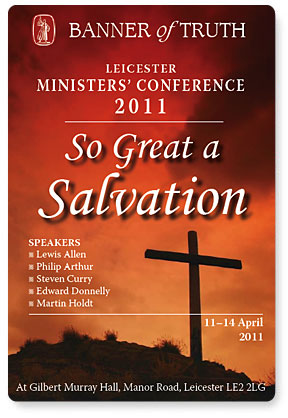
Banner of Truth Leicester Ministers' Conference 2011

Some conferences I attend every now and again, but I always try and make the Banner Ministers' Conference if I can. There is nothing quite like it for preaching that is at its best insightfully expositional, solidly doctrinal and searchingly applicatory. Some of the most powerful preaching I've ever heard has been at Banner; Sinclair Ferguson on Sanctification, Genesis 3:15 and Colossians 3, Ted Donnelly on the Temptation of Christ and Jeremiah. Theology on fire. Historical and biographical subjects are usually done well. Garry Williams' addresses on Jonathan Edwards and John Calvin were outstanding and unforgettable.  I'm looking forward to Phil Arthur's talk on William Tyndale at this year's event. Beyond the excellent teaching it's also good to have fellowship with friends in the ministry and to sample the delights of the discounted Banner bookshop. Scroll down this page for programme details. Note that Iain Murray will be speaking in place of Ted Donnelly, who is still unwell.

Tuesday, May 04, 2010

2010 Banner Conference Report #2


Following on from part 1, here is the rest of my report on Banner 2010:

The Sabbath

On Tuesday morning Ian D. Campbell gave an excellent address on the Lord's Day, waxing all theodramatic, or rather theooperatic, he entitled his message "Sabbath the Opera in Seven Acts". 'New Covenant Theology' types often complain that those who hold to a Christian Sabbath view of the Lord's Day do so on the basis of Puritan confessional theology rather than the teaching of the Bible. Ian D. undermined that claim by adopting a rigorous and bracing redemptive-historical approach. I can't hope to capture the power and impact of this message in these brief notes, but here is a little taster.

1. Before the beginning

God's rest in the tranquility of intertrinitarian fellowship prior to the creation. The Lord's  purpose in creation was that human beings might share in his rest.

2. Creation

Creation is a temple in which the glory of God is revealed. God rested from his labours on the 7th day (Genesis 2:1-3). After being created together with Eve on Day Six, Adam and his wife would have awoken to their first full day together on the Sabbath, enjoying rest and fellowship with God.

3. Sinai

After the exodus, Israel was set apart as God's covenant people at Sinai. The Lord gave his redeemed people the Ten Commandments, including the Fourth Commandment, giving Israel a day of rest.

4. The rest of Canaan

The people of God entered their rest in the land after years of wandering in the wilderness (Psalm 95). In accordance with the laws of Moses, life in the Promised Land was punctuated by a multiplicity of Sabbaths. The weekly Sabbath, the Day of Atonement, the 7th year, the 50th year of Jubilee. At the exile, the land enjoyed its Sabbaths.

5. The Word made flesh: the Lord appears on the Stage

Jesus came not to set aside the law, but that its requirements might be fulfilled in his people, Romans 8:3. He is Lord of the Sabbath, Mark 2:28. As Boaz would not rest (Ruth 3:18) until he had redeemed Elimelech's property and married Ruth, so Jesus, the "restless redeemer" would not rest until he had given rest to his people. It is through his finished work that we find rest. The old covenant Sabbath was buried in the grave with Jesus. He rose from the dead bringing in the new and better day of rest, Lord's Day. Also it was on the first day of the week the Holy Spirit was poured out on the church.

6. The church has entered the Sabbath rest that remains for the people of God

Hebrews 3 & 4. Our rest on the Lord's day is an anticipation of our eschatological rest. New Testament texts that appear to say that the Sabbath rule no longer applies (Romans 14:5-6, Colossians 2:16) do not refer to the Fourth Commandment/Lord's Day, but to the other Jewish Sabbaths that have now been abolished in Christ. If every day alike is in effect a Lord's Day, then no day is specifically set apart by him as holy

7. The Lord of the Sabbath will return

The coming of Christ will usher in the saint's everlasting rest, Hebrews 4:9.

If as Lloyd-Jones said, "Preaching is theology on fire", then this message was "biblical theology on fire", panoramic redemptive-historical preaching at its very best.

Ian D. gave a second message on Wednesday morning entitled, A Sabbath Rest for the People of God: Will That Be Sufficient?, concentrating on Revelation 1:10.

1. The change John witnessed

As a follower of Jesus John witnessed the change from Old Testament Sabbath to the Lord's Day. On the evening of his first Lord's Day the apostle saw the risen Christ in the upper room.

2. The practice John adopted

Even when in exile on Patmos, John continued to observe the Lord's Day as a special day of rest, noting that he was in the Spirit on the Lord's Day. In 1 John the apostle emphasised that sin is lawlessness and that God has saved us so that his righteous standards as revealed in the Ten Commandments might be fulfilled in us. His commandments are not burdensome, including the observance of a day of rest.

3. The blessing John enjoyed

He was "in the Spirit" on the Lord's Day. This suggests the Spirit's revelatory presence as in Ezekiel. But we can also expect that the risen Jesus will meet with us by the power of the Spirit as we gather in worship on the first day of the week, Matthew 18:20. Where Christ is the Father and the Spirit are also present.

4. The message John received

Christ is coming quickly, Revelation 1:7, 22:20. He is coming to take us to be with him for ever, John 17:24.

In Brief

On Tuesday and Wednesday mornings there were brief 15 minute slots. Bernard Lewis, now of Emmanuel Evangelical Church, Newport reflected on his impressions of the Evangelical scene in the UK since his return to this country after many years on the mission field in Papua New Guinea. Jonathan Watson of the Banner gave a talk on Scottish preacher, John Milne, friend of Andrew Bonar and his stress on the importance of the empowering presence of the Spirit in ministry.

Taffia 

The "Taffia" is a fringe meeting of mostly Welsh ministers, traditionally held on the Wednesday night of the conference. In recent years we have tended to meet in my room and things got a bit crowded last time. Looking for somewhere with a bit more space, Downsie blagged a key for one of the conference side rooms, which made for a more comfortable gathering. Enticed by the promise of a plentiful supply of Iron Bru and Pringles, Ian D. Campbell agreed to come along and field our questions. It was a fine time of fellowship as Ian D reflected on church life in the Highlands and islands of Scotland.

Loving the Lord

Ted Donnelly preached the closing sermon on Loving the Lord from John 21:15-17. He opened by reflection on what contradictory creatures we are. We can be wise and yet stupid, kind yet cruel, selfless yet egocentric. Peter like us was a mass of contradictions. The risen Lord dealt with him most graciously after Peter who boldly protested, "I will not deny you" in fact denied Jesus three times. Jesus dealt with his past. The fire he kindled on the beach was a reminder of the fire that blazed in the courtyard on the chilly evening when Peter denied his Lord. Jesus echoed the triple denial by asking Peter three times, "Do you love me?". Peter's past failures were recalled only to be forgiven. Next our Lord clarified the present. The key question, "Do you love me?" was intended to probe Peter's sense of forgiveness, Luke 7:47. Love for Jesus is an evidence of new life, 1 John. Finally Christ was commissioning Peter for the future. He needed to be publicly restored in order for him to exercise his apostolic ministry. Love for Jesus is the most important qualification for Christian service. Only those who truly love Jesus will be able to faithfully feed his sheep.

So, the conference drew to a close with a reminder of what matters most, love for Jesus, the Jesus who graciously  forgives and restores broken failures. I'm sure we all needed to hear that. I know I did.

Reflections

Conference highlights for me were Liam Goligher's first sermon on Monday evening on the Throne of Heaven, Ian D's first address on the Sabbath, O. Palmer Robertson's three messages, and Ted Donnelly's closing sermon. At its best the preaching was mind-expanding, powerful  and challenging, but perhaps more attention needs to be given to direct application of the Word to our ministries.

It was a joy to renew fellowship with old friends and meet some people for the first time. I don't know whether it's me getting less shy and feeling a bit more comfortable in my own skin as I get older, but the conference seems to be more a friendly gathering now than when I first started attending over 20 years ago. A surprising number of men approached me to say that they were regular readers of this blog. One lunch time fellow-bloggers Gary Brady, Jeremy Walker and I had a wonderfully geeky conversation on the finer points of blogging.  Ah well, that's it for another year. Its back to reality now, fortified and encouraged by the ministry and fellowship of the Banner conference. Oh, and the book featured at the top my Banner reports is one of the titles I purchased, The Imperative of Preaching: A  Theology of Sacred Rhetoric, by John Carrick, Banner of Truth Trust, 2002, 202pp.

Contact the Banner of Truth Trust to order recordings of the conference addresses.