Pages

Wednesday, May 27, 2015

Devon & Cornwall break list


1. Plymouth Hoe, drizzle & Drake.
2. Proper pasties with meat chunks & real veg, not gristle & gloop. 
3. Brunel's Royal Albert (Tamar) Bridge. Enough said.
4. Worst public loos in Looe. Unisex & skank.
5. Polperro, quintessence of quaint.
6. Saltram House, Nat Trust. Grand relaxation.
7. Anthony House, Nat Trust. Genteel orderliness & uncultivated beauty.
8. Beat Sarah at Tenpin bowling. Twice. Air Football. Once. 
9. Eden Project, Biomes hot & humid. Ice cream needed. 
10. Saturns Pattern soundtrack. 

Friday, May 01, 2015

Voting intentions


I can't make up my mind whether I'm Red Tory or Blue Labour. I'm a South Walian and so should be Red Labour, I suppose, but I can't be doing with all that Leftist identity politics drivel. My views are progressive in terms of wanting the State to use its powers to lift people out of poverty and increase social mobility, but conservative when it comes to marriage and family life, abortion, euthanasia, and so on. I'm a libertarian when it comes to free speech and don't believe that the law should be used to protect people from feeling insulted or having their views held up for ridicule. But I'm concerned that faith-based views are being squeezed out of the public square in an increasingly secular society. I think that it's only right that the wealthy should pay their fair share of tax rather than do all they can to avoid contributing to the public purse that funds valuable services like health and education. But I also believe in personal responsibility, and that well paid work rather than feckless benefits dependency is the best route out of poverty. Cameron's championing of the Protestant Work Ethic redux on last night's Question Time certainly struck a chord with me. But I don't feel like a Tory and Ukip's 'Little Englander' mentality certainly doesn't appeal.

As is the case with with many people who are not card carrying members of a political party, none of the mainstream parties wholly represent my views in all policy areas. Neither do any the fringe parties for that matter. I don't think supporting 'The Christian Party' is the answer. While believers should take an active interest in politics, government belongs to the 'common kingdom' where Christians rub shoulders with non-Christians, engaging in a whole range of cultural activities, and in which there is often no distinctly Christian take on things. It's no good trying to throw a proof text at whether or not the government should continue to pay its 2% of GDP subs to NATO, or to decide on whether LA maintained schools provide a better education than Academies or Free Schools. Yes, we are instructed to pray for rulers, 1 Timothy 2:1-4. But Paul's petitions concern the freedom of believers to live in peace and proclaim the gospel, not more purely political matters, like whether we'd be better off in or out of the EU.

I suppose it's about choosing the least worst option, having listened to what party leaders have to say, read the manifestos and taken local factors into account. The likelihood of another hung parliament only serves to complicate matters, as the compromise deals needed to garner support for a ruling party inevitably means that some manifesto promises will have to be dropped. Con-Dem, Con-DUP, Con-DUP-Ukip, Lab-Dem, Lab-Dem-Nat-Green, who knows what combination of parties the electoral arithmetic will serve up? 

Anyway, I've pretty much decided who I'll be voting for on May 7th, but wouldn't presume to tell readers how they should cast their vote, bar saying that you'll need to use a stubby pencil to make your mark on a ballot paper in a polling booth near you. Glad to be of service. 

Monday, April 27, 2015

You want the truth? You can't handle the truth

 Image result for election 2015
All we want from our politicians is that they tell us the truth about all the bad stuff they plan to do to the country when we vote them into power. I mean, we'd be more likely to elect a Conservative government if we only knew which poor slackers are going to bear the brunt of spending cuts. And hey, Ed, we'd not hold political fratricide against you if you were straight with us on how much the national debt is going to balloon because your lot isn't going to cut as much as those heartless Tories. C'mon tell us, added interest payments n'all and even Scottish Socialists will come flocking back to you singing, 'We'll keep the Red Flag flying here. Och, aye'.   

OK the Greens are more straight up, telling the electorate exactly what they'd do in the unlikely event of a landslide that increased their tally of MPs from 1 to 350. They'd ban the bomb, nationalise stuff, make global warming go away and solve the immigration crisis by making sure that Johnny foreigner was so happy in Libya and Somalia that they wouldn't even think of coming to good ol' Blighty. But let's face it, Greens are just commies who recycle. Who wants that? Really. 

'Tell  us the truth' we say, but we can't handle the truth. At least not too much of it and our politicians know that. The same applies in the spiritual realm. People reject the Christian message in the name of a free thinking quest for truth. But what they are really doing is fleeing from the truth that they are accountable to the God who made them. Much better to delude ourselves that, 'I am the master of my fate and the captain of my soul' and bellow out, 'I did it my way', than acknowledge our human frailty and fallenness. 

The truth is often painful and uncomfortable. Whichever combination of parties win power at the General Election there will be tough times ahead as the nation struggles to live within its means. The 'anti-austerity' line spouted by Nats and Greens is a fine sounding mantra, but put it into practice and Greece is the word. The Christian faith doesn't seek to butter us up by telling us that all's well with the world and things would be even better if we were all a little bit nicer. The world is broken with evil, oppression, suffering. And we don't have the answer. And we are part of the problem. To took at ourselves in the mirror and confess, 'I have sinned' is to begin to handle the truth.

But the 'sinner thing' is one of the factors that makes Christianity so unpalatable. Although we all live our lives with the tacit understanding that it is an accurate description of our human condition. Why bother with democracy with accountable political leaders, constitutional checks and balances, the rule of law, personal freedom etc? Why not get rid of the whole caboodle, leadership debates n'all and install a Great Man to rule and give him all the power he could wish for to get things done? Because as it has been said, 'power corrupts and absolute power corrupts absolutely'.

We know full well that given human fallenness, dictators can't be trusted to use their power benignly for the common good. When a culture ignores the stubborn reality of sin and begins to dream Utopian dreams that involve giving massive power to to unaccountable leaders for the betterment of the world, the result is always despotism and disaster. That's why Bolshevik Revolution started with off Lenin (not that he was that nice) and finished up with Stalin. Ironically one of the best bulwarks against totalitarian madness is a belief in human captivity to sin that insists on the separation of powers and the establishment of rigorous systems of accountability in the body politic.

So what's the answer to the fact of human sinfulness to which history and our own personal experience bear their tragic testimony? It's this. The God against whom we have sinned and whose judgement we deserve sent his Son into the world as one of us. He was born of woman, lived a sinless human life and was crucified, bearing the weight of the world's sin upon his shoulders. Jesus was his name. His Cross at once exposes our inability to save ourselves and demonstrates the costly love of God towards sin-ruined humanity. He was condemned that we might be justified. He was forsaken by God that we might be reconciled to him. He died in weakness that we might live by the power of his grace.

But this message of salvation through the Son of God crucified for us is hard to take on board. The preaching of the cross is an offence to the religious and foolishness to the intelligentsia. You want the truth? Here's the thing: 'Christ Jesus came into the world to save sinners' (1 Timothy 1:15). That's it. The question is, 'Can you handle the truth?'   

Sunday, April 19, 2015

Bible-centred church: Running a church in the biblical way by John Temple

Bible-centred church: Running a church in the biblical way,
 by John  Temple, Day One, 2014, p. 144

Someone or other sent me this book for free in the post. Can't remember who it was, or why, but it seems I'm not the only one. A friend at the Banner Conference said that he had also received a copy. Whoever it was, thanks. Although I have to confess that had I not been sent a freebie, I probably wouldn't have read the book. It's a bit 'how-to-ey' for my liking, but has the advantage of being concise and carry-aroundable. That was a real plus when looking for something to bring with me to while away time when taking my daughter to Uni interviews. Man bag busting, shoulder aching tomes of theology wouldn't have done the trick.

The author argues in favour of an eldership team-led, gathered church model of ecclesiology that is grounded in the teaching of Scripture. In his handling of the biblical materials Temple makes helpful distinctions between precepts, principles, precedents, guidelines and freedoms. He clearly sets out what the Bible has to say on the role and appointment of elders and deacons and gives attention to some of the practicalities of church life. He is good on the flow of authority in the church from Christ though the elders to the deacons and church members. 

However, I didn't always agree with Temple's conclusions. For example, he reasons that only existing elders should appoint additional members of the team, which gets him into some difficulty when it comes to planting a new church that has no elders. The biblical pattern seems to be that the local church appoints new elders in accordance with guidelines laid down in 1 Timothy 3 and Titus 1 and subject to the oversight of the existing eldership if there is one. In Acts 14:23 we read that Paul and Barnabas 'appointed elders in every church'. The churches existed prior to the appointment of elders and in the original the word translated 'appointed' means 'elected by show of hands'. Which suggests that under the oversight of Paul and Barnabas church members elected their own elders. 

Also the writer argues in favour of female deacons. While I certainly value and honour the work of women in the church, I don't think that 1 Timothy 3 supports female deacons. For one, the deacons should be 'husbands of one wife'. which kind of assumes that they are men. On the subject of deacons, Temple argues deacons are simply individuals with a special serving role in the church, unlike the eldership team, they do not constitute a body; 'the diaconate'. But what's to stop deacons meeting together to co-ordinate their activities, subject to the oversight of the elders?

The book provides a model Constitution, which by-and-large reflects biblical principles, includes wise practical counsel on procedural matters and complies with the legal niceties. Speaking personally, I wouldn't accept 9.3 Special Members' Meetings without some amendment. Our Providence Baptist Church Constitution allows for a weighted proportion of church members to call for a Special Members' Meeting, but it is made clear that an elder, ideally the pastor should chair that meeting, not, as Temple suggests, whoever a simple majority of members elect for the occasion. The elders' oversight of the church should extend to Special Members' Meetings and that should be reflected in the who gets to chair the meeting. 

If I've been somewhat critical, it's not because I take delight in churlishly looking this gift horse of a book in the mouth. Neither does it mean that I didn't find it helpful. Overall it was. I certainly agree with Temple's basic thesis that the eldership team-led, gathered church model presented here has biblical sanction. But perhaps Running a church in a biblical way would have been a more modest and accurate subtitle. The inclusion of the definite article claims more than can be justified for all the points made in this book. And there is more to being a Bible-centred church than getting church government right. As I'm sure the author would admit, the Bible must not only give shape to our church government, it must re-shape the lives of the people of God by refocusing them on the Christ-centred gospel to which Scripture bears witness so powerfully. 

Friday, April 17, 2015

Banner Conference 2015 Report 1

Banner speakers and grandees 
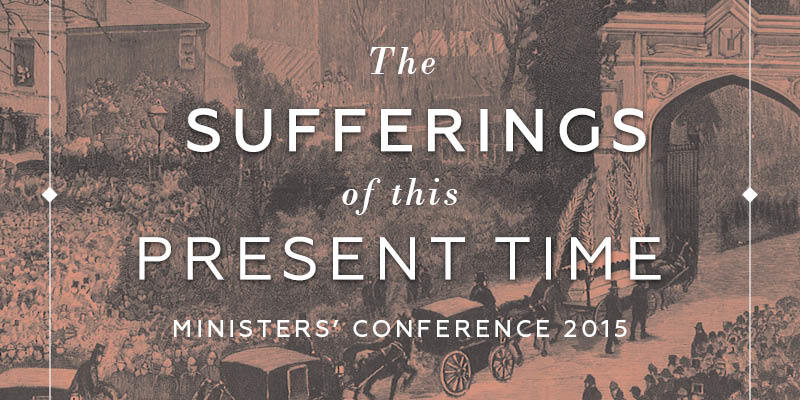
The theme of this year's Banner Conference was 'The Sufferings of this Present Time' and in one way or another most speakers addressed the theme of suffering and the Ministry. My notes are a little threadbare and patchy and can't really give much sense of the power of the messages delivered, but there we are. Such as I have I give unto you. I wasn't intending to take any notes at the start of the conference, but my urge to scribble things down grew as it unfolded. They are a bit staccato in style, reproduced with light editing from jottings on a Notes app on my phone. These reports (a 3 part series probably) don't strictly follow the programme as it developed over the four days of the conference. They are grouped together by speaker. 

Hywel Jones, who was Principal at the London Theological Seminary at the time I studied there (1988-90) was meant to be giving the opening and closing addresses, but due to ill health in his family he had to pull out. Instead the conference was topped and tailed by son-in-law and father-in-law double act, Gary Brady and Geoff Thomas. 

Gary spoke on 1 Peter 2:7, 'Christ, Precious to Believers', setting up the conference well by drawing our attention to the preciousness of our Lord and Saviour, Jesus Christ. Geoff's finale was on Romans 3:23, 'The Plight of Man and the Power of God'. In a searching message, the veteran Aber preacher showed us that: 1. Sin is inward. Reaching to the very core of our being and producing the sinful desires that manifest themselves in sinful conduct, 2. Sin lords it over our lives. Like a snake charmer who thought he had control of his boa constrictor, only for it to choke the living daylights out of him. 3. Affects every part of us. We are totally depraved by sin. Not that we are as bad as could be, but that the whole of our personality is affected by sin; our intellect, and even the conscience. 4. The wages of sin is death. God's judgement on a sinful world. ISA atrocities. Moral corruption of Western culture. The history of our personal sinfulness. Only Jesus can save us from sin. The message was a powerful reminder of why we have been called to preach the gospel, and why we are in desperate need of that message ourselves.  

Stuart Olyott gave two addresses. 

Address 1: 'Yes, it is hard, sometimes very hard, but . . . Paul’s testimony (2 Corinthians 11-12)'. Stuart spoke on Paul's record of his sufferings in these chapters by way of contrast to the trouble free 'super apostles'. We should ordinarily Refrain from speaking of our sufferings. Paul was reluctant to do so, and only did for the benefit of others, not to have a good moan. We should Reflect that our sufferings are nowhere near as bad as Paul's as listed in these chapters. Finally we should Refuse to give the impression that we are spiritual supermen who know little of trials and suffering. Grace is made perfect in weakness. 

Address 2: 'Yes, it is hard, sometimes very hard, but . . . Paul’s counsel (2 Corinthians 4)'. Now the preacher walked us though the chapter under the headings: Wow look  at what 2 Corinthians 4:1-6 has to say about Christ, the Gospel, the devil, conversion and true gospel preaching. Ow, 2 Corinthians 4:7-12 tells us that the treasure of the gospel is in jars of clay, proclaimed by weak human beings. Vs. 7 explains why. in vs, 8-12 Paul has a list of contrasting parallels. Ministers are under pressure. Prep deadlines. Pastoral responsibilities. We can't do it, but Jesus can. The life of Jesus is manifested in us. Finally, Now, we believe and therefore speak (vs 13-18), what we believe, vs. 14. Inward renewal despite outward decay, vs. 16. Seen in elderly Christians whose minds have gone, yet they respond to Scripture and hymns. Our troubles are put into perspective by eternity, vs. 17-18. 

Classic Olyott. Clear and easy to follow messages, shot through with insight, humour and telling application. Best joke. He was accused of being a modernist by a Premil while ministering in Switzerland because of his Amil views. 'The Lord bless Premillenialists...with understanding.' 

Next up, some notes on addresses given by Kevin DeYoung and Mike Reeves.  

Sunday, April 12, 2015

Eight days later

We saw him.
He is risen.
Don't believe you.

Dust remains dust.

But it was him.
He lives.
I must see to believe.

Dust remains dust.

Thomas,
Probe my wounds,
It is I.

See and believe.

My Lord and
my God.

The first man was of dust.
The second man was of heaven,
A life-giving Spirit.

Blessed are those who
have not seen,
and yet have
believed.

Saturday, April 11, 2015

Banner Ministers' Conference 2015


I'm very much looking forward to next week's Banner Conference. Always a great time of fellowship and ministry. Here's the rather appetising 'menu':

Monday, 13th, April

  • 5.15pm – Opening Sermon – Christ, Precious to Believers – Gary Brady
  • 8.15pm – Jesus, Our Hope and Example in the Midst of Injustice (Mark 15:16-32) – Kevin DeYoung

Tuesday, 14th April

  • 7.25am – United Prayer
  • 9.15am – Yes, it is hard, sometimes very hard, but . . . Paul’s testimony (2 Corinthians 11-12) – Stuart Olyott
  • 11.15am – The Puritan theology of suffering – Michael Reeves
  • 5.00pm – Reports Session
  • 8.15pm – Praying in Pain (Mark 14:32-52) – Kevin DeYoung

Wednesday, 15th April

  • 7.25am – United Prayer
  • 9.15am – Ten Minute Address
  • 9.30am – Yes, it is hard, sometimes very hard, but . . . Paul’s counsel (2 Corinthians 4) – Stuart Olyott
  • 11.15am – The Impassibility of God, the Sufferings of Christ and Good News for the Christian Hebrews (Hebrews 2:5-18) – Kevin DeYoung
  • 5.00pm – ‘To proclaim my name; to suffer for my name’ – Alan Davey
  • 8.15pm – Faith amid suffering in the life of Charles Spurgeon – Michael Reeves

Thursday, 16th April

  • 7.25am – United Prayer
  • 9.15am – The Bruised Bride – Jeff Kingswood
  • 11.00am – Closing Sermon – The Plight of Man and the Power of God – Geoff Thomas

Thursday, April 02, 2015

Jesus: A Reason for Hope

Image result for empty tomb
Hope realised

‘Well, you can always hope’ we sometimes say. Especially when things look quite hopeless. Hope can sometimes seem such a fragile thing when set against the stark reality of life with its disappointments and disasters. ‘You’re hoping’ is another one, by which we mean, ‘Get real and expect the worst’. Such pessimism might be excused given what’s happening in the world right now, with Russia flexing its muscles and the threat of Islamic terrorism looming large across the world.

It seems that human beings fail to learn the lessons of history and are doomed to keep on repeating its mistakes. But the situation is not hopeless. God promised that he would send someone to rescue us from sin and suffering. And that someone is Jesus. When he came into the world he specialised in giving hope to the hopeless. He healed people of incurable diseases. He promised forgiveness to people overwhelmed with guilt. He spoke of eternal life to people who lived in fear of death. The deepest human hopes were realised by Jesus.

Hope ruined

Jesus’ followers began to hope that their Master was the One who would make the world a better place, where kindness prevailed over cruelty and love over hate. But people turned against him. They took the very embodiment of hope and nailed him to a cross. As he hung and suffered there Jesus cried out, ‘My God, my God, why have you forsaken me?’

When Jesus’ followers took his lifeless body down from the cross and laid it in a tomb their hopes perished with him. At least that’s how it seemed to them at the time.

Hope reborn

On the first Easter Sunday morning some of Jesus’ disciples went to visit his tomb. To their surprise and amazement thy found it empty. The body of Jesus had gone. Some thought that his remains had been stolen away. But Jesus had not been a victim of grave robbery. Rather, he had been raised from the dead. Later that day he appeared to his followers and showed them the marks of crucifixion in his hands. He explained that his death on what we call ‘Good Friday’ was not a tragic accident. It was all part of God’s plan that Jesus would lay down his life for the sins of the world. He was forsaken by God that we might be reconciled to him.

Jesus lives. He has broken the power of death by his death and resurrection. The Christian has been ‘born again to a living hope by the resurrection of Jesus Christ from the dead.’ (1 Peter 1:3). Life in this world can sometimes seem quite hopeless, but those who believe in the living Lord Jesus have a reason for hope.

Monday, March 23, 2015

Coming soon: The Pastor as Public Theologian by Kevin J. Vanhoozer & Owen Strachan (and me)


I've long been an admirer of Kevin Vanhoozer's work and look forward to the publication of this title in August. Includes a contribution by yours truly on The Drama of Preaching, see here

Tuesday, March 03, 2015

Affinity Theological Studies Conference 2015 Report

Last Wednesday to Friday I attended the Affinity Theological Studies Conference. Many conferences aimed at Ministers and theological students take place annually. The Affinity one is biennial, which kind of makes it seem special. But that is not its only distinction. Most conferences involve very little actual conferring aside from general chit chat at meal times, or coffee-fueled late night conversations with friends. Confer-ences they are not. And even when panel-led discussions are laid on in an attempt to facilitate interaction they don't really work. It's a bit like BBC Question Time with Dimbleby on rambling form and no one especially interesting or controversial on the panel to liven things up. Plus tiresome and predictable questions from the audience. 'Why can't we all be Presbyterians?' and the like. 

The Affinity event is different, however. It's a proper conference with discussion at its heart. Papers are circulated to delegates beforehand. At the conference authors don't deliver their papers in full, but briefly introduce them in preparation for the discussion sessions.

This year's theme was Union with Christ. See here for a breakdown of the papers and their authors. I'm not going to attempt to summarise them here, as they will be published in due course in Affinity's online theological journal, Foundations. Suffice to say that all were of excellent quality as to content. Most were of reasonable length, which was handy as I hadn't managed much reading before the event and had to get through the papers during free time. A mammoth 36-pager defeated my best attempts at speed reading late on Thursday night, but I managed to get through most of it. One lacuna was the eschatological aspect of union with Christ. Most papers hinted at this dimension, but none were entirely devoted to it. Perhaps the next conference can make good by looking at biblical eschatology? We can always hope.

As far as discussion is concerned delegates were grouped into six groups of around eight people, each with its own chair. Our group gelled well, with lots of good quality theological discussion and reflection on how to apply the teaching of the various papers in our ministries. Speakers are divided up one per group, meaning each group gets to grill a one in turn. Ours was Bob Leatham whose paper on John Calvin and union with Christ prompted in-depth discussion on the Lord's Supper and theosis

After the group discussions delegates come together for plenary sessions. A panel discussion brought the conference to a close. Unusually, even that worked well. When David Dimbleby eventually retires the BBC should get Stephen Clark to chair Question Time

Several people were kind enough to mention that they read this blog, which I've rather neglected of late. Pastoral commitments, school governor work and family stuff have left me with little time for posting displaced fragments. But taking the wife to a hospital outpatients appointment meant I was able to snatch a few spare moments in the waiting room to begin composing this piece on my mobile. 

Given the conference theme I must admit to a twinge of disappointment that on Sunday I was due to preach on Nehemiah 11, rather than John 15 or Colossians 3, say. But on the other hand, I reflected, how could I preach that chapter meaningfully to the New Testament people of God apart from the interrelated themes of the covenant of grace and union with Christ that make the Old Testament Scriptures applicable to today's church? 

I left the conference with an enriched sense of the wonder of the believers' union with Christ and the blessings that flow to us in and through the Saviour, Ephesians 1:3.