Pages

Wednesday, January 16, 2013

To Affinity and beyond!

Right then, later this morning I'll be hitting the road and heading off to the Affinity Theological Studies Conference on The Bible and Ethics. I managed to read all six papers and am looking forward to chewing the fat in the discussion sessions. Some papers have raised controversial points, so there shouldn't be any problem in generating debate. I'll hopefully post a report when I get back.

Monday, January 14, 2013

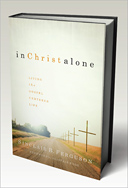
In Christ Alone: Living the gospel centred life by Sinclair B. Ferguson

In Christ Alone by Sinclair Ferguson

It's long been my practice to leave a book in the car that I can read when waiting for a doctor's or dentist's appointment or something. That way waiting time isn't wasted time. However, since investing in an Android tablet, loaded up with the Kobo e-Reader, I've been grabbing the tablet when I expect to be waiting around for a while. I've invested in several e-Books, usually at knock-down prices, but one of the first I downloaded was In Christ Alone by Sinclair Ferguson. It was going for only £0.99 at the time. Unbelievable. The title is really great for occasional reading, when you've got five or ten minutes to spare, as it's made up brief and punchy chapters that get straight to the point. 

If you are not already acquainted with Sinclair Ferguson's writings, then this might be a good place to start. You couldn't wish for a better theme than life in Christ and the theologian certainly warms to it. This title is informed by the theological acumen and exegetical skill that we have come to expect from Ferguson's pen, or keyboard more likely. But especially here, his gifts as a theologian and biblical scholar are at the service of a pastor-teacher with a keen desire to help the people of God live out of the fullness of their union with Christ.

Ferguson draws on the riches of God's Word to paint a fine portrait of the person and work of the Saviour. He is the second person of the Trinity, the Word made flesh for us and our salvation. He is our Prophet, Priest and King. He died for our sins and was raised from the tomb that we might live through him. In Christ we receive the gift of the Holy Spirit. By virtue of our union with him we are justified and called to a new life of faith and holiness. Ferguson gives attention to the practicalities of life in Christ, devoting pithy chapters to matters such as prayer, guidance, the mortification of sin, Christian liberty and humility in service. In the the final chapter we are given a glimpse of the rest that remains for the people of God.

This work is Ferguson at his best. In Christ Alone is theologically profound without being complicated, devotionally warm without being sentimental and practical without being a spiritual self-help manual. When reading I often had to pause and silently worship the Christ who brought me into saving union with himself by his Spirit and into communion with our God and Father. I doubt reading Hello magazine or a leaflet on the health benefits of tea while waiting for an appointment would have have the same effect. Highly recommended. 

Friday, January 04, 2013

Stephen Charnock on Christ and the theodrama

I know that posting quotations isn't proper blogging, which should involve at least some original writing. It's just typing stuff out. But I couldn't resist this one, which I came across when reading A Puritan Theology: Doctrine for Life, by Joel Beeke and Mark Jones. Puritan divine, Stephen Charnock sounds a bit like a seventeenth century version of theodramatist-in-chief, Kevin Vanhoozer (interviewed here). Charnock places Christ at the dramatic centre of the communicative action of God,  
Christ is the stage wherein all the attributes of God act their parts. (From Charnock, The Knowledge of Christ, in Works; 4:139). 
As Vanhoozer more recently put it,
Thinking of doctrine in dramatic rather than theoretical terms provides a wonderfully engaging and in integrative model for understanding what it means to follow – with all our mind, heart, soul and strength – the way, truth and life embodied and enacted in Jesus Christ. (From Vanhoozer, The Drama of Doctrine, p. 16.)
Admittedly, for Charnock  drama is a one-off handy metaphor, rather than the key idea that shapes his theologizing, but is is interesting to note this Puritan precedent for Vanhoozer's  theodramatic proposals.

Kevin Vanhoozer's follow up to Remythologizing Theology is  Divine Action and Providence, his contribution to Zondervan's promising looking 'New Studies in Dogmatics' series. 

Thursday, January 03, 2013

The blog is mightier than the tweet

Blogging increasingly seems like the elderly relative of the new media family. Young uns prefer to Tweet and update their Facebook status. But there is only so much that can be said in  Twitter's 140 character limit and  a Facebook status doesn't lend itself to a anything longer than a sentence or two. There is something to be said for articles that can explore subjects in a more reflective and considered way. Blogging is just the thing for that. John Stevens is master of the lengthy blog post.

That said, if my blog is anything to go by, most of my readers apparently prefer to access my blog content via Google Reader, email subscription or Facebook and Twitter feeds rather than visiting Exiled Preacher directly. With its longer posts, Blogger remains distinct from Facebook and Twitter, but feeds enable the grand old man of social networking to mix it with the new kids on the block. I probably get more comments and feedback on my blog posts on Facebook than on blog itself. 

Unbelievably, Exiled Preacher has been going for around seven years. I don't blog as frequently as I once did, but I continue to enjoy posting items on a reasonably regular basis. I probably do more personal newsy stuff now than I used to, but I still like to post up book reviews, theological reflections and do the occasional current affairs comment piece. Blogging is also a great format for interviews, of which I've done several. If I've written something for a local paper/magazine, Evangelical Times, or a theological journal it'll usually end up on the blog. Cyber-recycling.

So, I'll probably keep posting my displaced fragments from an exiled preacher. For the time being anyway. 

Tuesday, January 01, 2013

So, that was Christmas (and New Year)

Pre-Christmas was the usual whirl of activity. On the last day of term, Friday 21st December I did the Bible reading at the town's secondary school Carol Service, Luke 2:1-20. Last January I became a parent governor at the school, where our two are in years 11 & 13. Then we had an encouraging 'Evening with Carols' at a local sheltered housing complex on Friday evening. It was good to have some visitors come along to the Carol Services of both churches I serve on the Sunday before Christmas.

With schools breaking up on the Friday before Christmas, the 'Big Day' seemed to arrive with little warning. We'd done most of the shopping, but that left quite a bit of pressie wrapping to do. All seems a bit of a blur now. Had some nice presents, mostly clothes and some other bits and pieces. A  navy blue Ben Sherman Harrington jacket will help complete the midlife crisis ageing-mod look.

Preached on Isaiah 9:6 Christmas morning, emphasising God's gift of Jesus, "unto us a Child is born, unto us a Son us given". Quoted Thomas Goodwin's wonderful mash-up of Isaiah 9:6 and 1 Corinthians 1:30:
For would we have peace of conscience and the guilt of sin removed? He is the “Prince of Peace”, and is made “righteousness” unto us. Are we in depths of distress, terrors within, terrors without, out of which we see no redemption? He is the “mighty God;” “able to save to the utmost,” being made “redemption” to us. Want we grace and his image to be renewed and increased in us? He is “the everlasting Father;” a father to beget his likeness in us, and everlasting to maintain it [for] ever, when it is begun once: he is made “sanctification” to us. Want we wisdom to guide us? He is the “Counsellor,” and is made wisdom to us. All we want he has, even as all he has we want.
Not  sure that the old Puritan would approve of Christmas, but there we are. 

Wanted to go for a walk on  Boxing Day, but it was raining pretty heavily. So, we decided to have a game of  Monopoly. We've got the newfangled set where you use credit cards rather than cash. My daughter won, accumulating over £130 million. Something like that anyway. 

Managed to get out for a walk the day after. Sarah and I went for a wander around Shear Water, a local beauty spot. 

On Friday we went to Wales and had a lovely time seeing my family. My mum and sister and her family still live in the village where I was brought up. Always good to see Bassaleg again. On the way home we went to IKEA in Bristol and bought some stuff. Never been there before. Good quality. Cheap. Quite impressed. 

On Saturday we headed for London, partly to see Sarah's family and partly because I was booked to preach at Stanmore Chapel on the Sunday. The pastor is Colin Leyshon, who I first met when studying at LTS in 1989. Preached on Galatians 4:1-7 in the morning and Romans 8:35-39 in the evening. I struggled a bit in the morning, but felt more free in the later service. While we were away I finished the Kindle version of In Christ Alone by Sinclair Ferguson. It was only £0.99 from Amazon. A very helpful read at bargain basement price. Look out for a review soon. 

Back home on Monday. Went to a New Year's Eve party at Barnaby and Verity Alsop's place. Barnaby, another member of the 'LTS Mafia' is pastor at Bulford Chapel. We had a good time, eating, drinking and chatting away merrily. We played Monopoly Deal, a playing card version of the board game. Fun, even though we didn't win.

My reading highlights for 2012 were Herman Bavinck's Reformed Dogmatics Volume 3 and Iain Murray's moving biography of Archibald Brown. I hope to get through a sizeable chunk of RD Vol 4 this year. It's the biggie of the set. Over 900pp. On my 'to read' shelf I have What is Jesus doing now? by my good friend Gary Brady (to be reviewed for ET), The Mission of God, by Christopher Wright and some other stuff, including a volume of Dietrich Bonhoeffer's sermons. I've caught the e-reading bug and like to snap up Kindle special offers when I can. I've made a start on Puritan Theology: Doctrine for Life by Joel Beeke and Mark Jones and downloaded Pillars of Grace, by Stephen Lawson. I got the former for only £6.48. It is now £19.27 for the Kindle version, £34.40 hardback.  The early bird... and all that.

Who, but the Lord knows what 2013 holds for us? We trust in him and in his name we go forward into a new year. 

Friday, December 21, 2012

Ernest Kevan Leader in twentieth century British Evangelicalism, by Paul E. Brown


Ernest Kevan: Leader in twentieth century British Evangelicalism,
 Paul E. Brown, Banner of Truth Trust, 2012, 294pp

Ernest Kevan is best known as the founding principal of London Bible College, or London School of Theology as it is now called. He was also the author of a significant work on the Puritan theology of the law, entitled, The Grace of Law. Beyond those two facts, I don’t suppose many readers will know much about the subject of this first-rate biography. I certainly didn’t. Paul Brown has done the Christian world a service in rescuing Ernest Kevan from a measure of undeserved obscurity. The author studied at the London Bible College under Kevan.

Brown delves into his family history and charts the spiritual influences that by God’s grace helped to make him the man he was. Before becoming principal of London Bible College, Kevan was a Strict Baptist pastor. The Lord’s blessing was evident in the churches where he preached. Kevan was keen to engage the communities that surrounded the churches he served, offering practical help to those in need as well as proclaiming the gospel. Although he and his wife, Jennie were not blessed with children, Ernest head a great heart for little ones and his children’s talks were legendary for their clarity and winsomeness.

Kevan was an important figure in the resurgence of Evangelical and Reformed Christianity in the post-war period. What Martyn Lloyd-Jones was doing in his Westminster Chapel pulpit, Kevan was doing from his London Bible College lectern. Both men exposed a new generation to the riches of Puritan and Reformed theology. That’s not to say that Kevan and Lloyd-Jones always agreed. The former was more comfortable working with the theologically mixed denominations that the latter. Lloyd-Jones was critical of London Bible College offering the London University approved BD degree. The Westminster Chapel preacher would have nothing to do with the Billy Graham Crusades of the 1950’s. Despite Kevan’s misgivings concerning the Evangelist’s appeals for people to come forward and make a profession of faith, he penned some useful booklets that helped to ground new converts in the faith. While the ‘Doctor’ declined invitations to speak at the Keswick Conference due to its adherence to a faulty doctrine of sanctification, Kevan spoke there on a number of occasions. His addresses on Romans encouraged the conference to move away from its traditional ‘Higher Life’ teachings. It is interesting to ponder whether Kevan's "in it to win it" or Lloyd-Jones' "They shall turn to you, but you shall not turn to them." approach proved more effective. 

At Kevan’s memorial service John Stott remarked on his ‘strength and gentleness’, two qualities that are not always found in the same person. Kevan was a scholar with a pastor’s heart, the best kind of man to lead a Bible College. At a time when Evangelical scholarship was virtually regarded as a contradiction in terms he showed that it is possible to be theologically conservative and intellectually rigorous. He was indeed a key leader in twentieth century British Evangelicalism. He bold, yet gracious witness to the truth should not be forgotten.

Reviewed for Protestant Truth. 

Thursday, December 20, 2012

Affinity Theological Studies Conference 2013: Handling the Bible Ethically

Affinity logo

The Affinity Theological Studies Conference is due to take place on 16-18 January 2013. I attended the last one on 'The Doctrine and Function of Scripture in the 21st Century' back in 2011 (see here). During our discussions it emerged that more work needed to be done on biblical ethics in the contemporary context, hence the theme of next year's event. It is a proper conference, rather than a preaching-fest. Papers are circulated beforehand (I've already received my copies) and there are opportunities for discussion in small groups, plus plenary sessions. Here's the low-down:   
Paper 1: Natural Law in Scripture
Exploring multi-faceted aspects of natural law in the Bible
Stephen Clark
Director of EMW Theological Training Course and part time Lecturer at London Theological Seminary.

Paper 2: The teaching of Jesus & the NT
Exploring themes of continuity and discontinuity between aspects of ethical teaching in the ancient world and NT
Joshua Hordern
University Lecturer in Christian Ethics, University of Oxford

Paper 3: Psalms as Torah
Exploring the Bible’s ethical teaching in the Psalms
Gordon Wenham
Old Testament Tutor, Trinity College, Bristol
Paper 4: It’s A Rich Man's World? 
Exploring the biblical material on money, wealth and economic justice
Andrew Hartropp
Church minister, economist & Research Tutor at the Oxford Centre for Mission Studies
Paper 5: War and Peace
Exploring the ethics of war, 'undercover' operations, torture etc.
Paul Helm
Theologian, philosopher & Teaching Fellow at Regent College, Canada
Paper 6: Bioethics
Exploring issues at the beginning and ending of life
Leonardo De Chirico
Church planter, theologian & ethicist in Rome, Italy

Tuesday, December 18, 2012

What love is this?

Swaddling band, Italy 1590-1600 Museum no. B.878-1993


O Father, what love is this?
You sent your only Son,
forever wrapped in love,
to take our bone and flesh,
born of woman by the Spirit's power,
and wrapped in swaddling bands,
to suffer and die for us,
the just for the unjust,
that we might be wrapped
in his righteousness.
O Father, what love is this? 

Thursday, December 13, 2012

Christmas and the Trinity


If it is true that all three divine persons are involved any act of God, then the incarnation of the Son involved the whole Trinity. That does not mean that the Father and the Holy Spirit as well as the Son became incarnate. It was fitting that the Son as the image of the invisible God became man, created in the image of God according to his human nature. 

But the Son did not become incarnate apart from the Father and the Holy Spirit. The Father sent the Son into the world as man and sustained, taught, guided and empowered him by the presence of the Holy Spirit. The purpose of the incarnation was that Christ might redeem us from sin by offering himself without blemish to God through the eternal Spirit. The Father raised his Son from the dead by the Spirit of holiness and by that same Spirit exalted Christ to his right hand in glory. The glorified Jesus poured out the Spirit from the Father upon the church on  the Day of Pentecost. 

Through the Son the godhead bears the impress of Jesus' human experience of humiliation, sorrow and death. Our triune Lord remembers our frame, knowing that we are dust. The Holy Spirit as the Spirit of Christ, who groaned under the burden of our fallen world, makes intercession for us with groanings that cannot be uttered.  The Father of the suffering Son's ear is ever attentive to the cries of his children. His tender hand will wipe all tears from their eyes.

Believers will share in the glory and exaltation of the incarnate Son. He, as the life-giving Spirit will raise them from the dead, transform them into his image and welcome them into his Father's house. There they will dwell with the Triune God for ever. Christmas is the gift of the Trinity.