Pages

Thursday, March 30, 2006

Did Jesus know that he was God?

In my review of Brian Edgar's The Message of the Trinity here, I take issue with his statement,

if [Jesus] was aware of being God, could he live a life of faith and trust as every other human is called to do? Would the incarnation not be somewhat like the experience of the crew in Star Trek who, when visiting an alien planet could, in moments of danger, call out, 'Beam me up, Scotty!' and be miraculously...transported back to the safety of the starship. (p. 162)

I indicated that I would like to devote a post to considering this issue. Was Jesus, in his human mind, conscious that he was God?

The gospel accounts seem to suggest that Jesus was aware that he was God the Son. He did things that "only God could do" like forgive sins (Mark 2:5-11) . He claimed to stand in a unique relationship to the Father as knower and known. As such he saw himself as the unrivalled revealer of God.

All things have been delivered to Me by My Father, and no one knows the Son except the Father. Nor does anyone know the Father except the Son, and the one to whom the Son wills to reveal Him. (Matthew 11:27)

It seems that the devil tried to use Jesus' awareness of who he was to tempt him to use his powers in a selfish, God-denying way (Matthew 4:1-11).

If Jesus was not conscious of being God the Son, what to we make of the following statements?

For as the Father raises the dead and gives life to them, even so the Son gives life to whom He will. For the Father judges no one, but has committed all judgment to the Son, that all should honor the Son just as they honor the Father. He who does not honor the Son does not honor the Father who sent Him. (John 5:21-23)

Jesus exercised God's own prerogative of judgement. He, as the Son demanded to be honoured on the same terms as the Father. He was "making himself equal with God", as the Jews rightly perceived (5:18).

I and My Father are one. (John 10:30)

“If you had known Me, you would have known My Father also; and from now on you know Him and have seen Him.” Philip said to Him, “Lord, show us the Father, and it is sufficient for us.” Jesus said to him, “Have I been with you so long, and yet you have not known Me, Philip? He who has seen Me has seen the Father; so how can you say, ‘Show us the Father’? Do you not believe that I am in the Father, and the Father in Me? The words that I speak to you I do not speak on My own authority; but the Father who dwells in Me does the works. Believe Me that I am in the Father and the Father in Me, or else believe Me for the sake of the works themselves. (John 14:7-11)

Jesus was conscious that he was one with God. The Father was "in" him and he was "in" the Father. To see the human Jesus was to see the Father because the Son is homoousion - of one substance with the Father.

And now, O Father, glorify Me together with Yourself, with the glory which I had with You before the world was. (John 17:5)

Jesus, in his human mind, was aware of his pre-existence as the glorious Son of God who dwelt with the Father before the world was.

Edgar suggests that if Jesus knew that he was God, he would not have needed to exercise faith. But Jesus trusted in God and prayed to him continually. Luke's Gospel especially emphasises the importance of prayer for Jesus. He was aware of his human frailty and need as well as his divine glory.

N. T. Wright reflects,

I do not think Jesus "knew he was God" in the same way that one knows one is tired or happy, male or female. He did not sit back and think to himself, "Well I never! I'm the second person of the Trinity!" Rather, "as part of his human vocation, grasped in faith, sustained in prayer, tested in confrontation, agonized over further in prayer and doubt, and implemented in action, he believed that he had to do for Israel and the world, that which according to scripture only YHWH himself could do and be." (The Meaning of Jesus, Wright & Borg, SPCK, 2003, p. 166).

But, perhaps we can go futher than that. Jesus knew that he was Man with a human intellect, a human emotional life and a human physicality. He was profoundly aware of his human needs and limitations. But he also knew that he was the Son of God, one with the Father from eternity and deserving of equal honour to the Father. In his human understanding, Jesus was conscious of his humanity and deity.
.
None on this means that in Jesus there are two self-consciousnesses, but it does mean that there are two levels of consciousness of the one self. There is a divine consciousness that he is the eternal Son of God and there is a human consciousness of the same fact. These two forms of consciousness remain distinct, united in one person, communicating through the Holy Spirit. (The Person of Christ, Donald Macleod, IVP, 1998, p. 193).
.
The amazing thing is, that Jesus knew that he was the Son of God, yet he went to the cross to die for the sins of the world. The form of God took the form of a servant and was made sin for us. At the cross, his sense of being the beloved Son of the Father was overwhelmed by a crushing awareness of the holiness of God and the enormity of the sin that he bore in his own body on the tree. He who was homoousion with the Father cried out, "My God, my God why have you forsaken me?" (Matthew 27:46). Jesus, in his human consciousness, entered the hitherto unknown territory of abandonment by God as he was made a curse for us, "suffering in his soul the terrible torments of a condemned and forsaken man". (Calvin, cited in Macleod op cit. p. 177). Jesus' consciousness of being the Son of God brought him no comfort at that point. There was no reassuring, 'This is my beloved Son in whom I am well pleased', only the bleak, impenetrable darkness of the wrath of God upon the the sin-bearing Jesus.
.
Yes, Jesus knew who he was. But there was no, "Beam me up, Scotty!", only "Why have you forsaken me?" followed by the triumphant, "It is finished!" (John 19:30).
.
See here for an article by Donald Macleod on the Trinity that includes reflection on Jesus' awareness that he was God.

Wednesday, March 29, 2006

John Owen on Beholding the Glory of Christ

Father, I desire that they also, whom you have given me, may be with me where I am, to see my glory that you have given me because you loved me before the foundation of the world.
(John 17:24 ESV)
.
When the sun is under total eclipse, he loseth nothing of his native beauty, light and glory. He is still the same that he was from the beginning, - "a great light to rule the day." To us he appears as a dark, useless meteor; but when he comes by his course to free himself from the lunar imposition, unto his proper aspect towards us, he manifests his native light and glory. So it was with the divine nature of Christ...He veiled the glory of it by the interposition of the flesh, or the assumption of our nature to be his own; with this addition, that therein he took on him the "form of a servant", - of a person of mean and low degree. But this temporary eclipse being past and over, it now shines forth in its infinite lustre and beauty, which belongs unto the present exaltation of his person. And when those who beheld him here as a poor, sorrowful, persecuted man, dying on a cross, came to see him in all the infinite, uncreated glories of the divine nature, manifesting themselves in his person, it could not but fill their souls with transcendent joy and admiration. And this is one reason of his prayer for them whilst he was on earth, that they might be where he is to behold his glory; for he knew what ineffable satisfaction it would be unto them for evermore.

Tuesday, March 28, 2006

How to Safeguard the Future of Evangelicalism

Several of my posts over the last few days have been devoted to the historic evangelical view of the Bible as the infallible and inerrant Word of God. Some people, who still refer to themselves as Evangelicals (see here), have rejected this older view of Scripture. They argue that although the Bible is God's inspired Word, it may be mistaken on matters of fact and Theology.
.
In 1969, D. M. Lloyd-Jones gave an address on How to Safeguard the Future at the fiftieth Annual Conference of the Inter-Varsity Fellowship (now UCCF). He began by describing the origins of the IVF as an evangelical student movement. The older Student Christian Movement (SCM) started out as an evangelical grouping. But by the turn of the 20th Century SCM had drifted from its old position. According to Lloyd-Jones,
.
SCM had become more social than Christian and it had departed in a very serious manner from the fundamentals of the Christian faith - from the authority, the inspiration, and the inerrancy of Scripture, and from the whole doctrine of salvation.
.
Evangelical students were not happy with this situation so they separated from the SCM and founded the IVF as a distinctly evangelical student body. The question to which Lloyd-Jones addressed himself was, how could IVF safeguard its evangelical position rather than go the way of SCM? "The Doctor" argued that it was essential for the IVF to hold the the inspiration and authority of the whole of the Bible,
.
The whole of the Scriptures are of God and we must accept them all. We must accept the history as well as the didactic teaching. We must take the whole of the revelation which God has been pleased to give us.
.
In other words, it is wrong to say that you go to the Bible only for 'religious' truth or truth concerning salvation. This has often been taught. It was taught very prominently in the last century by an German theologian called Ritschl; he drew this distinction. He argued that you must not go to your Bible for anything apart from the 'religious' truth or truth concerning salvation. That is not true. The Bible speaks concerning creation, the origin of the world, and the message of the Bible on salvation is not merely a personal one; it deals with cosmic salvation. It is interested in the whole of life and the whole universe, because God the Saviour is first God the Creator. So we have to accept the history and the record of its beginning. In teaching this central doctrine of salvation in this very chapter, Paul refers to Adam, the historical Adam, the first man (1 Cor 15:45). Salvation involves history; it involves the doctrine of creation; it involves the whole doctrine of man. Therefore is is vitally important that we take the whole of Scripture, and no not pick and choose and say, because of our new knowledge, certain passages not longer apply. That is to deny the Scripture, the very basis and foundation of our faith, and we know from history that churches, movements and individuals which have gone astray and become heretical have generally done so because they have ceased to believe, and to accept, the whole of Scripture. (From chapter 15 of Knowing the Times Banner of Truth Trust, 1989)
.
The lesson of the demise of the SCM as an evangelical body is that once evangelicals begin to attribute errors to the Bible, further doctrinal decay is almost inevitable. The denial of inerrancy is the first step towards theological entropy. This principle can be observed in this history of Methodism. See my post below for John Wesley's view of the Bible. But by the early 20th Century, Methodism had come under the influence of Liberal, critical scholarship. Donald Soper suggested that the Scriptures 'represents an incubus' and proposed that Bible reading should be banned for 1965. Leslie Weatherhead taught that 'William Temple was just as inspired as Paul'. He commented on the text, "Without the shedding of blood there is no remission [of sin]" (Hebrews 9:22), 'In our modern view this simply is not true.' (See Wesley and Men Who Followed by Iain H. Murray, Banner of Truth Trust, 2003, p. 257 & 258).
.
The vitality of the Methodist movement was based on the proclamation of the word of God in the power of the Spirit. The Bible alone was the ground of their faith. Once faith in the Bible was undermined, Methodism lost its Christ-glorifying evangelistic power. If we are to safeguard the future of evangelicalism, we must hold fast to the authority, sufficiency and inerrancy of Scripture.

Saturday, March 25, 2006

John Wesley on the Bible, "O give me that book!"

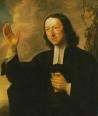
John Wesley Posted by Picasa

To candid, reasonable men, I am not afraid to lay open what have been the inmost thoughts of my heart. I have thought, I am a creature of a day, passing through life as an arrow through the air. I am a spirit come from God, and returning to God: just hovering over the great gulf; till, a few moments hence, I am no more seen; I drop into an unchangeable eternity! I want to know one thing the way to heaven; how to land safe on that happy shore. God Himself has condescended to teach the way; for this very end He came from heaven. He hath written it down in a book. O give me that book! At any price, give me the book of God! I have it: here is knowledge enough for me. Let me be "homo unius libri."

Here then I am, far from the busy ways of men. I sit down alone: only God is here. In His presence I open, I read His book; for this end, to find the way to heaven. Is there a doubt concerning the meaning of what I read? Does anything appear dark or intricate? I lift up my heart to the Father of Lights: "Lord, is it not Thy word, 'If any man lack wisdom, let him ask of God'? Thou 'givest liberally, and upbraidest not.' Thou hast said, 'If any be willing to do Thy will, he shall know.' I am willing to do, let me know, Thy will. ' I then search after and consider parallel passages of Scripture, "comparing spiritual things with spiritual." I meditate thereon with all the attention and earnestness of which my mind is capable. If any doubt still remains, I consult those who are experienced in the things of God; and then the writings whereby, being dead, they yet speak. And what I thus learn, that I teach.

Concerning the Scriptures in general, it may be observed, the word of the living God, which directed the first patriarchs also, was, in the time of Moses, committed to writing. To this were added, in several succeeding generations, the inspired writings of the other prophets. Afterward, what the Son of God preached, and the Holy Ghost spake by the apostles, the apostles and evangelists wrote. This is what we now style the "Holy Scripture:" this is that "word of God which remaineth for ever:" of which, though "heaven and earth pass away, one jot or tittle shall not pass away." The Scripture therefore of the "Old and New Testament," is a most solid and precious system of divine truth. Every part thereof is worthy of God; and all together are one entire body, wherein is no defect, no excess. It is the fountain of heavenly wisdom, which they who are able to taste, prefer to all writings of men, however wise, or learned, or holy.

From his Preface to Standard Sermons

Friday, March 24, 2006

John Owen on the Richness of Scripture

John Owen Posted by Picasa

O heavenly, O blessed depositum of divine grace and goodness!...Hence, although every humble soul may learn and receive from it what is absolutely sufficient for itself on all occasions, with respect to its own duty and eternal welfare, yet the whole church of God, neither jointly nor severally, from the beginning to the end of the world, have been, are, or shall be, able to examine these stores to the bottom, and find out perfectly all the truths, in all their dimensions, concerns, extent, that are contained therein.

Cited in Sinclair B. Ferguson's excellent John Owen on the Christian Life, Banner of Truth Trust, 1987, (p. 189-190).

Thursday, March 23, 2006

Back to the (no) Future with Liberal Evangelicals

In his book, Evangelicalism in Britain 1935-1995, (IVP 1997), Oliver Barclay makes a distinction between "classical" or "conservative" evangelicals (CE's) and "liberal evangelicals" (LE's). He is writing of the state of evangelicalism in the 1930's at this point,

CE meaning those who maintain a doctrine of the reliability, sufficiency and final authority of the Bible, and as a result maintain also the substitutionary character of the atonement and seek to bring people to an experience of new birth... LE's, while they maintain typical evangelical emphases, do not maintain, and often repudiate, the total reliability of the Bible and usually do not preach substitutionary atonement, even if they stress the cross in a doctrinally undefined way. (p. 12)
.
Barclay charts the decline of the LE movement, as LE's became less and less evangelical and more and more liberal in their teaching. His description of the liberal evangelical movement of the 1930's certainly rings some bells today. Some of today's evangelicals dismiss Biblical inerrancy, substitutionary atonement and the eternal punishment of the wicked. They seem more like the liberal evangelicals of the 1930's than classic evangelicals. Barclay concludes his book with a sober assessment of the future of evangelicalism if we follow the liberal evangelical model of doctrinal compromise and accommodation to the spirit of the age,
.
What, then, of the present and the future? The portion of history I have sketched suggests strongly that evangelicalism will not advance by cultural and intellectual compromise, as advocated by the LE tradition...The danger is that, as many evangelicals did then, we should either compromise the truth or dilute it to a point where there is little biblical substance left. (p. 137)
.
But, suggests Barclay, there is an alternative, better future for the evangelical movement:
>
All down the centuries God has blessed the recovery of biblical truth, and we cannot expect to find greater blessing in anything else. There must me a commitment to biblical Christianity in dependence on the Holy Spirit to enable us to understand the Bible, and to apply its teaching to ourselves and to the hearts of believers and unbelievers alike. Given that foundation, it should be possible to recapture for a more nearly biblical position much more of the life and thought of the churches, and from there, of the life and thought of the community. It will not be easy, but we cannot aim for less. We must pray for that, and work in genuine dependence upon God who alone is able to bring it about. (p. 142)

Tuesday, March 21, 2006

Biblical Inerrancy?

Chris Tilling has posted on Biblical inerrancy. See here and here and here for the posts and to follow the discussion. Only an Exiled Preacher has so far been prepared to argue the case for an inerrant Bible.

It seems that Biblical inerrancy is now something of an embarrassment to many who would consider themselves Theological conservatives. Iain Murray, in his Evangelicalism Divided (2000, Banner of Truth Trust) has a chapter on 'Intellectual Respectability' and Scripture. Murray argues that some have abandoned the older Evangelical doctrine of Scripture for the sake of academic respectability.

Murray writes,

It was not a passing quirk of the first century that Christianity was 'everywhere spoken against' (Acts 28:22). Certainly the gospel can penetrate academia. It has done so in the past. But it has never done so by a quiet coalescence within systems with which it is basically incompatible. Christians are not to be sheep in wolves' clothing. The Christian faith is rather at its strongest when its antagonism to unbelief is most definite, when its spirit is other-worldly, and when its whole trust is not 'in the wisdom of men but in the power of God'
(1 Cor 2:5).

Click here for an article on the Inerrancy and Infallibility of the Bible.

Psalm 19: 7-14 (ESV)

7The law of the LORD is perfect, reviving the soul;the testimony of the LORD is sure, making wise the simple; 8the precepts of the LORD are right, rejoicing the heart;the commandment of the LORD is pure, enlightening the eyes; 9the fear of the LORD is clean, enduring forever;the rules of the LORD are true, and righteous altogether. 10More to be desired are they than gold, even much fine gold;sweeter also than honey and drippings of the honeycomb. 11Moreover, by them is your servant warned; in keeping them there is great reward.

12Who can discern his errors? Declare me innocent from hidden faults. 13Keep back your servant also from presumptuous sins; let them not have dominion over me!Then I shall be blameless, and innocent of great transgression.

14Let the words of my mouth and the meditation of my heart be acceptable in your sight, O LORD, my rock and my redeemer.

To Affinity and Beyond!

The Evangelical Theological College of Wales has appointed Jonathan Stephen, Director of Affinity to replace Dr Eryl Davies as Principal of the College. Mr Stephen will continue with his work for Affinity.

Jonathan Stephen

Buzz Lightyear

"To Affinity and beyond!!!"

Sunday, March 19, 2006

Remembering Cranmer 450 years after his Martyrdom

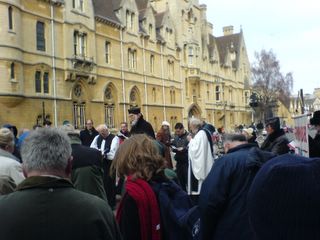
Rt. Rev. Dr. David Samuel speaks on the testimony of Cranmer at the martyrdom site, Broad Street, Oxford

450 Years ago, on 21st March 1556 Archbishop Cranmer was burned at the stake for his Protestant faith. He was intimidated into recanting his Protestant views in order to save his life. But he was sentenced to death by burning anyway.

A show trial was held at St Mary's Church Oxford, where Cranmer was expected to confirm that he had rejected his former Protestant convictions. But, the old Archbishop shocked everyone by repudiating his retraction and reaffirming his Protestant teaching. John Foxes' Book of Martyrs takes up the story.

Cranmer said,

"And now I come to the great thing which so much troubleth my conscience, more than any thing that ever I did or said in my whole life, and that is the setting abroad of a writing contrary to the truth, which now here I renounce and refuse, as things written with my hand contrary to the truth which I thought in my heart, and written for fear of death, and to save my life, if it might be; and that is, all such bills or papers which I have written or signed with my hand since my degradation, wherein I have written many things untrue. And forasmuch as my hand hath offended, writing contrary to my heart, therefore my hand shall first be punished; for when I come to the fire it shall first be burned".

Foxe describes the brave martyrdom of the first Protestant Archbishop of Canterbury,

With thoughts intent upon a far higher object than the empty threats of man, he reached the spot dyed with the blood of Ridley and Latimer. There he knelt for a short time in earnest devotion, and then arose, that he might undress and prepare for the fire. Two friars who had been parties in prevailing upon him to abjure, now endeavored to draw him off again from the truth, but he was steadfast and immovable in what he had just professed, and publicly taught. A chain was provided to bind him to the stake, and after it had tightly encircled him, fire was put to the fuel, and the flames began soon to ascend.

Then were the glorious sentiments of the martyr made manifest; then it was, that stretching out his right hand, he held it unshrinkingly in the fire until it was burnt to a cinder, even before his body wa sinjured, frequently exclaiming, "This unworthy right hand."

His body did abide the burning with such steadfastness that he seemed to have no more than the stake to which he was bound; his eyes were lifted up to heaven, and he repeated "this unworthy right hand," as long as his voice would suffer him; and using often the words of Stephen, "Lord Jesus, receive my spirit," in the greatness of the flame, he gave up the ghost.

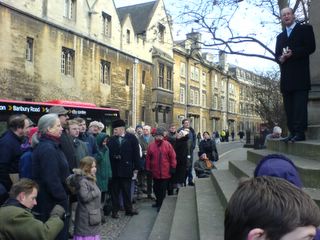
Last Saturday afternoon over 100 people gathered in a chilly Oxford to remember the burning of Cranmer. The meetings, which culminated with gospel preaching at the Oxford Martyr's Memorial were organised by the Protestant Truth Society .

An Exiled Preacher proclaims the gospel hope of a martyred Archbishop

450 Years on, let us remember that we have a gospel worth living for and a hope worth dying for in the Lord Jesus Christ. May we not forget those who are persecuted because of righteousness, in our own day.

Visit the Barnabas Fund Website . Consider what you can do to give hope and aid to the persecuted church.

And they overcame...by the blood of the Lamb and by the word of their testimony, and they did not love their lives to the death. (Revelation 12:11)

Saturday, March 18, 2006

A Mention in Dispatches for Exiled Preacher

I was honoured to be mentioned in dispatches here by Michael Haykin at his blog:

Historica Ecclesiastica

Dr Haykin's blog is packed full of useful posts on Church History and Historical Theology.