Pages

Showing posts with label Iain H. Murray. Show all posts

Tuesday, September 05, 2017

Seven Leaders: Preachers and Pastors by Iain H. Murray

Banner of Truth Trust, 2017, 279pp 

The author wrote this book out of the conviction that lessons of abiding importance may be learned from godly and able preachers and pastors across the ages. It will be of interest to men aspiring to pastoral ministry, or who are just setting out in that work. Here they will find role models to follow whose example will both challenge and encourage them. More seasoned pastors will also find help here. If we are not careful it is easy to drift into going through the motions of ministry, rather than our work being the overflow of deep communion with God. These pages will provide a necessary corrective. Those not called to preach or pastor will none the less find their souls stirred by Murray’s accounts of seven exceptional Ministers of the Gospel.

Attention is given to seven men: John Elias, Andrew A. Bonar, Archie Brown, Kenneth A MacRae, Martyn Lloyd-Jones, W. J. Grier and John MacArthur. Murray does not so much give us potted biographies of these varied characters, as attempt to show what made them tick. These are very different men, called to serve the Lord at different times and in different situations. Some had more academic training than others. All were wonderfully used by the Lord to accomplish great things for him.

While certainly not like peas in a pod, these ‘Magnificent Seven’ Ministers had a number of things in common that helps account for their usefulness. They were all strongly Calvinistic in their doctrinal emphasis, some at times when the Reformed faith seemed to be going out of fashion. They maintained their stand for the sovereign grace of God because they were convinced that the great truths commonly labelled ‘Calvinism’ were in fact nothing less than biblical Christianity.

The importance of prayer and communion with God in ministry is highlighted in the chapter on Andrew A. Bonar. The thoughtful reader will be humbled, challenged and made to yearn for a deeper walk with God through Bonar’s example. A missing note in some Evangelical circles today is the need for the empowering presence of the Spirit in preaching. The preachers described here were men of the Word, yet they also longed and prayed for the Spirit’s work upon their preaching and in the lives of their hearers. He alone is able to give the Word preached its life-transforming effectiveness.  

All were evangelistic preachers, in that they intentionally addressed their messages to the unconverted, aiming at their salvation. In addition, Murray shows that these gifted preachers worked hard to make their content-rich sermons as clear, logical and easy to follow as possible. Helpful instances are given as to how they did just that, especially in the chapters on Lloyd-Jones and MacRae. 

Martin Luther once wrote, “It is not by reading, writing, or speculation that one becomes a theologian. Nay, rather, it is living, dying, and being damned that makes one a theologian.” The same may be said of pastors and Murray describes how the Lord made these men tender hearted shepherds of the flock by bringing suffering and trials into their lives, This is especially brought out in the chapter on C. H. Spurgeon’s friend and contemporary, Archie Brown. 

Some chapters are stronger than others. Elias, Bonar, Brown and Lloyd-Jones are highlights. I'd barely heard of MacRae, but enjoyed Murray's pen portrait of the Isle of Lewis pastor. I found the one on W.J Grier a little hard going. The MacArthur chapter was good on preaching and Scripture. 

The book as a whole is a standing reminder of one vital fact, “what a preacher is as a Christian is of greater consequence than his natural gifts. In the words of M’Cheyne: ‘It is not great talents that God blesses so much as great likeness to Jesus. A holy minister is an awful weapon in the hand of God.’” The great burden of this work is a call to return to the apostolic pattern of gospel ministry, 'we will give ourselves to prayer and to the ministry of the word' (Acts 6:4). In that order. 

* Reviewed for Evangelical Times

Monday, September 05, 2016

J. C. Ryle: Prepared to Stand Alone by Iain H. Murray

 Banner of Truth Trust, 2016, 273pp

A good biographer helps his readers to get under the skin of their subject so that you feel you get to know them. Almost personally. A good Christian biographer will do more that that. As well as setting their subject against the background of their times and offering a convincing psychological portrait, they will give readers a glimpse of a soul in its communion with God and dealings with people.

Iain H. Murray has often pulled off this feat in his many biographies of Christian men and women. Jonathan Edwards, C. H. Spurgeon, Archibald Brown, D. Martyn Lloyd-Jones and Amy Carmichael among them. He has now done the same for J. C, Ryle.

Ryle was one of the most famous Evangelical Anglicans of his day. He became the first Bishop of Liverpool. His many tracts and books attracted avid readers all around the globe. Yet towards the end of his life and in the decades the followed he was regarded as something of a dinosaur. His 'old fashioned' beliefs and attitudes were dismissed as irrelevant for the times. 

In some ways Ryle was 'a man born out of due time'. A staunch Protestant, he seemed more like a Bishop from the days of Latimer and Ridley than Victorian Churchman. The Church of England of that period was in a state of flux. Newman and Pusey of the Oxford Movement were seeking to pull the Church in a Rome-ward direction. Theological liberalism was beginning to take hold, questioning the authority of Scripture in the name of the 'assured results of modern scholarship'. 

Against these trends Ryle dared to stand alone. He called the Church of England to remain true to its confessional heritage in the Thirty Nine Articles. But he was fighting a losing battle. When he became a Bishop, Ryle found himself torn between the need to be an ecclesiastical statesman, trying to hold together all the various parties in his diocese, and his principled stand for Protestant beliefs. 

Ryle never wanted to be a clergyman. It was only because his father's bank collapsed that he turned to the Church for employment. He was converted some years earlier when a student at Oxford University, but had no desire whatever to become a Minister. The Lord had other ideas. All doors closed to him bar one; that of becoming curate of a parish church in Exbury, Hampshire. Thereafter he served churches in Winchester, Helmingham, and Stradbroke, before being appointed Bishop of Liverpool. Just as his call to the ministry seemed a matter of financial expediency from a human point of view, so his becoming a Bishop was a political fix on the part of Tory Prime Minister, Disraeli. The politician was keen to avoid his Liberal opponent Gladsone imposing a ritualist on the growing city.  

But whatever man's motivations and machinations there can be no doubt that J. C. Ryle was called by God to proclaim the good old truths of the gospel to the people of his day. And it is those good old truths, held by the Reformers and Puritans so beloved by Ryle that have stood the test of time. For they are the mighty life-transforming doctrines of God's Word. Few bother to read the 'state of the art' works of nineteenth century theological liberalism these days, but Ryle's writings have been rediscovered and reprinted for a global audience. His Expository Thoughts on the Gospels are a model of straightforward applicatory exposition.  Historical  writings such as Christian Leaders of the Eighteenth Century have introduced readers to the mighty work of God that was the Evangelical Revival. His work on Holiness has helped to correct unhelpful emphases in Evangelical teaching on sanctification.

Although Ryle was a somewhat reluctant pastor, he threw himself unstintingly into the work. He was a diligent visitor of his flocks and a fully engaged in the life of the communities in which he served. He sought to preach with simplicity and verve, grabbing the attention of his people with lively illustrations. The preacher brought God's Word to bear upon his hearers' lives with punchy and direct application of the truth. In a day when Calvinism was rapidly going out of fashion, Ryle was not ashamed to identify himself with the Reformed faith, which he saw as essential for the life and witness of the Church. He seems, however, to have held to a 'hypothetical universalist' view of the atonement, rather than the 'definite atonement' view of full-blown Calvinism. 

Murray brings out the private trials and struggles of the public figure. A recently discovered memoir penned by Ryle for the benefit of his children has thrown new light on his early years. As a younger man, he was twice widowed and left in sole charge of small children. His time at Helmington was marked by tensions with the local bigwig who owned the living of the parish church he served. Throughout his long life he never really got over the shock and shame of his family losing everything when his father's bank collapsed. Although Ryle could be a combative figure, he felt himself lacking in social confidence. The 'man of granite' had his vulnerable side, which only served to make him a better pastor. 

Murray brings to the fore key aspects of Ryle's teachings and considers what we may learn from him today. Ryle was a keen believer in the Establishment principle and believed that nations should recognise God and his law. He would have preferred Spurgeon as a Baptist equivalent to the Archbishop of Canterbury, rather than no Established Protestant Church at all. I trust Ryle's Baptist contemporary would have demurred on the grounds of Baptist belief in the separation of Church and State. Ryle's position in the Church of England made him a somewhat conflicted character, especially when he became Bishop of Liverpool, His hopes of bringing together a mainstream bulwark against Anglo Catholicism and Liberalism were misplaced. The Church of England is no longer bound to uphold the Thirty Nine Articles that Ryle fought to maintain. His policy for recovering Anglicanism for the gospel didn't work and cannot realistically be used as a model for today's Evangelical Anglicans. 

Ryle was catholic spirited enough to transcend denominational boundaries and had more spiritual affinity with Liverpool Nonconformist leaders than many of the Anglican clergy over whom he presided as Bishop. His was a generous orthodoxy. Valiant for truth, but without ever becoming sectarian. That's why his writings have a timeless quality that has recommended them to a new generation of readers. Murray's biography helpfully brings out the man, the grace-touched soul, behind the impressive beard and many instructive books.

Venice, Rome and Ryle. So ends my summer hols reading roundup. 

Sunday, September 06, 2015

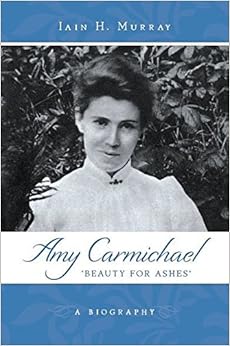
Amy Carmichael: 'Beauty for Ashes', A Biography, by Iain H. Murray

Amy Carmichael: 'Beauty for Ashes', A Biography,
by Iain H. Murray, Banner of Truth Trust, 2015, 168pp

Must confess that I didn't know an awful lot about Amy Carmichael. Apart from what I'd read years ago in psychiatrist Gaius Davies' [no relation] Genius and Grace. Bit of a nutter, apparently. An hysteric with a penchant for melodrama. Cared for vulnerable children in India, which was nice, but set herself as a Protestant 'Mother Superior'. Something of a poet.

Iain Murray's brief biog presents a more rounded portrait of the missionary-poet and her work in founding the Dohnavur Fellowship, which was originally set up as a refuge for children who were in danger of being dragged into ritual prostitution. Hers is a fine story of faith and fortitude, well told by Murray. 

I used some of my birthday money to buy the book with the intention of reading it on holiday. So gripping was Murray's account that I'd finished it within a day or two of our summer break. Admittedly, Carmichael isn't your typical 'Banner Woman'. Her piety was that of Kewsick-mysticism rather than  experimental Calvinism, but she evidently loved  the Lord and had a deep concern for needy children. Murray highlights the value of her devotional writings and commends her example of sacrificial service.  

Murray is critical of Carmichael's take on guidance by spiritual impulse and acknowledges that she could sometimes be headstrong and hot-tempered. But he defends her of Davies' charge that she could brook no disagreement from her co-workers and would send dissenters packing. That is how Davies explains Amy falling out with Stephen Niell, whom the psychiatrist describes as 'the brilliant Bishop of Tinnevelly'. Murray points out what Davies neglects to mention - that Niell rejected the inerrancy of Scripture. Carmichael's disagreement with him was not so much a personality clash, as a serious doctrinal disagreement. Murray devotes a chapter to exposing the detrimental impact of a critical view of the Bible on the cause of world mission. 

Not the author's best biog by a long chalk, but an inspiring little book none the less. Well worth a read. 

Monday, September 23, 2013

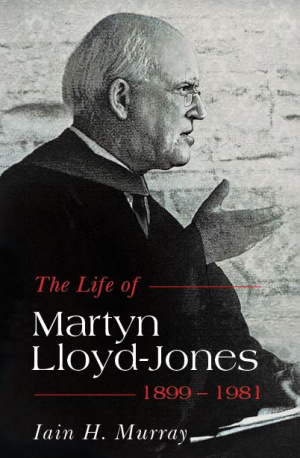
The Life of Martyn Lloyd-Jones 1899-1981 by Iain H. Murray

The Life of Martyn Lloyd-Jones 1899-1981
The Life of Martyn Lloyd-Jones 1899-1981Iain H. Murray,
 The Banner of Truth Trust, 2013, 476pp

Although I never heard Martyn Lloyd-Jones preach, his ministry had a huge effect on my early Christian life as I hungrily devoured his sermons on Romans and Ephesians and other published addresses besides. Wanting to know more about the man behind the messages I read and very much enjoyed Iain Murray’s two volume biography of the preacher, also published by the Banner of Truth. This edition of Murray’s life of Lloyd-Jones is a condensed and updated version of the larger works, which between them add up to over 1200 pages.

Lloyd-Jones’ story makes for a gripping read. He turned his back on an eminent medical career in order to become a preacher in Mission Hall in depression era Port Talbot. The Lord blessed his work there and many were converted under his earnest and passionate evangelical preaching. He was then called to Westminster Chapel in London, where he served for thirty years. There he regularly preached to thousands who were captivated by his powerful expository ministry.

Lloyd-Jones helped to spearhead the recovery of Reformed teaching in the United Kingdom, both through his preaching and by his involvement in organisations and initiatives such as IVF (now UCCF), the Evangelical Library and the Westminster Conference. He helped to found the London Theological Seminary.

His ministry was not without controversy. In 1966 he urged evangelicals to come together rather than be subsumed in the Ecumenical Movement. While many heeded his call and left the mixed denominations, other evangelicals such as John Stott and J. I. Packer followed a policy of integration rather than separation. Ironically the preacher’s call for Evangelical Unity left evangelicals badly divided and much ink has been spilt in trying to determine exactly what ‘the Doctor’ hoped to achieve. Murray interacts with some of Lloyd-Jones’ critics in an attempt to set the record straight.

This is not a critical biography that aims at presenting a coolly detached view of is subject. Lloyd-Jones and Murray were great friends and it shows. The author’s evident sympathy for the physician-cum-minister shines through on every page and enables him to present a convincing psychological and spiritual portrait of ‘the Doctor’. Murray’s treatment of Lloyd-Jones’ boyhood years and the account he gives of his death in the final chapter are especially moving.

Mrs Lloyd-Jones said that her husband was ‘first of all a man of prayer and then an evangelist’. In our era of media courting celebrity pastors, it is refreshing to read of an evangelical leader who refused to stand for a press photographer. He preached not himself, but Christ Jesus the Lord and did so in demonstration of the Spirit and power. Through his books and recordings of his preaching being dead, Lloyd-Jones still speaks to today, urging us to hold fast to the gospel that he lived to proclaim and died believing. This condensed biography serves as a welcome reminder of the man and his message. 

* Reviewed for Evangelical Times

Monday, June 25, 2012

Archibald G. Brown: Spurgeon's Successor by Iain H. Murray

Archibald Brown: Spurgeon’s Successor,
Iain H. Murray, Banner of Truth Trust, 2011, 405pp.

At the 2011 Banner Ministers' Conference Iain Murray gave an address on Archibald Brown (1844-1922). Few of us knew anything much about the subject of his talk. But by the end we wanted to know more about this remarkable servant of God. With the publication of this excellent biography this longing is more than fulfilled.

Brown was converted at the age of sixteen. A friend of his, Annie Bigg (later to become his first wife), invited him to an evangelistic meeting. The speaker, Arthur Blackwood asked if Brown were a Christian. When he replied, "no", the evangelist said, "how sad". This affected him deeply. Brown was convicted of sin and then soundly converted while sitting under a tree. Full of joy, he threw his cap in the air, which then got stuck in the tree. His first act as a Christian was to retrieve his hat.

Brown trained for the ministry under C. H. Spurgeon at the Pastors’ College. He became great friends with the famous London preacher and stood with him during the Down-Grade controversy. Spurgeon was no great fan of physical exercise, but he said that he would walk four miles to hear Brown preach.

Brown’s first pastorate was in Bromley, Kent. After that he served several London churches, ministering in Stepney Green Tabernacle, East London Tabernacle, Chastsworth Road Chapel and the Metropolitan Tabernacle.

However, the 'Spurgeon's Successor' tag, while true is a little misleading. Brown was only pastor of the Metropolitan Tabernacle from 1907-1910, initially serving as co-pastor with C. H. Spurgeon’s son, Thomas. Browns’ longest and most fruitful period of ministry was spent in the East End of London from 1866-1897. Revival in the Stepney Green Tabernacle necessitated the building of East London Tabernacle to accommodate the large number of converts that had been added to the church. Congregations of 3,000 people thronged to hear him preach. 

The East London Tabernacle was a true community church. Murray movingly details Brown’s attempts to minister to the poverty-stricken people of the East End. He appointed nine missionaries to reach into the community with gospel hope and practical help. Brown was a fervent evangelist. His ministry touched all kinds of people. The record of his converts includes prostitutes, thieves and other criminals.

The preacher experienced personal tragedy, losing four wives to the grave, before dying himself shortly after his last wife, Edith was taken to glory.

Brown knew times of revival in the earlier period of his ministry.  As the 20th century wore on he was faithful to the gospel in days of general decline. He remained a staunch Calvinist when Calvinistic theology was rapidly going out of fashion.

Iain Murray had produced a masterly biography of Archibald Brown, giving a vivid portrait of his times and capturing something of the essence of this undeservedly forgotten minister of Christ. His life is full of lessons for our situation today. Brown lived to preach the gospel in season and out of season. And so should we. 

* Reviewed for Evangelical Times.

Wednesday, April 20, 2011

Banner Ministers' Conference 2011 Episode III

History Men 


Happy birthday to you,
Happy birthday dear Iain.
Happy birthday to you.

Quite what our exclusive psalmody brethren thought of it I don't know, but one of the items sung on Tuesday evening was a hearty rendition of Happy Birthday in honour of Iain Murray. He is now 80 years of age. Mr. Murray was also presented with a birthday cake replete with lit candles, which he blew out before the session began. Who says that Calvinists don't know how to have fun?

Enough of that hilarity. Among my personal conference highlights were two historical addresses, one on Archibald Brown by the grand old man of Banner, Iain Murray, and another on William Tyndale by Philip Arthur. Here are some bones to for you pick over as best you can. Oh, I'd better say that any inaccuracies in these reports is more likely due to my notes rather than what was actually said by the speakers. You try taking fullish notes on a mobile phone (albeit one with a tiny QWERTY keyboard).

Iain Murray on Archibald Brown

His dates are 1844-1922. Brown served four pastorates including the  Metropolitan Tabernacle. Around 5000 people were  added to church under his ministry. Brown's sermons were published worldwide. He engaged in mission work among destitute people in the east end of London.

Brown was an evangelist. His ministry touched all kinds of people. A photographic record of his converts includes prostitutes, thieves and other criminals.

Brown speaks to us on the issue of how should we live in a time of apostasy? He ministered in the late 19th and  early 20th centuries, days of general decline in the churches.

Background

He was of Scottish ancestry. His father was involved in the  Clapham Sect. Brown was the eldest son, with  4 sisters and  2 brother. His father sat under Spurgeon's ministry. Archibald heard CHS preaching in Surrey Gardens Music Hall. He was sent to boarding school in Brighton, but left and returned home. His father then had him apprenticed to city tea firm. At 16 Brown was a careless young man, who often used bad language. Annie Bigg, a Sunday School friend who he quite fancied invited Archibald to an evangelistic meeting. The speaker, Arthur Blackwood asked if Brown were a Christian. When he replied, "no", the evangelist said, "how sad". This affected Brown deeply and for two days he was convicted of sin. Sitting under a tree, his burden lifted as Archibald saw meaning of salvation. Full of joy he threw his cap in the air, which then got stuck in the tree. His first act as a Christian was to retrieve his hat.

Brown soon started witnessing and preached his first sermon on Matthew 1:21. He entered Spurgeon's Pastors Collage aged 18, the rules being bent for his sake. 

The Pastors Collage aimed not at making preachers, but training men who were gifted and called to preach. The old divinity - Calvinism - was taught. Students carried on preaching while they studied. Brown was sent to a church in in Bromley. It was a small work.  Spurgeon urged him to hang on. CHS once took 1000 people to Bromley in support of Brown. He served there for four years.

Archibald married his beloved Annie Bigg in 1865, aged 21. At 22 he was called to Stepney Green Tabernacle. Spurgeon was no great fan of physical exercise, but he said that he would walk four miles to hear Brown preach.

One AB preached on Luke 7:11-17. He felt helped in preparation and delivery and expected conversions, but none came. Later when he preached on the same text, 70 were saved. It is not the means, but the Lord's blessing on the means that saves.

AB experienced revival under his ministry. The work impacted the local community. A revived church has magnetic power. Congregations numbered around 800. A new chapel, the East London Tabernacle was erected with room 3000 souls.

Emphases of Brown's Ministry

Preaching and conviction

He preached a living Christ, an ascended Christ, an active Christ.  His theme was the love of God. Truth was baptised into love. Brown loved and served the Lord.

Preaching and prayer

At Stepney extra prayer meetings were laid on, including a 7 am prayer meeting on Saturdays. At the East London Tabernacle there was a loving concern for the community. Workers regularly visited over 2000 families.

Brown was a tall man of military bearing, yet he was gracious and approachable.

What made him what he was?

Brown knew trials and suffering. His first wife died after 5 years of marriage. The Lord gave him peace in his sorrow. Brown remarried, but his wife died in giving birth. This prostrated him, leaving him a broken man. Hearing CHS preach on the saints in glory restored him.

He was touched by the plight of the poor people of the east end. He appointed 9 missionaries to reach into the community with gospel hope and practical help. Brown felt for people living in empty houses, without employment, healthcare, education and adequate food.  

Brown stood with CHS in the downgrade controversy of 1887. Evangelicals didn't discern liberalising trends in the church. Concessions were made. Brown left the Baptist Union. Shortly after CHS died.

Why is Brown so forgotten?

 He belonged to a minority, declining, Calvinist party.

Why did Brown still stand?

He had the assurance that the churches needed biblical Calvinism.

Brown's preaching

1. Scripture is God's vital, living Word.
2. The need of the Holy Spirit and the importance of prayer.
3. He did not preach from paper, an extemporary preacher.
4. He preached the second coming of Christ.

Brown speaks to us of the need for a revival bible of centred, convicting preaching.

Philip Arthur on William Tyndale

1. The making of an exile

Tyndale was born circa 1484. He received his Oxford BA in 1512 and MA in 1515. He hailed from Gloucestershire. 

At Oxford, the "new learning" or Lutheranism was beginning to gain influence. In 1522 Tyndale became family tutor to John Walsh in Little Sodbury. He was ordained to the priesthood and held to evangelical views.

The local clergy were blind guides. Tyndale saw the need for the Scriptures to be translated for ordinary people to read. One clergyman objected, "We had better be without God's laws than the Pope's." Tyndale responded, "I defy the Pope, and all his laws; and if God spares my life, ere many years, I will cause the boy that driveth the plow to know more of the Scriptures than thou dost!"
But at this time is was a crime punishable by being burnt at the stake to own a copy of the Bible in English. Tyndale, however sought a powerful patron for his translation project. He approached the Bishop of London, but received no reply.

In 1524 Tyndale moved to Hamburg where he could start translating the Bible into the language of his people.

2. The need for a vernacular bible

Tyndale's was not the first English translation of the Scriptures. In the  11th century king Athelstan had substantial portions of the Bible translated into the vernacular. The Lindisfarne Gospels included some English translation. Bede translated the Psalms. King Alfred also engaged in translation work. But this was Old Ango Saxon. Since then Norman French had impacted the language. To show how foreign Old Anglo Saxon sounds, Phil Arthur read a portion of Scriptures in the old tongue. It sounded amazing, but I couldn't make head nor tail of it. (The reading was from Matthew 7:24-28).

Lollard Scriptures were in Middle English.  250 Wickliffite Bibles are still extant. Tyndale did not use these earlier translations, which were from Latin into English. The language had changed so much by the sixteenth century that a completely new translation of the Bible was needed.

According to Catholic revisionist historians like Eamon Duffy,  Tyndale need not have bothered. The Church produced Books of Hours in English for the faithful to read. However, these devotional volumes contained little solid biblical content.

3. The 1526 Worms New Testament

Within a year of arriving on continent Tyndale's work was discovered. He fled from Hamburg, but much of the translation Matthew was published.

In Worms, Tyndale found a printer and in 1526 the first English New Testament was published. It was produced in small octavo volumes to keep the price down. Only three copies have survived.  Tyndale often used used words of 1 syllable, with words of more than one at end of the sentence.

His New Testament is the basis of 80% of the AV's translation. But Tyndale used the word "congregation", rather than "church", "overseer" rather than "bishop" and "love" rather than "charity".

His New Testament began to find its way  into England.

4. Persecutions and polemics

Tyndale published a sermon on justification based on Luke 16.

His NT's were burned, together with "heretics" who professed the Protestant faith.

Henry VIII liked Tyndale's The Obedience of a Christian Man, with its emphasis on submission to rulers.

Thomas Moore published an anti-Tyndale work, Dialogue Concerning Heresies. Tyndale wrote an answer to Dialogue. Moore responded with a half a million word rebuttal. His contribution to English literature was half a million words that no-one reads. Tyndale's was the English  Bible.

5. Hebrew

Hebrew was the eighth language Tyndale learned. By 1530 Genesis had been completed. The Matthew Bible, completed by John Rogers included Tyndale's work on  Joshua to 2 Chronicles. Tyndale used simple, homely English. "The Lord troounced sisera", "he clouted them", "tush ye shall not die".

He used a variety of English words to render original.

6. 40 Pieces  of silver

Henry Phillips  befriended Tyndale in Antwerp. But he betrayed him to the authorities in 1535. For a year and a half Tyndale was imprisoned. He wrote this famous letter to a local marquis,

I believe, most excellent Sir, that you are not unacquainted with the decision reached concerning me. On which account, I beseech your lordship, even by the Lord Jesus, that if I am to pass the winter here, to urge upon the lord commissary, if he will deign, to send me from my goods in his keeping a warmer cap, for I suffer greatly from cold in the head, being troubled with a continual catarrh, which is aggravated in this prison vault. A warmer coat also, for that which I have is very thin. Also cloth for repairing my leggings. My overcoat is worn out; the shirts also are worn out. He has a woolen shirt of mine, if he will please send it. I have also with him leggings of heavier cloth for overwear. He likewise has warmer nightcaps: I also ask for leave to use a lamp in the evening, for it is tiresome to sit alone in the dark.

But above all, I beg and entreat your clemency earnestly to intercede with the lord commissary, that he would deign to allow me the use of my Hebrew Bible, Hebrew Grammar, and Hebrew Lexicon, and that I might employ my time with that study. Thus likewise may you obtain what you most desire, saving that it further the salvation of your soul. But if, before the end of winter, a different decision be reached concerning me, I shall be patient, and submit to the will of God to the glory of the grace of Jesus Christ my Lord, whose spirit may ever direct your heart. Amen.
In 1536 Tyndale was condemned as heretic and defrocked. The prison warden and daughter became believers through the translator's witness. He was strangled and then burned at the stake. Before dying Tyndale is reputed to have prayed, "Lord, open kings eyes". His ashes were thrown into the  River Zena.

What prompted Tyndale's labours, suffering and death? It was love for God, his Word, and the simple ploughboy.

A deeply moving and challenging paper.


Monday, April 18, 2011

Banner Ministers' Conference 2011 Episode II

Faith, hope and love

One of the founders of the Banner of Truth Trust, Iain Murray ably stood in for Ted Donnelly, with two messages on John 17 and a biographical address, of which more in a later post.

Iain Murray on John 17:1

John 17 is different from other prayers of Jesus recorded in the Gospels, which are fragmentary. Here we have full disclosure. Jesus intended that his people might hear what he prayed to the Father. Through his teaching and prayer, he wanted to give his people peace (John 16:33) and joy (John 17:13). Jesus prayed as though already within the veil, having finished the work the Father gave him to do, John 17:3, 11, 12.

1. In this prayer we have prophecy fulfilled

Under the Old Testament, access to God was granted via the high priest's ministry on the Day of Atonement, Exodus 28. The coming of a greater high priest was prophesied, Isaiah  53:12, Psalm 110:4, Zechariah 6:12.

Now the hour of fulfilment has come. The veil of the temple was torn, Matthew 27:51. We have a great high priest who has passed through the heavens, Hebrews 4:14-16.

2. How this prayer brings before us our Lords continuing ministry

Jesus' work on earth is complete. Hebrews 7:27, 9:28. But his work is still ongoing. He is not less active now that he has returned to the Father. In John 17 we see him giving eternal life to his people, sanctifying them, giving them unity, sending them on mission, and bestowing his glory upon them. He continues to intercede for his people, Romans 8:33-34, Hebrews 7:25, 1 John 2:2. Too little thought is given to ongoing work of Christ.

3. The petition itself

Jesus asks the Father, "Glorify thy Son", John 17:1. He is praying for the restoration of his glory which was obscured by the incarnation. This entails the glorification of Christ's humanity. In answer to his prayer, Christ is now in glory in our nature on our behalf. John Owen gives helpful attention to the exalted glory of Christ in Volume 1 of his Works.

4. The reason for the petition

Jesus was exalted in order to give eternal life to his people, John 17:2, John 6:40. The Father's glory is bound up with our salvation, John 17:10. See also Isaiah 53:10 & 55;4.

5. Observations

1) Believers are the glory of Christ 

The glory of Christ is seen in the in grace and holiness of his subjects. (John Owen).

2) The glorification of man is a serious offence in the sight of God

1 Corinthians 3:5-6. The glorification of man is a cause of the decay and ruin of churches. Are we sometimes guilty of the idolatrous veneration of men? Consider the number of endorsements and commendations carried by recent evangelical books. Are we putting too much emphasis on theology decrees? Have funeral eulogies become too extravagant, detracting from the glory of God? Let us not glory in men.

3) The truth concerning Christ's present work is the answer to our unbelief

Jesus reigns. He is the risen Lord. In Revelation 1 we see him clothed in high priestly garments. He is active among the candlesticks. Once John Murray rebuked the Banner conference for drawing up plans to do this and that as if the work of the kingdom depended upon man. He urged the gathering to  focus afresh on the on present activity of Christ.

When John Knox lay dying, he asked for John 17 to be read to him. The chapter shows that in Christ we have an anchor in troubled times. The church can recover her strength if we will only look to Christ.

Iain Murray on John 17:25-26

This was the closing sermon of the conference, but I include some notes in this report.

John 17 represents the conclusion of Christ's ministry to his disciples. He was virtually silent thereafter. Jesus was certain that his righteous Father would answer his prayer. We see the contrast between Christ and world, John 17:25. Reference is made to the prophetic office of Christ, John 17:6-8, 13-14. His prophetic office continues, Psalm 22:22.

1. The teaching work of Christ

Our Lord's teaching is always effective and successful John 17:6. He opens our hearts to the truth, revealing God's name to his people,  John 1:18, 1 John 1:1-2, John 8:58, 2 Corinthians 4:6. Jesus continues to teach his people, calling them by name, John 10:3, Acts 9:4. Christ is the prophet of church. He uses messengers, to speak to his people by the power of the Holy Spirit, Ephesians 2:17, 4:20-21. Christ preaches through the ministry of his servants.

2. The special purpose of his teaching ministry

This is revealed in John 17:26. Love is the purpose of Jesus' intercession. Love for God and love in the church for one another. Love is supreme, 1 Corinthians 13:13. The Father's love for his Son will be in is and the Son will be in us.

It is through the indwelling and teaching of Christ that love dwells in and expands the believer, John 10:17. The Father's love for us is in Christ, Romans 8:39, 1 John 4:16, Ephesians 3:14-21.

3. The relevance of Christ's teaching for ministers

1) Christ should be the sum of our preaching

Our main problem is the gap between the truth we believe and our lives. The church needs pastors after God's own heart who will teach his people knowledge, Jeremiah 3:15.

2) Our lord's ministry was not isolated from prayer

If our Saviour needed to bath his ministry in prayer, how much more do we. Prayer is more important than preaching, Acts 6:4.  

**********************************************

With Olyottesque simplicity and directness, Lewis Allen gave two challenging and encouraging messages on the church's love and longing.

Lewis Allen on First Priorities: The Church's Love (Eph 6:23-24)

What does it mean to love Christ? Ephesians 6:24.

In his commentary on this verse, Charles Hodge made four points:

1. Adoring admiration of his person

'O come, let us adore him. Christ the Lord!' He is the Son of Man, the Mediator, our high priest, the bread of life, the good spepherd, our King, the Lamb of God, the life, the light and the Mighty God.

There is nothing disappointing in him. Christ is adorable.

Reflect also on the work of Christ, especially his cross. His mercies swim to us - John Flavel.

2. Desire his presence

Ephesians 3:14-21. Are we in danger of exalting the propositional at the expense of the experiential?

Desiring his presence involves:

1) Desirous of his truth John 16:13.

2) Enjoying his peace John 14:27.

3) Experiencing his joy John 15.11, 16:22

Knowing Christ's presence will make us kind men who are available to our people.

3. Zeal for his glory

Romans 12:11. God is zealous Isiah 59:17. As was Jesus, John 2:17 A minister without zeal is no minister. Bill Maclaren's rugby commentaries were the product of his hard work and enthusiasm for the game. If we are not excited about the truth, then no one else will be.

Let our preaching be fresh and vivid, with a varied use of English so that is is not predictable and tiresome. Zeal for his glory demands this.

4. Devotion to his service

Ministry is costly. A barren ministry is often due to a lack of devotion to Christ and his people.

Love for Christ is what matters.

Lewis Allen on First Priorities: The Church's Longing (Rev 22:20-21)

We have certainty in changing world. Christ is coming. This should be our controlling reality. If it is not we are out of touch with reality.

Too few sermons are preached on Christ's return. But this should be our greatest longing.

1. The Lord's promise

There are around 300 references to Christ's return in the New Testament. The the last promise of the Bible concerns his coming. This makes sense of all the others, bringing them to completion. Here the suffering church finds hope. Jesus is still reigning. His promises cannot be broken.

The promise is:

1) Personal. I am coming.

2) Visible. Every eye will see him.

3) Triumphant. Jesus will be seen as Lord of all.

4) Transforming. His coming will be the climax of history, involving judgement and restoration.

5) Cannot be predicted. He is coming soon, meaning suddenly, like a thief in the night.

The second coming is the most important truth of all. The incarnation of Christ makes little sense without his return. Christ's redeeming work will be completed when he comes - the redemption of the body at the resurrection. There will be  no day of judgement without Jesus' return. Salvation will be consummated when he comes.

Churches and communities need to hear of Christ's return. Without it there is only rampant aimlessness and unbelief. The parousia gives focus and hope to ministry. Our task is to prepare sinners for judgement.

2. The church's longing

Christianity is personal. Jesus is coming for us. Creation will be restored, Revelation 22:1-5. We will see his face and reign with him. But the focus should not be on what this means for us, but on Christ. his glory.

Live on the promises.

God's terrifying judgement is at hand. Be earnest and prayerful for the lost. We will rejoice in the holy judgement of God.

The Rolling Stones' I just want to see his face, covered by Christian band, The Blind Boys of Alabama gives expression to the church's longing,

Then you don't want to walk and talk about Jesus,
You just want to see His face.
You don't want to walk and talk about Jesus,
You just want to see His face. 

3. The church's commitment to living by the grace of Jesus

Revelation 22:21. We need grace to live in the light of return.

The Heidelberg Catechism Lord's Day 19.

Question 51. What profit is this glory of Christ, our head, unto us?
Answer: First, that by his Holy Spirit he pours out heavenly graces upon us his members; and then that by his power he defends and preserves us against all enemies.

Question 52. What comfort is it to thee that "Christ shall come again to judge the quick and the dead"?
Answer: That in all my sorrows and persecutions, with uplifted head I look for the very same person, who before offered himself for my sake, to the tribunal of God, and has removed all curse from me, to come as judge from heaven: who shall cast all his and my enemies into everlasting condemnation,  but shall translate me with all his chosen ones to himself, into heavenly joys and glory.

We are saved in hope, Romans 8:24. Are you a moaner or groaner? Romans 8:26. In this broken world we groan, but we have the  hope of salvation.

By grace we shall see Christ and be made like him.

Even so, come Lord Jesus!

Thursday, July 01, 2010

A Day's March Nearer Home by J. Graham Miller


A Day's March Nearer Home: Autobiography of J. Graham Miller,
Edited by Iain H. Murray, Banner of Truth Trust, 2010, 328pp.

In a care home in Wangaratta, Australia lived an elderly couple, Graham and Flora Miller. They had been married for over sixty years. Although now rather frail, their faith in Christ and love for each other was evident to all. In a letter to his son, Graham Miller wrote, “Our health grows poorer as our expectations grow richer… we advance ‘a day’s march nearer home.’” That line from James Montgomery’s hymn, For ever with the Lord! admirably sums up the Millers’ attitude to life. It is also the title of Graham Miller’s journal from which this autobiography was drawn. The journal was originally written as a family archive for his grandchildren to read with “interest and surprise”. But you don’t have to be a member of the Miller family for this autobiography to fascinate, astonish and inspire.

Graham was a Presbyterian Minister. He began his ministerial career in the early 1940’s as a missionary in the New Hebrides, then a UK/French Condominium, now the independent Republic of Vanuatu. Under Graham’s enlightened leadership the native church became self-governing, paving the way for national independence and self-government in 1980. A charming account is given of the challenges and joys faced by the missionary couple and their growing family on the islands of the New Hebrides. Miller’s death in 2008 was marked by a day of mourning by the grateful people of Vanuatu.

In 1953 the Millers returned to their native New Zealand and Graham Miller became the Minister of Papakura Presbyterian Church. The church was blessed under his solid biblical teaching and Miller was given opportunities to minister overseas, including preaching at the Keswick Conference in the UK. After a short spell as Principal of Melbourne Bible Institute, Graham and Flora once again served on the New Hebrides before taking up his final pastorate at St. Giles’, Sidney.

After such a busy and fruitful life retirement could have proved a difficult prospect for Graham Miller. But he made good use of his latter years, giving himself to writing and above all, intercessory prayer. As such he regarded retirement the most rich and productive phase of his ministry, the crown of his life’s work.

Miller was a man of decided Reformed convictions. With grace and integrity he stood against the liberalising tendencies of his denomination, the Presbyterian Church of New Zealand and did all he could to promote the Reformed faith. Miller did not follow the Lloyd-Jones line of separation from theologically mixed denominations. But when, during his St. Giles’ pastorate the Presbyterian Church of Australia merged with Methodists and Congregationalists to form the Uniting Church, Miller sided with those who opted to retain their distinctive Presbyterian and Reformed identity. Again, unlike Lloyd-Jones, Miller was an enthusiastic participant in the Billy Graham crusades that took place in New Zealand and Australia.

There is no sense of self-aggrandizement or self-justification in this autobiography. Miller honestly chronicles set backs and disappointments as well as the successes of his ministerial career and is careful to give God all the glory. The work is full of human interest, from the simple joys of Christian family life to facing earthquakes and hurricanes on the New Hebrides.

The Millers lived as “strangers and pilgrims on the earth”, seeing each day as “a day’s march nearer home.” This journal, ably edited by Iain Murray will inspire its readers to adopt a similar mindset. It is the most heavenly minded who will do the most earthy good.


* An edited version of this review will appear in Protestant Truth magazine.

Thursday, March 04, 2010

Carl Trueman responds to Iain Murray on Packer and Lloyd-Jones

In the March edition of the Banner Magazine Iain Murray takes Carl Trueman to task for his contribution to J. I. Packer and the Evangelical Future: The Impact of his Life and Thought, (Baker Academic, 2009). Murray, Lloyd-Jones' official biographer charges Trueman with supporting slander against "the Doctor". Over at Reformation 21, Trueman responds to Murray's strictures, here.
Lloyd-Jones was one of the towering figures in 20th century Evangelicalism and his ministry did much to stimulate the recovery of Reformed doctrine in the UK and beyond. His writings had a massive effect on my own theological development. I believe that he was right to force Evangelicals to face up to the issue of ecumenical integration in 1966. But he was no infallible oracle whose every utterance may be quoted to end all argument almost 30 years after his death. One task that faces us is the critical appropriation of Lloyd-Jones' legacy. We need to learn what we can from him and press on to face the challenges of the present time. If the discussion between Murray and Trueman helps us to do that, all well and good.

Wednesday, October 21, 2009

Heroes by Iain H. Murray

Heroes, by Iain H. Murray, Banner of Truth Trust, 2009, 303pp
Here Iain Murray pays homage to some of his spiritual heroes and seeks to draw lessons from their lives. He offers an unashamedly exemplarist style of biography that is at odds with the more critical writing of some contemporary Evangelical scholars. He takes exception to Harry S. Stout's work, The Divine Dramatist: George Whitefield and the Rise of Modern Evangelicalism, charging him with sharing the naturalistic presuppositions of unbelieving historians. For Murray the purpose of Christian biography is not to do a hatchet job on the subject, mercilessly exposing their faults and failings. He knows very well that saints are also sinners and uncritical adulation of great preachers must be avoided. But we still have much to learn from the example of those who have gone before us.
In the opening chapter, the writer returns to the the subject of one of his full length biographies, considering Jonathan Edwards, The Man and the Legacy. Drawing on scholarly work that was not available to him when he wrote the biography, Murray offers a compact and compelling account of Edwards' life. He commends Edwards to his readers as a theologian of revival and Christian experience. Edwards' ministry is an abiding witness to the fact that Calvinistic orthodoxy is not enough on its own. We need the presence and power of the Holy Spirit to make the preaching of sovereign grace effective in advancing the gospel of salvation.
In George Whitefield and Christian Unity, Murray highlights the 18th century evangelist's catholicity of spirit. Whitefield held fast to his theological and ecclesiastical distinctives as a Calvinistic Anglican clergyman. But he had a deep love and regard for all true believers. We have a lot to learn from Whitefield on the importance of keeping the main thing the main thing. A winsome catholicity of spirit will do more good than angry bigotry in commending the doctrines of grace to a wider Evangelical world.
Chapters are devoted to the famous John Newton and the not so well known (outside of Wales) Thomas Charles. Murray gives skillful pen portraits of both men. Lessons from the life and ministry of the two preachers are helpfully applied.
The story is told of Two Men and an Island, the two men being William Hepburn Hewitson and Robert Reid Kalley, and the island being Madeira. God mightily used the sacrificial labours of these two missionary pioneers. Many Madeiran people were converted in the face of intense persecution from the Roman Catholic infuenced authorities.
Controversially, Murray includes a chapter on Charles and Mary Colcok Jones. Charles was an evangelist to slaves in the the American "Old South". The problem is that he was also the owner of a large plantation manned by slave labour. Jones undoubtedly had a deep concern for enslaved people and did all he could to reach them with the gospel. His efforts were blessed and many blacks were converted under his ministry. But his work was compromised by the fact that he was a slave owner preaching to slaves. He believed that slavery should be gradually phased out and distanced himself from the more impatient emancipationists in the North. While we cannot doubt Jones' genuine love for slaves, his ownership of enslaved black people makes him a badly conflicted hero.
Finally, Murray gives a stirring account of Spurgeon as an Evangelist. Such were the exceptional gifts possessed by the preacher, we might think that we have little to learn from his example. But Spurgeon was a model evangelist. He was a man of prayer who depended upon the Holy Spirit as he proclaimed the gospel of salvation in the great Metropolitan Tabernacle. We may not be as eminently gifted as the Victorian pastor, but as M'Cheyne reminds us, "It is not great gifts that God is pleased to bless, but great likeness to Jesus." Spurgeon calls us to be men of God if we would be used by God.
I was a little unwell when I read this book. It was a real tonic and encouragement to me as well as being very challenging. In an age of jaundiced cynicism we could do with some heroes. Murray has succeeded in bringing to life some of the great heroes of the Christian Church, "whose faith follow considering the outcome of their conduct. Jesus Christ is the same yesteday, today and for ever." (Hebrews 13:7 & 8).