Pages

Friday, May 19, 2006

Biblical Protestantism: Part 2 Protestant Evangelicals

Part of the problem with Evangelicalism today is that we have forgotten our origins in the Protestant Reformation. The times are certainly a changing. Evangelicalism is in danger of losing its doctrinal clarity. In his book The Gagging of God, (Apollos, 1996) Don Carson devotes a chapter to The Changing Face of Western Evangelicalism. He argues that the Evangelical world is “fraying, fragmented and frustrated”. The early years of the 21st Century represent a watershed moment for Evangelicalism. Old certainties are being challenged from within the camp. Truths that were once regarded as essential and indispensable to faithful gospel preaching are now regarded by some as mere matters of emphasis and opinion. The Evangelical movement no longer coheres around an agreed doctrinal and spiritual centre.

We need to go back to the great truths rediscovered at the Reformation if evangelicalism is to have a future as a movement that is faithful to the biblical gospel. We do not go back to the Reformation as an arbitrary point in Church history. The Reformation was an attempt to re-form the Church’s life and teaching in the light of the New Testament. Chris Sinkinson discusses the changing shape of evangelicalism and says,

If we take the Reformation as our starting point then evangelicalism is born out of a theological rediscovery. Of course there is a breadth to the Reformation but the breadth is held together by a shift in the location of authority from church councils and traditions to the Bible. Ultimately, to be evangelical is to be biblical in our approach to the knowledge of God and life.

As a movement stemming from the Reformation, evangelicalism is essentially creedal. Not only that, there are clear doctrinal commitments that make up the creed.
(Table Talk, Issue 14. Summer 2005, Published by Affinity)
.
The doctrinal foundation of the evangelical movement is found in the Bible-based creeds and confessions of the Reformation and Puritan periods: The 39 Articles of the Church of England, Westminster Confession of Faith, Savoy Declaration and 1689 Baptist Confession. These confessions differ on matters such as church government and baptism, but they all give expression to the great biblical doctrines that were rediscovered at the Reformation.

Evangelical doctrine, rooted in these Confessions, is not ill-defined and endlessly flexible. Spurgeon said of the 1689 Confession. “This ancient document is a most excellent epitome of the things most surely believed among us”. May we continue to hold fast our profession.

But what truths lay at the heart of the Reformation? The Theology of the Protestant Reformers crystallises around five great principles. Sola Scriptura, Solo Christo, Sola Fide, Sola Gratia and Soli Dieo Gloria. This series will continue with a consideration of the Five Solas of the Reformation and their value for us today.

Thursday, May 18, 2006

Biblical Protestantism: Part 1 Definition

I want to try to suggest that to be truly biblical, evangelicals need to be Protestants. This is part 1 of a short series.

Let me begin by defining terms. The word “Protestant” has very negative connotations nowadays. The word is perceived to refer to a narrow, bigoted intransigent mindset. This is partly because the troubles in Northern Ireland have often been reported by the media in terms of the tensions between Protestant and Catholic factions.

This is unfortunate. The word did not originally mean to protest against something so much as to speak up for ones views. Word first used in the context of the Reformation, at Holy Roman Empire’s Diet of Speyer in 1529. The diet had been called to discuss the religious and political issues that had been raised in Germany by the reforming activities of Martin Luther and Huldrych Zwingli. The princes and city representatives who supported reform found themselves in a minority. But they united behind a “Protestatio”, affirming their shared reforming beliefs. For some years, the word “Protestant” simply meant Germans who supported the Reformation. Only later was the term applied to Reformed people in general. For that reason, Dairmaid MacCulloch, in his Reformation, Europe’s House Divided (Penguin History, 2004) prefers the word “evangelical”, arguing,

That word has the advantage that it was widely used at the time, and it also encapsulates what was most important to this collection of activists: the good news of the Gospel, in Latinized Greek, the evangeluim. (p. xx)

Macculloch makes a helpful point here. The Evangelical movement clearly had its origins in Reformation.

Words do change their meaning over time. The word “Protestant” in English usage, was redefined along nationalistic lines. The original, religious meaning of the word was gradually chipped away. As a result of the Reformation in England, the whole country was regarded as “Protestant” over and against the Catholic countries of continental Europe. This was so much so that Christopher Hill could write that, ‘After 1688, “the Protestant interest” and “England” came to be used as interchangeable terms’. (P. 56 Puritanism and Revolution, Penguin, 1990). Elsewhere, Hill recounts this anecdote to illustrate his point,

The word ‘protestant’ in this context came to have political, or nationalistic, significance. When Nell Gwynn was mistaken by a hostile crowd for King Charles IInd’s French mistress, she said reassuringly, ‘Be silent good people, I am the protestant whore’. What mattered was her patriotism, not her theology. (p. 297, The English Bible and the Seventeenth Century Revolution, Allen Lane Penguin Press, 1993)

We need to recapture the original meaning of the word “Protestant”. As Nick Needham points out, we should not ashamed to be Protestant Evangelicals,

The term “Protestant” has often been completely misunderstood as meaning simply a negative protest against Rome. Originally, however it had a far more positive meaning; to “protest” was a transitive verb which meant to declare, to affirm, to set forth a position. (It survives in this meaning when a person “protests his innocence” or a lover “protests his love” for his beloved.) The first Protestants were not only protesting against medieval Catholic errors; they were also “protesting the gospel”, declaring the positive truths of Scripture which medieval Rome had neglected, obscured, distorted, or denied. It is therefore in correct that the term “Protestant” would loose its meaning if Roman Catholicism either reformed itself or ceased to exist. As long as there is a gospel, there is something to protests – to declare, affirm, and set forth to the world.(P. 137, 2000 Years of Christ’s Power, Part Three, Renaissance and Reformation, Grace Publications, 2004)

In this sense we must be biblical Protestants, as was the apostle Paul who wrote,

Even as it is meet for me to think this of you all, because I have you in my heart; inasmuch as both in my bonds, and in the defence and confirmation of the gospel, ye all are partakers of my grace. (Philippians 1:7) [epmasis added]

He urged to Philippians to join in with this “protestant” ministry,

Only let your conversation be as it becomes the gospel of Christ: that whether I come and see you, or else be absent, I may hear of your affairs, that ye stand fast in one spirit, with one mind striving together for the faith of the gospel (Philippians 1:27). [emphasis added]

Jude too was a good biblical protestant,

Beloved, when I gave all diligence to write unto you of the common salvation, it was needful for me to write unto you, and exhort you that you should earnestly contend for the faith which was once delivered unto the saints. (Jude 3)
.
For more in Biblical Protestantism visit this website: Protestant Truth Society

Wednesday, May 17, 2006

Jonathan Edwards on Christian blogging?

Miscellany 262: Millenium

It is probable that the world shall be more like heaven in the millenium in this respect: that contemplation and spiritual employments, and those things that more directly concern the mind and religion, will be more the saint’s ordinary business than now. There will be so many contrivances and inventions to facilitate and expedite their necessary secular business that they shall have more time for more noble exercise, and that they will have better contrivances for assisting one another through the whole earth by more expedite, easy, and safe communication between distant regions than now. The invention of the mariner’s compass is a thing discovered by God to the world to that end. And how exceedingly has that one thing enlarged and facilitated communication. And who can doubt but that yet God will make it more perfect, so that there need not be such a tedious voyage in order to hear from the other hemisphere? And so the country about the poles need no longer be hid to us, but the whole earth may be as one community, one body in Christ.

See here for more of Edwards' Miscellanies

Tuesday, May 16, 2006

John Donne on the captivating liberty of God

John Donne (1572-1631) Posted by Picasa
.
Divine Poems XIV
.
Batter my heart, three-person'd God, for you
As yet but knock, breathe, shine, and seek to mend;
That I may rise and stand, o'erthrow me, and bend
Your force to break, blow, burn, and make me new.
I, like an usurp'd town to'another due,
Labor to'admit you, but oh, to no end;
Reason, your viceroy in me, me should defend,
But is captiv'd, and proves weak or untrue.
Yet dearly'I love you, and would be lov'd fain,
But am betroth'd unto your enemy;
Divorce me,'untie or break that knot again,
Take me to you, imprison me, for I,
Except you'enthrall me, never shall be free,
Nor ever chaste, except you ravish me.
.
.
See here and here for more Donne.

Sunday, May 14, 2006

Geoff Thomas on The Garden of Eden

Click here for a wonderful article, packed with exposition, imagination and doctrine that brings Eden to life.

Thursday, May 11, 2006

Assisted Dying Bill - Resources

Lord Joffe's Assisted Dying Bill will be debated in the UK House of Lord's tomorrow. The Bill proposes the legalisation of Doctor assisted suicide for the terminally ill.

Click here for an excellent campaigning website by Care not Killing

Click here for a video presentation by the Christian Medical Fellowship & Lawyer's Christian Fellowship

Click here to sign an online petition against the Bill.

I will be giving an interview on this subject to BBC Radio Wiltshire at 7.05am BST on Friday 12th, so I would value your prayers.

John Calvin on Solo Christo - salvation though Christ alone

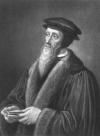
John Calvin

When we see that the whole sum of our salvation and every single part of it, are comprehended in Christ, we must beware of deriving the minutest portion of it from any other quarter. If we seek salvation, we are taught by the very name of Jesus that he possesses it. If we seek any other gifts of the Spirit, we shall find them in his unction; strength in his government; purity in his conception; indulgence in his nativity, in which he was made like us in all respects, in order that he might learn to sympathise with us. If we seek redemption, we shall find it in his passion; acquittal in his condemnation; remission of the curse in his cross; satisfaction in his sacrifice; purification in his blood; reconciliation in his descent into hell; mortification of the flesh in his sepulchre; newness of life in his resurrection; immortality also in his resurrection; the inheritance of a celestial kingdom in his entrance into heaven; protection , security, and the abundant supply of all blessings, in his kingdom; secure anticipation of judgement in the power of judging committed to him. In fine, since in him all kinds of blessings are treasured up, let us draw a full supply from him, and none from any other quarter.

The Institutes of the Christian Religion Book II Chapter 16:19.

Islam the Challenge to the Church

This is a new publication by Patrick Sookhdeo, International Director of Barnabas Fund. The author was brought up as a Muslim, but is now a Christian believer. In this book, Sookhdeo helps Christians to understand Islamic teaching. He makes clear that there are fundamental differences between Islam and Christianity. Islam explicitly denies the deity of Christ with its claim "There is no god but God". Christ's death and resurrection are also rejected. Islam emphasizes the love of power, while Christianity glories in the power of love.
.
If "love is the meaning of reality" for Christians, then power is the meaning of reality for Muslims. Power and its accompanying prestige must be gained at all costs. There is no place in Islam for a suffering God, and human vulnerability is likewise spurned. But the glory of Christianity is the vulnerability of human suffering borne out of our understanding of the suffering of God in Christ Jesus. To the Muslim mind this is an appalling thought. (p. 101)
>
Sookhdeo details the political objectives of Islam and exposes the persecution of Christians and other minority groups in many Islamic regimes. He warns Western Christians not to be naive when it comes to Christian-Muslim relations. The author urges us to engage in open, critical evangelistic dialogue with Muslim people, "it is vital that we week scholarly accuracy, that our hearts are filled with compassionate concern for Muslims as human beings, and that we remain utterly faithful to Christ and to his revelation." (p. 102)
.
This most helpful book will assist the Church to face the challenge of Islam. Click here to order.

Friday, May 05, 2006

Tolerance, Freedom & Law

There is no consensus on what is "the true religion". We face the challenge of presenting the gospel to a society in which many other versions of faith and non-faith are competing for adherents. We cannot take the hitherto predominance of Christianity for granted. It was wrong ever to do that. Each new generation has to be evangelised. Yet this is what we are here for. The Lord has given us a great opportunity along with that responsibility. The mission field is on our doorstep as well as overseas.

Click here for full article by Gordon Murray, Chairman of the Protestant Truth Society.

Wednesday, May 03, 2006

Geoff Thomas' Hobby (and mine)

Geoff Thomas - A Calvinist in Cyberspace

At the recent Banner of Truth Conference in Leicester (see below), Geoff Thomas drew attention to the Banner Website. Geoff is responsible for the excellent Articles page. He described his work on the site as his "hobby". Some hobby!

Visit Banner of Truth Articles here . See also Geoff's blog here .

I thought that "hobby" was an interesting way of describing internet work by a Minister. To me the word "hobby" is associated with shed-dwelling males who make model aeroplanes out of bits of old wood and string. I have long fed the delusion that I am far too cool and intellectual to have a hobby. But it seems that I have one after all - and you're reading it.
.
At the Banner Conference, I was surprised and slightly embarrassed to learn that several people I know have been visiting my little blog. Thanks for dropping by to look at my hobby whether you are an old friend someone from the other side of the world.
.
Still, sharing a pastime with Geoff Thomas can't be a bad thing can it? Ah well, back to the shed....er....study.