Pages

Monday, February 14, 2022

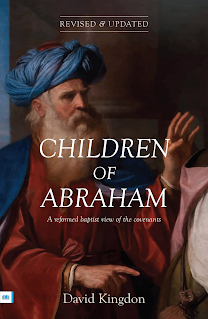
Children of Abraham: A reformed baptist view of the covenants, by David Kingdon

 
Grace Publications, 2021 edition, 256pp

Christmas Evans the Welsh Baptist preacher began his Christian life as a believer in infant baptism. He was outraged when he came across Baptists who contradicted his views. Evans set out to prove them wrong by reading the Bible from cover to cover and making a careful note of all the many references to the baptism of babies he discovered in holy writ. To his great disappointment he found none. Evans became a Baptist. The strength of the peadobaptist position, however, is not in its advocates' ability to produce killer proof texts in support of their position. Which is just as well. The case for infant baptism, rather, rests on elaborate biblical-theological arguments. Essentially it's all about the relationship between the old and new covenants, which is where David Kingdon rightly concentrates his considerable firepower. 

Paedobaptists hold that there is one overarching covenant of grace that is administered in different ways in the various biblical covenants. Under the old covenant, covenant membership was for Abraham and his offspring. Following on from that, paedobaptists contend that children of believers are also children of the covenant and should therefore be baptised. That is exactly the point that Kingdon sets out to dispute. 

Reformed Baptists certainly agree that there is one overarching covenant of grace. That covenant was first announced in the promise of Genesis 3:15 and was revealed with increasing clarity and fulness in the Abrahamic, Mosaic and Davidic covenants. They were not, however, administrations of the covenant of grace, the author argues. They were 'covenants of promise' (Ephesians 2:12). The covenants that God made with his people in the Old Testament period were earthly types and shadows of the blessings that would be granted under the new covenant. 

People were saved during the Old Testament period through faith in the promise of grace effected by Christ in the new covenant. In that sense the Saviour's death retrospectively atoned for the sins of old covenant believers, Romans 3:25-26, Hebrews 9:15. It was on that basis that 'Abraham believed God and it was accounted to him for righteousness' (Romans 4:3, citing Genesis 15:6). 

While it was true that all of Abraham's descendants were to be circumcised, not all of his offspring believed in the promise of salvation through Abraham's offspring, the Messiah. The Lord gave the Promised Land to the people of Israel, but not every inhabitant of the Land looked beyond it to the eternal inheritance of the new creation. In fact, it seems that only a remnant in Israel experienced the circumcision of their hearts to which circumcision in their flesh was but a sign, Deuteronomy 30:6, Romans 2:29). 

It is with that in mind that Paul could say, 'not all who are descended from Israel are Israel' (Romans 9:6). Belonging to God's covenant people by natural descent from Abraham was part and parcel of the earthly and temporary character of the the old covenant. That has now become obsolete since the Messianic offspring of Abraham has come, Galatians 3:16. Membership of the new covenant people of God is on the basis of 'believe and belong' whether Jew or Gentile, not natural descent (Galatians 3:29, 6:15-16). That is why baptism is only for those who have repented of their sins and believed in Jesus, for they alone are in Christ, Galatians 3:27. 

The old covenant distinction between outward membership of the people of God by descent from Abraham plus circumcision, and inward membership by circumcision of the heart and faith in the coming Messiah has been rendered null and void under the new covenant. In Jeremiah's promise of the new covenant (Jeremiah 31:31-34) all new covenant members of the people of God know the Lord, all have the law written on their hearts and all have their sins forgiven. Those things were only true for a godly remnant in Old Testament Israel. 

John the Baptist recognised the 'believing remnant' principle. The Baptist warned that Jewish people should not rest in the fact that they were descended from Abraham and circumcised, Matthew 3:9. He did not baptise the children of baptised adults, only repentant sinners who were waiting for Messiah to be revealed, Matthew 3:10-11. Christian baptism similarly is upon repentance and faith in accordance with the consistent witness of the New Testament, Acts 2:38-40, 8:36-38, 9:17-18, 10:44-48 etc. Church membership is for those who have made a credible profession of faith and have been baptised, Acts 2:41. 

David Kingdon originally published this work in 1973. This edition includes fresh maternal on the ministry of John the Baptist and the newness of the new covenant. Kingdon argues his case well, interacting throughout with representatives of the infant baptist tradition. In line with the Independent divine, John Owen, some Reformed Baptists have held that the old covenant was a republication of the covenant of works. Here Kingdon rightly lays stress on Paul's teaching that God's covenants with Israel were 'covenants of promise' that bore earthly and temporary witness to the spiritual and eternal blessings of the new covenant that are ours in Christ. 

Convinced paedobaptists will find much to chew on in his book as the writer calls into question some of their most cherished assumptions and points out weaknesses in their key arguments. Baptists will be helped to see that our position is rooted in sound theological reasoning as well as the plain teaching of the New Testament. As the author convincingly demonstrates, baptism is only for those who have repented of their sin and believed in Jesus Christ for salvation. Grace Publications are to be congratulated for publishing this revised and updated edition of Children of Abraham

Wednesday, January 26, 2022

Hypocrites!


As I write Sue Gray hasn’t yet delivered her verdict on the Downing Street lockdown parties. It would be foolish of me to try and speculate on what the fallout will be once her findings have been published. Once thing’s for sure, the appearance that lockdown rule makers were also rule breakers has left a bitter taste in people’s mouths. No one likes a hypocrite.

Some of Jesus’ harshest words were levelled against hypocrites, “they preach, but do not practise. They tie up heavy burdens, hard to bear, and lay them on people's shoulders, but they themselves are not willing to move them with their finger.” Seven times in Matthew 23 Jesus thunders, “Woe to you, scribes and Pharisees, hypocrites!”

The scribes and Pharisees styled themselves as righteous embodiments of God’s law. They were quick to condemn anyone who fell short of their high standards. But Jesus removed their masks to expose all the dishonest ways in which they tried to wriggle out of doing what God required. The scribes and Pharisees were careful to give away tenth of their garden produce, but neglected to practice justice, mercy and faithfulness. Jesus accused them of “straining at a gnat and swallowing a camel”.

Jesus had every right to denounce hypocrisy. He is the one preacher who always practiced what he preached. As for us, there is something of the hypocrite in us all. We are quick to condemn others when they behave badly. But do we always and without exception live up to our own noblest principles? The Golden Rule laid down by Jesus teaches, “So whatever you wish that others would do to you, do also to them”. It would be a very brave or foolhardy person to insist that they have always treated others as they wish to be treated themselves.  Never an unkind remark, never an irritable response?

It is only right that those who imposed harsh lockdown rules on others should be held to account if they broke them. “Woe to you, hypocrites!” But let’s not forget our own hypocrisy. We are all sinners who have fallen short of what God requires. All is not lost, however. The Christian faith teaches there is hope even for hypocrites. God offers mercy and forgiveness to everyone who believes in Jesus who died on the cross for our sins. 

* For the February edition of various local parish magazines.

Tuesday, January 04, 2022

A Christian’s Pocket Guide to Humanity: Created and Re-created, by David McKay

Christian Focus, 2021, 113pp, paperback

‘What is man?’, asks the psalmist. We will only begin to know the answer to that question if we understand what it means to be human in relation to God. This is exactly what this pocket guide sets out to do. McKay’s treatment is concise and straightforward without ever being superficial. He sets modern day concerns such as identity politics and transgenderism in clear biblical perspective, drawing upon the insights of Reformed covenant theology.          

Human identity

There is a lot of talk these days about human ‘identity’. For some their fundamental identity is tied up with their gender, sexuality, race, or political views. As David McKay shows, our true identity is not one that is made up by us, but one that is handed down by God. Our Triune Lord created human beings in his image as male and female. That fact bestows great dignity and worth on every human person. 

Ruined humanity

Recently Headmistress Katharine Birbalsingh got herself into spot of bother on Twitter when she suggested that due to ‘original sin’ children need rules and sanctions to keep them in line (see here). Cue predictable outrage at the idea that children might be morally flawed. But the Christian doctrine of original sin insists that all are sinners before God. McKay gives attention to humanity Ravaged by Sin. Man was created to live in a covenant relationship to his Maker. Adam represented the human race in the Covenant of Works. When Adam fell into sin, humanity fell with him. Adam’s sin was imputed to the whole human race. All are born with a sin-corrupted nature. Death reigns over all in Adam.

Redeemed humanity

But God has raised up a new representative for humanity in Jesus, the mediator of the Covenant of Grace. United to him, our sins are atoned for so that we may be forgiven and put right with God. In Christ believers are set apart as God’s holy people and adopted into his family. McKay could perhaps have said more about the corporate aspects of union with Christ in the life of the church.  

Renewed humanity

Finally, redeemed humanity will share Christ’s glory, gaining in him more than we ever lost, or could have had in Adam. God’s new humanity will bear the image of the last Adam in resurrection glory. Only then will the full answer to the psalmist's question, ‘What is man?’ be revealed. 

An excellent treatment of a timely theme.

*An edited version of this review was published in The Banner of Truth Magazine, January 2022

Friday, December 24, 2021

Christmas theology according to the Westminster and Baptist 1689 Confessions

I know that the Puritans who drew up the Westminster Confession and the Second London Baptist Confession weren't too keen on the idea of Christmas. But here are some thoughts on what those confessions (both Chapter VIII:2 - here) had to say on the incarnation of the Son of God. Where the LBC differs from the WCF, I have highlighted slight differences in wording in blue and more significant differences in red. In both the Confessions the relevant Chapter is headed, "of Christ the Mediator". The interest is not in exploring Christology for its own sake, but on setting out what the Son of God is for us.

The Westminster Confession of Faith (1646) The Son of God, the second Person in the Trinity, being very and eternal God, of one substance, and equal with the Father, did, when the fullness of time was come, take upon him man's nature, with all the essential properties and common infirmities thereof; yet without sin: being conceived by the power of the Holy Ghost, in the womb of the Virgin Mary, of her substance. So that two whole, perfect, and distinct natures, the Godhead and the manhood, were inseparably joined together in one person, without conversion, composition, or confusion. Which person is very God and very man, yet one Christ, the only Mediator between God and man.

The Second London Baptist Confession of Faith (1689) The Son of God, the second person in the Holy Trinity, being very and eternal God, the brightness of the Father's glory, of one substance and equal with him who made the world, who upholdeth and governeth all things he hath made, did, when the fullness of time was come, take upon him man's nature, with all the essential properties and common infirmities thereof, yet without sin; being conceived by the Holy Spirit in the womb of the Virgin Mary, the Holy Spirit coming down upon her: and the power of the Most High overshadowing her; and so was made of a woman of the tribe of Judah, of the seed of Abraham and David according to the Scriptures; so that two whole, perfect, and distinct natures were inseparably joined together in one person, without conversion, composition, or confusion; which person is very God and very man, yet one Christ, the only mediator between God and man.

The Savoy Declaration of Faith, the Independent's revision of the WCF makes no alterations to this section at all (see here). But the Baptists were clearly not content to leave the Presbyterian confession untouched. The Baptist version of VIII:2 is longer with 157 words to the WCF's 110. They add "Holy" to Trinity and were clearly unhappy with a reference to the "Holy Ghost", which they render "Holy Spirit". The first main addition, "the brightness of the Father's glory", is clearly an allusion to Hebrews 1:3. The statement that Jesus is equal with "him who made the world, who upholdeth and governeth all things he hath made" brings God's works of creation and providence into the frame. Where the WCF concentrates on the being of God, the LBC also emphasises his mighty acts.

The LBC omits the words "of her substance" from the clause "conceived by the Holy Spirit in the womb of the Virgin Mary of her substance" (WCF). This is a pity as it destroys the parallelism of the opening proposition, "The Son of God, the second Person in the Trinity, being very and eternal God, of one substance, and equal with the Father" (WCF). Also, the statement that Jesus was conceived in the womb of the Virgin Mary of her substance bears witness to two important truths: 
1) Mary was not a 'surrogate mother' who simply bore in her womb the humanity of Jesus which was created ex nihilo by the Holy Spirit. She was his true genetic mother. Hopefully without trespassing on the mystery of the Virgin Birth we can say in the light of modern genetics that Mary contributed the unfertilized egg, replete with her DNA. It was from that egg that the Holy Spirit created the human nature of the Son of God. The Spirit contributed the remainder of Jesus’ genetic code including his Y chromosome that made him male. Jesus really was the Son of Mary - of her substance
2) That Jesus was conceived by the Holy Spirit of the substance of his mother means that he is genuinely one of us. At the incarnation, the Son of God identified himself fully with the humanity he came to save. As the children were partakers of flesh and blood, he himself shared in the same, coming in the likeness of sinful flesh (Hebrews 2:14, Romans 8:3). Undoubtedly there is also something new here. Jesus was sinless, being conceived by the Holy Spirit in the womb of the Virgin. He was not 'shapen in iniquity and born in sin' as a son of Adam. He is the head of God's new humanity. As the risen Lord he is the last Adam, who gives resurrection life to those who were dead in trespasses and sins. Of course the LBC insists that Jesus was "made of a woman" and so none of this is denied. But perhaps the phrase of her substance makes the reality of our Lord's enfleshment and identification with humanity a little more clear. 
The Person of Christ is of one substance with God and of one substance with us, fully God and fully Man. The Baptist confession also alludes to Luke 1:35 in its description of the virginal conception of Christ, saying, "the Holy Spirit coming down upon her: and the power of the Most High overshadowing her." The LBC sets his incarnation in salvation-historical context by saying that Jesus "was made of a woman of the tribe of Judah, of the seed of Abraham and David according to the Scriptures"

Both confessions conclude with language that very much resembles the Definition of Chalcedon (here). It is worthwhile noting that the Puritans were not radical revisionists, who wanted to jettison the traditions of the Church in order to start again from scratch, aided by the Bible alone. For all their emphasis on sola Scriptura, they valued the theological heritage of the Church and were wiling to work within the parameters of earlier creedal theology. Where they had new light from Scripture, they revised - the WCF was a revision of the Anglican 39 Articles, and the LBC revises the WCF on baptism and other issues. But the Puritans were Catholic and Orthodox Christians, not sectarian hotheads. They believed in the historical dimension of the communion of the saints. Apart from details of punctuation, the WCF and LBC are in complete agreement in the final statement,
"So that two whole, perfect, and distinct natures, the Godhead and the manhood, were inseparably joined together in one person, without conversion, composition, or confusion. Which person is very God and very man, yet one Christ, the only Mediator between God and man."
Here we have the two natures, one person Christology that is characteristic of Chalcedonian orthodoxy. Also included are several safeguards against misunderstanding. The incarnation does not involve the conversion of the divine nature into another substance. The Son did not become man in the sense that he ceased to be God. After his enfleshment he was fully God and fully Man. Jesus' incarnate humanity is not a composition of the divine and human. For example, the Logos did not take the place of Jesus' human soul. If the Son did not assume a true humanity, with a real body and rational soul, then he cannot save us. Neither is there a confusion of natures in the person of Christ. For example, the humanity of the Son did not take on the attribute of omnipresence (even at his glorification - contrary to the Luther!). We are not to think that the whole person of Christ died on the cross. The Son died in his humanity. There was no confusion of natures at Calvary.

So, the WCF and LBC give us some clear headed Christmas theology. It seems that the Baptists preferred to express their teaching in the language of Scripture whenever possible, although they were not totally adverse to extra-biblical language such as "substance", "nature" and the Chalcedonian negations at the end of the statement. The reluctance of the Baptists to follow the Presbyterians and Independents in saying that Jesus was conceived by the Holy Spirit of the substance of the Virgin Mary is regrettable. But the Baptist revision adds welcome reference to God's works of creation and providence, and roots the incarnation of the Son of God in the flow of redemption history.

Sometimes we Evangelicals are guilty of speaking quite unadvisedly about what happened at the first Christmas. In the Christmas edition of a respected Evangelical newspaper I read these words, "It was a great and mighty miracle for God (who made us in his own image and likeness) to add our nature to his divine nature in one new person - the God-man." What's the problem with that statement? Well, if we are thinking in terms of the Church's historic confession, the union of the divine and human natures in Christ did not constitute a new person. What happened was that the Person of the Son took a human nature. Both the WCF and LBC make it clear that the second Person in the Trinity was the subject of the incarnation. The words "person", "nature" etc have been carefully defined over centuries and we need to use them with great care. Study of the great Puritan confessions of faith will help to save us from such blunders.

*Reprint of an old post

Monday, December 13, 2021

Christmas as planned


As we know from last year, Christmas doesn’t always go according to plan. With infection rates on the up the government reimposed Covid restrictions. Plans for festive reunions with family and friends had to be shelved. Hopefully that won’t happen again this time.*

Hopefully. The pandemic has certainly reminded us that our best laid plans may be disrupted. We are only human after all. None of us knows what challenges the future may bring. But the first Christmas happened exactly according to plan.

According to the Bible that plan was revealed almost as soon as the first human beings had sinned against God by defying his command. The Lord promised that a deliverer would come to break the power of sin and death. The fulfilment of that promise is the golden thread that runs through the Bible’s story.

God promised Abraham that one of his descendants would bring the blessings of salvation to all peoples. The Lord told King David that from his royal family line would come a king who would bring hope to the world. Then, in the fulness of time God sent his Son the Lord Jesus. He came as one of us, born of Mary. His birthplace was Bethlehem, the City of David. Just as the ancient prophets foretold. 

All went exactly according to plan. As Jesus grew up he knew that God’s plan meant he was going to have to lay down his life and then rise from the dead to break the power of sin and death. And so he did. By faith in Jesus we can know forgiveness of sin and the hope of everlasting life. Nothing can separate the believer from God’s love in the Lord Jesus. You can be sure of that because while our plans often fail, God’s never will.

*For local parish magazines, deadline mid-November, before the discovery of the Omicron variant 

Wednesday, November 10, 2021

Can We Trust the Gospels? by Peter J. Williams

Crossway, 2018, 153pp

'Gospel truth'. Really? Aren't the Gospel accounts of Jesus' life, teaching, death and resurrection just made up stuff that no rational person should believe? That's the question biblical scholar Peter Williams seeks to address in this little book. He produces a convincing cumulative case for the historical reliability of the New Testament Gospels; Matthew, Mark, Luke and John.

Few if any figures in the ancient world had so much written about them as Jesus of Nazareth. We not only have the witness of the four Gospels. Jesus is also mentioned in a number of non-Christian sources. These Roman and Jewish authors in no way intended intended to write favourably of the Christian faith.  Yet what they said bears out the essential facts concerning Jesus' life and death as recorded in the Gospels. These sources also describe Christian belief in the resurrection of Jesus from the dead and that the early church worshipped him as divine. 

Its is often suggested that the Gospels were written so long after the event that they can't be accurate. Like in the 'Chinese whispers' game, where a phrase is whispered into the ear of one person, who then passed it down the line to others. By the end of the game the phrase usually bears little resemblance to the one at the given at the beginning. 'Sausage, egg and chips' becomes 'postage stamps and crisps', or whatever. This idea is discounted by Williams. For starters, Jesus' treasured teachings weren't communicated in whispers to see what random stuff would come out the other end. They were committed to memory and handed on with great care. The author defends the view that the Gospels were written close the the period the describe, either by eyewitnesses (Matthew and John), or by writers who had access to eyewitness testimony (Mark and Luke). Even liberal scholars now accept an early dating of the Gospels. 

The chapter on Did the Gospel Authors Know their Stuff? is full of fascinating facts. The Evangelists certainly did. Their writings show deep familiarity with the Geography that forms the backdrop to Jesus' ministry.  For instance, local boy Matthew, Mark (based on Peter's testimony) and John refer to the 'Sea of Galilee', or simply 'the Sea'. Peter and John were fisherman on that stretch of water, so for them it was the sea. Luke who may well have hailed from Antioch near the Mediterranean refers to the same waters as 'the lake'. 

Williams delves into the way names are recorded in the Gospels, where the writers disambiguate names that were popular at the time. 'Jesus' was the sixth or seventh most popular Jewish Palestinian name in those days. Which is why when characters are recorded in the Gospels as speaking of Jesus  they often disambiguate, saying, 'Jesus of Nazareth' so listeners knew exactly which Jesus they were taking about. The quotes cited in the Gospels therefore have a contemporary ring to them. They were not made up after the event and placed in people's mouths for effect. When narrating what Jesus said or did the Gospel writers tend simply to say 'Jesus' without disambiguation, as they could be confident that their readers knew very well which Jesus they were talking about. 

As Williams points out, we don't get a sense that the Evangelists were deliberately corroborating each other's accounts. They weren't like criminals concocting their watertight alibis lest they be collared by the police. While there is overlapping material in the four Gospels (especially the 'Synoptics; Matthew, Mark and Luke'), each has their own unique touches. Williams highlights a number of 'undesigned coincidences' where one Gospel in supplying information that is missing from the others helps to fill out the picture. What Luke and John have to say about the sisters Mary and Martha is given a case in point. In different ways both Evangelists present Martha as down-to-earth and practical, while Mary is seen as the more contemplative sibling.  

Various questions that may cause people to doubt the truthfulness of the Gospels are also given attention. Do we have the actual words of Jesus? Has the text changed? What about contradictions? And so on. For me one of the most powerful arguments that Williams makes is about the person of Jesus himself. The one who emerges from the pages of the Gospels is clearly extraordinary in every way. Which is why the preacher from Nazareth continues to command our attention some 2,000 years after he waked on earth. It could be that the Gospel writers were literary geniuses who independently created this special character and put amazing words into his mouth. The simpler and more likely explanation is that Jesus was who they said he was, the Son of God in human form, John 20:30-31.

If you are interested in the Christian faith, but not yet convinced, this book may address some of your doubts. Believers will have their confidence in the Gospels confirmed. They will be able to use the author's arguments in discussing the faith with friends who may be sceptical about the Gospel records. Pastors reading this will have their understanding of the Evangelists' multifaceted witness to Jesus enriched, which will hopefully serve to make their preaching all the more persuasive. 

Gospel truth? Yes, really.

Friday, October 22, 2021

The Way of Forgiveness

‘Unforgiveable’. That might well be our reaction to the cruel murder of the MP David Amess. By all accounts he was a decent and honourable man who sought to do his best by the Southend constituents he was elected to serve. The culprit will no doubt face justice. Questions will be asked about the effectiveness of the deradicalisation programme, Prevent. All right and good. Yet the MP’s grief-shattered family called not for recriminations, but asked that “people to set aside their differences and show kindness”.

Kindness and forgiveness seem to be in short supply these days. England cricketer Ollie Robinson was suspended for foolish tweets he posted when a teenager, for which he sincerely apologised when they came to light. Universities used to style themselves as champions of free speech where students would go to have their ideas challenged. Not so much these days. Students at the University of Sussex demanded that Professor Kathleen Stock be sacked from her post. Her questioning of transgender ideology was deemed beyond the pale. The professor has been subjected to such angry intimidation that she now needs bodyguards to escort her to lectures. Social media has only amplified tensions, with 'Twitter mobs' piling on people whose views are regarded as 'problematic'. 

Politely ‘agreeing to disagree’ is no longer enoughStep out of line and you might find yourself ‘cancelled’, with little hope of redemption. But who of us is perfect in thought, word and deed? The Christian faith reminds us that we are all sinners. Every one of us falls far short of God’s perfect standard of righteousness and truth. That is why we need forgiveness. The wonderful thing is that God has provided the way of forgiveness through his Son, Jesus. He was ‘cancelled’, condemned to death by crucifixion. There on the cross Jesus died for the sins of the world. All who believe in him are forgiven and put right with God. Jesus taught his followers to pray, ‘Father, forgive us our sins, for we ourselves forgive everyone who is indebted to us.’

As a society we desperately need to recover the idea that the lost can be found and the guilty forgiven. The cross of Jesus is a good place to start.

*Edited versions in various local publications for November: Trinity Magazine Dilton Marsh, News & Views West Lavington, Market Lavington & Easterton Church & Community News, and White Horse News Westbury. 

Tuesday, July 20, 2021

Letter to Robert Jenrick objecting to Westbury Waste Incinerator Plant

The Rt. Hon Robert Jenrick MP
Secretary of State
Ministry for Housing, Communities & Local Government
2 Marsham Street,
London
SW1P 4DF

 Dear The Rt. Hon Robert Jenrick MP,

We are writing to object to the granting of planning approval for the Waste Incinerator plant at Northacre Industrial Estate, Westbury by the Strategic Planning Panel of Wiltshire Council in June 2021. This was despite over 2000 objections made by local residents, as well as opposition from Westbury Town Council and seventeen other neighbouring town and parish councils.

Many people living in the Westbury already suffer with chronic health problems. Cancer and lung condition deaths are higher here than across Wiltshire. Poor air quality has been exacerbated by HGVs being diverted from Bath onto the A350 through Westbury.

The incinerator would mean an estimated additional 20,000 truck journeys a year around the town. Smoke belching from the incinerator chimney would make the situation even worse, further damaging the health of Westbury residents.

Arla Foods (Westbury) Ltd are so concerned about the impact of the plant on air quality that they have threatened to close their dairy if the waste incinerator is allowed to go ahead, resulting in the loss of at least 250 jobs.

The incinerator will increase CO2 emissions, flying in the face of the government’s Climate Emergency Commitments. The children and young people of the town deserve better than to have their lives blighted by growing up in the shadow of this environmentally disastrous development.

I understand our local MP The Rt. Hon Dr Andrew Murrison has written to you asking that you ‘call in’ the decision of the Strategic Planning Panel for review. In the light of overwhelming local objections, I would ask that you overturn planning approval for siting a waste incinerator plant in Westbury, where it is certainly not wanted.  

Yours sincerely..... 

Thursday, July 08, 2021

The Rise and Triumph of the Modern Self, by Carl R. Trueman

The Rise and Triumph of the Modern Self: 
Cultural Amnesia, Expressive Individualism and the Road to Sexual Revolution,
by Carl R. Trueman, Crossway, 2020. 434pp, Kindle edition 

The other week Housing Secretary Robert Jenrick was interviewed on Times Radio. It's the job of journalists to put government Ministers on the spot by asking them tricky questions. But the nature of what constitutes a 'tricky question' changes. In this case Jenrick was quizzed on whether he agreed with his colleague, Liz Truss, the International Trade Secretary that you need to have a vagina to be a woman (see here). The Housing Secretary replied, 'I think there's a matter of biology, of course, what is a woman. I mean absolutely, I agree with Liz Truss. That's the point that she's made in the past.' Given the constraints of collective responsibility, how could Jenrick say otherwise? He knew, however, that a trap was being set and not wanting to offend the perpetually offended trans lobby, the minister qualified his words saying, 'Undoubtedly, of course we want to ensure that those people who are trans can live their life comfortably. I want everyone to be able to live their life the way they want to and be happy and to find love wherever they can do.' 

Expressive individualism 

You may be wondering how on earth we got ourselves into a position where journalists put government ministers through their paces by asking them whether women have vaginas. Since when did the basic facts of biology become a matter of political debate? Charles Taylor speaks of the 'social imaginary', a set of underlying assumptions that make beliefs plausible at any given time. In a less secular age faith in God was part of the 'social imaginary'. While a minority may have dissented, most people assumed the existence of a divine being and lived their lives accordingly. Now, not so much. These days the 'social imaginary' is limited to the immanent frame, haunted only on occasion by the sense of a transcendent realm. Similarly, the idea that a man can become a woman and just as much a woman as someone who was born female would have been regarded as nonsense until relatively recently. But now it is part of the 'social imaginary' and to dissent from that view is to attract accusations of 'transphobia', which Robert Jenrick for one was so keen to avoid

In this book Carl Trueman sets out how the 'social imaginary' of the Western world lent itself to the belief that a man can become a woman, or vice versa. Transgender ideology didn't emerge from nowhere. The writer traces its roots back to the 18th-century Romantic movement. Jean-Jacques Rousseau was the father of Romanticism. He held that people are born free and innocent, but are corrupted by society which imposes its oppressive values on the individual in order to force to them into conformity with accepted standards of behaviour. English Romantic poet Percy Bysshe Shelley agreed. He wanted to break free from from societal norms that were based on monogamous marriage so he could practice sexual self-expression. That was the only authentic way to live, free from outward constraints. The Romantics expected society to uphold basic moral values for the good of everyone concerned, but the emphasis was on the psychological fulfillment of the individual. 

Prime Minister Boris Johnson might call it 'cakeism', a case of  'having one's cake and eating it'. The Romantics granted the benefits of Christian ethics for society as a whole, but reserved the right to transgress the elements that hindered their self-expression. Friedrich Nietzsche saw things more clearly. If God was pronounced dead, then faith-based values ceased to have any validity. Heroic self-invention is the only way forwards. Add Karl Marx and Charles Darwin to the mix and all sense that human beings are distinct creatures with a nature bestowed upon them by God is lost. We are plastic people in a fluid world. 

Then along came Sigmund Freud to sex things up a bit. He basically thought that everything is about sex. Society enforces the suppression of the sex drive of the individual by insisting that desire is channelled through monogamous marriage. That may not necessarily be a bad thing, but if marriage is simply a social construct, people are free to deviate from its constraints if they wish. Freud had no time for belief in God, rendering marriage as a 'divine ordinance' meaningless. Taking their cue from Freud, Marxist thinkers such as Herbert Marcuse began to see patterns of oppression more in psychological than economic terms. People with sexual proclivities that deviated from the norms of society weren't so much 'depraved deviants' as victims of heteronormative oppression. 

The Romantics taught the primacy of psychological self-expression over and against the norms of society. Freud emphasised the primacy of the sexual in the realm of psychology. Marx argued that rather than being a fixed entity, human nature is shaped by the economic tides of history. Industrialisation had a profound effect on how society viewed the role of women. The rise of the machines meant that women as well as men could be employed in factories, eroding traditional gender-based distinctions. Modern medicine has made further erosion possible. Men may be given female sex hormones. They may submit to sex change surgery so that the body of a natal male is refashioned to resemble that of a woman. (DNA and internal reproductive organs aside). Expressive individualism demands that if a man feels he is really a woman, but trapped in the wrong body, his psychology trumps his biology and his gender identity must be validated by society. 'Trans women are women', get over it. 

That's what you get when the 'social imaginary' is the product of expressive individualism. Robert Jenrick's nod towards trans ideology cited earlier is a perfect case in point, 'of course we want to ensure that those people who are trans can live their life comfortably. I want everyone to be able to live their life the way they want to and be happy and to find love wherever they can do.' In this context the idea that sex is immutably rooted in biology and that biology should have something to say about sexual expression is regarded as oppressive. 

Tensions 

And so it is that in England the LGBT pressure group 'Educate & Celebrate' seeks access to schools so it can advance its mission to 'smash heteronormativity' (see here). Children are taught they can choose whether to be a boy or a girl, based on how they feel inside. Expressive individualism for kids. But there are pushbacks, especially from feminist groups whose whole outlook is based on women being oppressed by a patriarchal society on the basis of sex differences. Feminists resent the downgrading of their biological reality by men who demand to be recognised as women. They are also outraged that biologically intact males who identify as female are given access women's toilets, prisons and refuges. Parents are alarmed when it becomes apparent that their children have been exposed to the kind of trans propaganda promoted by groups such as 'Educate & Celebrate'. Even that bastion of 'muscular liberalism', Ofsted is now concerned about the influence of lobby groups on sex education in schools (see here). 

Adding the 'T' to the LGB lobby has also resulted in tensions. The gay lobby traditionally fought for rights on the basis that people don't choose to be gay or lesbian. Sexual identity, they claimed, is fixed and society should't regard same-sex attracted people as deviants who should be made to conform heterosexual norms. Trans ideology promotes the idea that sexual identity is not fixed, but fluid. If they wish, people should be able to identify as a gender that is different to their birth sex. 'Trans women are women' and woe betide anyone who says otherwise. But lesbian sexuality is based on attraction to people of the same sex, not male-bodied people who identify as women. The LGBT lobby group Stonewall is being dropped by government departments because of its attempts to silence gender critical voices and the misleading advice it gives on the Equality Act with regard to female-only spaces etc. (see here). 

True identity 

In an Unscientific Postscript Trueman looks at how things may pan out in Western culture, captured as it has been by expressive individualism. With the trans lobby labelling gender critical feminists as a bunch of no good 'TERFs' (Trans Exclusionary Radical Feminists), intersectionality isn't exactly providing a recipe for a more harmonious society. Free speech and with it freedom of religion is likely to come off worst when Christians voice their opposition to the LGBT agenda. After all, the 'heteronormativity' represented by traditional Christians is part of the problem and we can't have people voicing opinions that would disturb the phycological wellbeing of others. But we must stand firm and not allow the world to press us into its mould. Contra expressive individualism, people are not free to create their own identity. Human identity is a given thing, rooted in our being made in the image of God as male and female. Marriage can't simply be redefined so as to ignore that reality. The identity of the believer is not located in their sexuality, or gender identity, but in Christ. Our task is to preach him and all things in relation to him, Colossians 1:28-29. 

Thursday, July 01, 2021

Methodism: 'an alien place for conservative evangelicals'

As a boy I used to attend the local Wesleyan Methodist Chapel Sunday School. I believe the work has since closed, but when I was a kid a good number of children used to attend 'Aunty Betty's' Sunday School meetings. I can't recall much of what we were taught, but the lessons were Scripture-focussed. Bible stories mainly, rather than clear presentations of the gospel. I have no lingering impression of the Way of Salvation ever being explained to the children. The Christmas Nativity Play was an annual highlight, as parents would also attend. I have a vague recollection of being a shepherd; decked out in a dressing gown and with a tea towel on my head that was kept in place by one of those snake-buckle belts that were all the rage in the 1970s. 

So much for my youthful brush with Methodism. Todays' Methodist Church is a far cry from anything 'Aunty Betty' would have recognised, let alone John Wesley. Yesterday The Times newspaper reported Methodists to allow same-sex weddings. Members of the Methodist Conference voted on a motion that marriage could be defined as a union between "two people", rather than only between "one man and one woman". The vote to redefine marriage passed with 254 in favour to only 46 against. Methodists leaders expressed concern that a significant minority of 'traditionalists' might leave the grouping over this matter. Opponents of same-sex marriage were assured that there were safeguards in place that would allow them to opt out of performing same-sex weddings.  

One evangelical minister responded, "There's a real sense that the Church has become an increasingly alien place to be a conservative evangelical, and there is a sense that the Church is on a direction of travel which many over the course of this next year or two will probably feel unable to sustain". (See this report in Christian Today). A request that evangelicals be allowed to leave Methodism with their church buildings and assets was quite predictably rejected. Evangelicals are none the less weighing up their options.

Methodism was born of the 18th century Evangelical Revival. Methodism had two main branches, those who followed the Calvinistic teaching of George Whitefield and others who came under the influence of the Arminian John Wesley. The Methodist Church of today had its genesis in Wesleyan Methodism.  Whitefield and Wesley had their doctrinal disagreements, but they were united in the basic elements of evangelical belief. The historian David Bebbington has identified four defining characteristics of evangelicalism
  • Conversionism: the belief that lives need to be transformed through a “born-again” experience and a life long process of following Jesus
  • Activism: the expression and demonstration of the gospel in missionary and social reform efforts
  • Biblicism: a high regard for and obedience to the Bible as the ultimate authority
  • Crucicentrism: a stress on the sacrifice of Jesus Christ on the cross as making possible the redemption of humanity
The vote of the Methodist Conference to allow same-sex weddings didn't come from nowhere. In his Wesley and Men Who Followed (2003, Banner of Truth Trust), Iain H. Murray tells the story of how Methodism gradually drifted away from its evangelical origins. Certainly 'Biblicism' as defined by Bebbington is no longer the default position of the Methodist Church.  John Wesley was ready to be called a 'Bible bigot'. Many of today's Methodists would probably run a mile to get away from any such label. But that is nothing new. In 1965 Donald Soper was president of the Methodist Conference. Far from being a 'Man of One Book', he held that the Scriptures 'represent an incubus' and proposed a one-year ban on Bible reading. 

Around the same time Leslie Weatherhead argued that, 'William Temple was just bas inspired as Paul and T. S. Eliot more inspired than the Song of Solomon'. Weatherhead was especially opposed to the deity of Christ and his substitutionary atonement. Commenting on the text, 'Without the shedding of blood there is no forgiveness of sins' (Hebrews 9:22), the Methodist leader countered, 'In our modern view this is simply not true.' Old fashioned Methodists were left asking, 'Was John Wesley deceived? have our hymnwriters been deceived in their immortal songs? Was Saul of Tarsus deceived? Have we all been deceived?' (See Wesley and Men Who Followed, p. 257-258). 

In his 1966 address, Evangelical Unity: An Appeal. D. Martyn Lloyd-Jones asked, 'Are we content, as evangelicals, to go on being nothing but an evangelical wing of a church?' At least since the 1960's evangelicals have been a minority group within the Methodism. Liberal thinking that is happy to accommodate itself to contemporary opinion has prevailed. The overwhelming vote in favour of redefining marriage is merely a symptom of a deeper doctrinal and spiritual malaise. The leadership of the Methodist Church has long sold the pass when it comes to the authority of Scripture and basic gospel truths such as the deity of Christ and his penal substitutionary death. How can evangelicals continue stand shoulder to shoulder with leaders who have departed from the gospel? 

Yes, 'traditionalists' within Methodism may be granted an 'opt out' when it comes to performing same-sex weddings. At least for now. But wouldn't it be better for people who are committed to the gospel to opt out altogether from a church grouping that takes its lead from the spirit of the age, rather than the authority of the Holy Spirit speaking in the Scriptures? Separation will be costly, but separation need not mean isolation for evangelical Methodists. The call is for them to come out and come together with other gospel churches who stand for the truth in these days of compromise and confusion.