Pages

Tuesday, March 22, 2022

May we pray to the Holy Spirit?


I once heard a preacher say  that prayer should ordinarily be addressed to God the Father. Arguably, he said, we may pray to Jesus, but we should probably not pray to the Holy Spirit. The preacher conceded that John 14:13 may give us good grounds for praying to Jesus, plus Stephen's example in Acts 7:59-60. Paul makes calling on the name of the Lord Jesus Christ the hallmark of belonging to his people (1 Corinthians 1:2), so I think we may safely conclude that doing so is perfectly fine. Prayer to the Holy Spirit, though, where's that in the Bible? 

Rest assured I have a perfectly serviceable 'proof text' for you, but before we come to that, please allow me to introduce Dr John Owen and his great work On Communion with God. You'll find it in Volume 2 of his Works, published by the Banner of Truth Trust. Although various standalone versions are also available, if you prefer. In On Communion with God, Owen meditates on how the believer may have distinct communion with each person of the Trinity. One of his driving thoughts is that communion with any one divine person necessarily involves the other two. Inseparable operations and all that. 

Our preacher's text was Matthew 6:9, 'Our Father in heaven, hallowed be your name'. It is true that prayer is ordinarily addressed to the Father in the name of the Son and by the presence of the Holy Spirit, Ephesians 2:18. But the Father we address is the God and Father of our Lord Jesus Christ, the Father's only begotten Son. The Holy Spirit is the Spirit of God and Christ, (Romans 8:9), who proceeds from the Father and the Son. When we 'hallow' the name of 'our Father', we are also 'hallowing' his Son and the Holy Spirit. 

Why? Because holiness is an attribute of God's being, which is possessed equally, fully and without division by all three persons of the Trinity. As Owen says, "The divine nature is the reason and cause of all worship; so that it is impossible to worship any one person and not worship the whole Trinity." (p. 268). Our Puritan divine gives attention to the text cited in the previous paragraph, Ephesians 2:18:
Our access in our worship is said to be "to the Father;" and this "through Christ," or his mediation; "by the Spirit," or his assistance. Here is a distinction of the persons, as to their operations, but not as their being or object of worship. For the Son and the Holy Ghost are no less worshipped in our access to God than the Father himself; only, the grace of the Father, which we obtain by the mediation of the Son and the assistance of the Spirit, is what we draw nigh to God for. So that when, by the distinct dispensation of the Trinity, and every person, we are led to worship (that is, to act faith on or invocate) any person, we do herein worship the whole Trinity and every person, by what name soever, of the Father, Son or Holy Ghost, we invocate him. (p. 269)

In worshipping or praying to the Father, we are also worshipping and praying to the Son and the Holy Spirit, for the Son and Spirit are one being with the Father. Reflect also on the great trinitarian benediction in 2 Corinthians 13:14. 'Grace' is appropriated to the Lord Jesus Christ, 'love' to God [the Father] and 'fellowship' to the Holy Spirit. But grace is also the grace of God (Romans 5:15) and of the Spirit (Hebrews 10:29). God's love is commended to us in the death of his Son and poured into our hearts by the Spirit (Romans 5:8, 5). Fellowship with the Spirit is also fellowship with the Father and his Son Jesus Christ (1 John 1:3). With that in mind, it is no more problematic to offer worship to the Holy Spirit, or pray to him, than it is to worship and pray to the Father, or the Son. 

Indeed, Owen goes on to argue that we should offer distinct praise to the Holy Spirit for his work in our lives, as we rightly give glory to the Son for redeeming us by his blood, Revelation 1:5-6. We should also pray to the Holy Spirit "for the carrying on the work of our consolation, which he hath undertaken, lies our communion with him. John prays for grace and peace from the seven Spirits that are before the throne, or the Holy Ghost, whose operations are perfect and complete." (p. 271). Owen gives directions on how the believer may do just that in the following pages.

Theologically speaking then, prayer to the Holy Spirit is part and parcel of our communion with the triune God. But I promised you a proof text. Let me take you to Ezekiel's vison of the valley of dry bones. When Ezekiel prophesied to the bones they came together and were covered with flesh, but there was no life in them (Ezekiel 37:7-8). Then the Lord told Ezekiel to speak to the breath that the slain may live. The breath came and raised them to life, 'an exceedingly great army' Ezekiel 37:9-10. The 'breath' or roach in Hebrew is none other than the Spirt of the Lord, Ezekiel 37:14, compare Psalm 33:6. Israel's national  'resurrection' after the Babylonian Captivity is a picture of the resurrection of believers by the power of the Spirit, Romans 8:11. If Ezekiel could speak to the 'Spirit of life' (Romans 8:2, 10), so may we. Besides, as Owen points out, in Revelation 1:5-6, the Spirit is invoked as the source of grace and peace alongside 'him who is and who was and who is to come' [the Father] and Jesus Christ. 

While the usual order in prayer is to the Father, in the name of the Son and by the Spirit, this is not a stereotypical formula in Holy Scripture. We may also call upon the name of the Lord Jesus Christ and seek the aid of the Holy Spirit in prayer. 

Come, Holy Spirit, like a dove descending,
Rest Thou upon us while we meet to pray;
Show us the Savior, all His love revealing,
Lead us to Him, the Life, the Truth, the Way.

Thursday, March 17, 2022

Shakespeare by Bill Bryson

 William Collins, 2007, 200pp

Last autumn my wife and I enjoyed a week's holiday in the Cotswolds. Our base was the historic town of Tewkesbury. Little did we know when we booked to stay there some months earlier, that in late October 2021 Tewkesbury was to become the Covid hotspot of England. Infection rates had skyrocketed. Thankfully, we managed not to catch it. 

Plague aside, staying in Tewkesbury was convenient for visiting Cotswoldy hotspots such as Bourton on the Water and Stow on the Wold. The town, boasting an Abbey and battlefield site, was also handy for a quick drive to nearby Cheltenham, where we saw Dune in the cinema. It's not too far from Stratford on Avon, either, or 'Shakespeare country' as the Warwickshire Tourist Board likes to call it.

We've been to see I don't know how many Shakespeare plays over the years. In fact on our first date we went to see Kenneth Branagh's Henry V. Worked for us. A local amateur company, Shakespeare Live  stages an outdoor performance for a week in early July.  Well timed for a wedding anniversary night out. We've seen a few plays at Shakespeare's Globe in London. Who knew the Bard was woke before his time, with a penchant for gender fluidity so complex that he had women playing men's roles and even women playing men who were playing women? Box Tale Soup do an excellent Twelfth Night with puppets. And then there are the various films and TV versions, most recently The Tragedy of Macbeth with Denzel Washington in the title role.

But apart from a basic smattering of facts, I didn't know much about William Shakespeare himself. On our day trip to Stratford on Avon we booked a boat trip on the River Avon and a visit to Shakespeare's Birthplace. It was fascinating to look round the exhibits on display in the visitor centre and explore the playwright's childhood home. On our way out we passed through the gift shop and I was possessed by the sudden urge to buy a Shakespeare biography. As you might expect there were several on the shelves, but I opted for this one by Bill Bryson. Although I'd heard of the author this was the first book I had read by him.

Turns out that apart from a basic smattering of facts little is actually known about the world-renowned figure of English literature. Scholars don't have a clue what he was up to for huge chunks of his life. The only access we have to his inner thoughts and feelings is through his poems and plays. They don't necessarily represent his personal feelings or views on life. We can't be sure what he looked like, or even how his name should be spelled. By way of contrast we have a wealth of information from various reliable sources when it comes to the life and teachings of Jesus, who walked among men some 1500 years before Shakespeare, (see here).

Bryson carefully sifts the established facts of Shakespeare's life from the stuff of myth and legend. He sets the writer against the backdrop of his times and offers a brief analysis of his key poems plays. All is done with the lightness of touch and good humour for which the author is renowned. In a final chapter, Claimants Bryson briefly, but devastatingly critiques the claims of those who believe that an ordinary fellow like William Shakespeare could not possibly have written the great works associated with his name. 

Making Covid-stricken Tewkesbury our base probably wasn't such a bad idea for trying to understand Shakespeare's life and times, which were characterised by wave after wave of population decimating plague. 

Friday, March 04, 2022

Spring is Sprung


'Spring is sprung, the grass is riz
I wonder where the birdies is'

Well, it all depends on what you mean by Spring. Astronomers insist that Spring begins on 20 March. All to do with the Earth’s orbit in relation to the Sun. Meanwhile Meteorologists date the start of Spring from 1 March, when the weather gets a little warmer after the chill of winter. That still doesn’t solve the mystery of ‘where the birdies is’, but there we are.

It’s been a mild winter overall, although drew to an end in a stormy rage. Spring will certainly welcome. It’s a joy to see the daffodils in bloom and to know that lighter evenings are on the way. There are also hopeful signs that the worst of the coronavirus pandemic is behind us, with brighter days ahead.

The annual round of the seasons is testimony to the faithfulness of God. As it says in the Book of Genesis, ‘While the earth remains, seedtime and harvest, cold and heat, summer and winter, day and night, shall not cease.”

Spring is the season when Christians celebrate that Jesus is risen from the dead. The long dark winter of the world is over. By his death on the cross and resurrection from the tomb Jesus broke the power of sin that reigns in death. Spring is sprung. Jesus said, “I came that they may have life and have it abundantly.”

Jesus offers this abundant life to all who hear his voice and come to him, “I give them eternal life, and they will never perish, and no one will snatch them out of my hand.”*

* For March editions of various local parish magazines/newspapers 

Tuesday, February 22, 2022

The Mosaic Covenant: a covenant of works?

"This covenant [of grace] is revealed in the gospel; first of all to Adam in the promise of salvation by the seed of the woman, and afterwards by farther steps, until the full discovery thereof was completed in the New Testament" (Second London Baptist Confession of Faith, 1689, chapter 7:3)

Samuel Renihan (@Petty_France) recently tweeted a ten point summary of Thomas Goodwin's view of the Mosaic Covenant. I've reproduced the list below. Goodwin's stance bears more than a passing resemblance to that of his fellow Independent and good friend, John Owen. Owen's understanding of the Mosaic Covenant was highly influential in Particular Baptist circles. Renihan has dealt with this at length in his excellent, From Shadow to Substance: The Federal Theology of the English Particular Baptists (1642-1704), Regent's Park College, 2018. In essence Goodwin, Owen and many Particular Baptists held that the Mosaic Covenant was a covenant of works that was subservient to the covenant of grace. This line of thought is certainly compatible with the Second London Baptist Confession, but it is not explicitly taught in that document. 

In his more recent The Mystery of Christ: His Covenant And His Kingdom, Founders Press, 2019 or Broken Warfe (UK edition), Renihan make this distinction between a covenant of works and a covenant of grace, "In a covenant of works, when obedience has been rendered, blessings promised are enjoyed. Conversely, in a covenant of grace, after promises have been received, laws are introduced." But on that basis, was the Mosaic Covenant really a covenant of works? Did the Lord redeem Israel from Egypt and promise them the land of Canaan on the basis of obedience rendered? I think not. 

The Mosaic Covenant was a further elaboration of the Abrahamic Covenant especially formulated for Israel's life in the Promised Land, Exodus 3:1-8. The law was given to Israel as God's redeemed people, Exodus 20:1-2. It was as such that Israel entered into a solemn covenant with the Lord and promised to obey him, Exodus 24:3. The covenant was ratified by the shedding of blood without which there is no forgiveness of sins, Exodus 24:6-8, Hebrews 9:18-22. 

Should Israel renege on their covenant obligations they were threatened with exile from the Promised Land (Deuteronomy 28). But that does not make the Sinai Covenant a covenant of works. Unlike with Adam, there was a way back for Israel from the dark paths of sin, Leviticus 26:40-45. 

But neither does this mean that the old covenant was an administration of the covenant of grace, as taught in the Westminster Confession of Faith (Chapter VII:V). It was not. For one, the covenant of grace is with Christ and his elect people. The old covenant was with Abraham and his descendants, but 'not all who are descended from Israel belong to Israel' (Romans 9:6). Among the people of Israel only a remnant were chosen by grace for salvation through the coming Messiah, Romans 11:5). The Abrahamic, Mosaic and Davidic covenants were 'covenants of promise' (Ephesians 2:12) wherein the covenant of grace was revealed, "until the full discovery thereof was completed in the New Testament". 

With those thoughts in mind I will offer a brief comment on each of Goodwin's points on the Mosaic Covenant as summarised by Renihan. 

1. It was a promulgation of the covenant of works - no. The Mosaic covenant was not a republication of the covenant of works with with Adam. Life in the Promised Land was not granted to Israel on the basis of their righteous obedience, Deuteronomy 7:6-8, 9:5. Neither was it an administration of the covenant of grace. It was a 'farther step' in the revelation of salvation promised in Christ. 

2. It was based on a redemption other than Christ's - yes, the exodus, which typified Christ's redemption, Colossians 1:12-14.  

3. It had a Mediator other than Christ - yes, Moses, who foreshadowed the work of Christ as mediator of the new covenant, Hebrews 3:1-6. 

4. It offered a sanctification other than Christ's - 'I am the Lord who sanctifies you' (Leviticus 20:8). Israel was set apart as God's holy nation by virtue of the Lord's electing love and redeeming power. Israel's holiness was to manifest itself as the nation was devoted to God in obedience to his commands. These commands included ceremonial rules such as the food laws of Leviticus 11 and regulations concerning bodily discharges in Leviticus 15. But Israel was also called to pursue an inward holiness that was only possible by the work of the Spirit, Psalm 24:3-6, Ezekiel 36:25-28. Israel's role as a 'holy nation' to the Lord was a shadowy picture of the sanctifying work of Christ by the Spirit under the new covenant, 1 Peter 1:1-2, 14-19, 2:9-10. 

5. It gave a justification other than Christ's. What does this even mean? Under the Abrahamic and Mosaic covenants justification was by faith in the promised Christ, Gen 15:6 (Romans 4:1-5), Psalm 32 (Romans 4:6-7). The Law and the Prophets of the old covenant bore witness to the righteousness of God apart from the law by faith in Christ, Romans 3:21-22. 

6. It promised an earthly life and inheritance. Yes, which was typical of the eternal inheritance of the saints, 1 Peter 1:3-5. 

7. Unregenerate Jews could keep the covenant. No, to do that their hearts needed to be circumcised,  Deuteronomy 10:12-16, 30:6. That was only the case for a godly remnant, which was why Israel as a whole broke the covenant and was exiled from the land. The unregenerate could not live up to the law's demands and stood condemned for their disobedience (Romans 8:3a, Galatians 3:10-11). By way of contrast the new covenant was 'not of the letter, but of the Spirit. For the letter kills, but the Spirit gives life.' (2 Corinthians 3:6).

8. It was typical of the covenant of grace. How is this compatible with point 1? The Mosaic covenant is typical of the covenant of grace only because it was graciously made with Israel as a covenant of promise. The types and shadows of the old covenant point to Christ, the antitype and substance, Hebrews 8:5-6, Colossians 2:16-17. 

9. It was subservient to the covenant of grace. Yes. Its function was to prepare the way for Christ and then get out of the way once the mediator of a new and better covenant had come, Galatians 3:23-25, Hebrews 8:13.  

10. It was "truly, and toto genre, differing from" the covenant of grace. Yes, because a promise is different from its fulfilment, a type is different from an antitype and a shadow different from the substance. The temporary old covenant was indeed different from the eternal covenant of grace which was finally and fully disclosed in the new covenant.

Monday, February 14, 2022

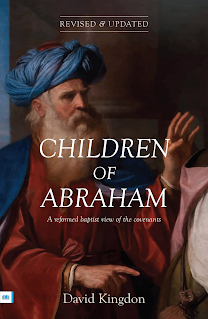
Children of Abraham: A reformed baptist view of the covenants, by David Kingdon

 
Grace Publications, 2021 edition, 256pp

Christmas Evans the Welsh Baptist preacher began his Christian life as a believer in infant baptism. He was outraged when he came across Baptists who contradicted his views. Evans set out to prove them wrong by reading the Bible from cover to cover and making a careful note of all the many references to the baptism of babies he discovered in holy writ. To his great disappointment he found none. Evans became a Baptist. The strength of the peadobaptist position, however, is not in its advocates' ability to produce killer proof texts in support of their position. Which is just as well. The case for infant baptism, rather, rests on elaborate biblical-theological arguments. Essentially it's all about the relationship between the old and new covenants, which is where David Kingdon rightly concentrates his considerable firepower. 

Paedobaptists hold that there is one overarching covenant of grace that is administered in different ways in the various biblical covenants. Under the old covenant, covenant membership was for Abraham and his offspring. Following on from that, paedobaptists contend that children of believers are also children of the covenant and should therefore be baptised. That is exactly the point that Kingdon sets out to dispute. 

Reformed Baptists certainly agree that there is one overarching covenant of grace. That covenant was first announced in the promise of Genesis 3:15 and was revealed with increasing clarity and fulness in the Abrahamic, Mosaic and Davidic covenants. They were not, however, administrations of the covenant of grace, the author argues. They were 'covenants of promise' (Ephesians 2:12). The covenants that God made with his people in the Old Testament period were earthly types and shadows of the blessings that would be granted under the new covenant. 

People were saved during the Old Testament period through faith in the promise of grace effected by Christ in the new covenant. In that sense the Saviour's death retrospectively atoned for the sins of old covenant believers, Romans 3:25-26, Hebrews 9:15. It was on that basis that 'Abraham believed God and it was accounted to him for righteousness' (Romans 4:3, citing Genesis 15:6). 

While it was true that all of Abraham's descendants were to be circumcised, not all of his offspring believed in the promise of salvation through Abraham's offspring, the Messiah. The Lord gave the Promised Land to the people of Israel, but not every inhabitant of the Land looked beyond it to the eternal inheritance of the new creation. In fact, it seems that only a remnant in Israel experienced the circumcision of their hearts to which circumcision in their flesh was but a sign, Deuteronomy 30:6, Romans 2:29). 

It is with that in mind that Paul could say, 'not all who are descended from Israel are Israel' (Romans 9:6). Belonging to God's covenant people by natural descent from Abraham was part and parcel of the earthly and temporary character of the the old covenant. That has now become obsolete since the Messianic offspring of Abraham has come, Galatians 3:16. Membership of the new covenant people of God is on the basis of 'believe and belong' whether Jew or Gentile, not natural descent (Galatians 3:29, 6:15-16). That is why baptism is only for those who have repented of their sins and believed in Jesus, for they alone are in Christ, Galatians 3:27. 

The old covenant distinction between outward membership of the people of God by descent from Abraham plus circumcision, and inward membership by circumcision of the heart and faith in the coming Messiah has been rendered null and void under the new covenant. In Jeremiah's promise of the new covenant (Jeremiah 31:31-34) all new covenant members of the people of God know the Lord, all have the law written on their hearts and all have their sins forgiven. Those things were only true for a godly remnant in Old Testament Israel. 

John the Baptist recognised the 'believing remnant' principle. The Baptist warned that Jewish people should not rest in the fact that they were descended from Abraham and circumcised, Matthew 3:9. He did not baptise the children of baptised adults, only repentant sinners who were waiting for Messiah to be revealed, Matthew 3:10-11. Christian baptism similarly is upon repentance and faith in accordance with the consistent witness of the New Testament, Acts 2:38-40, 8:36-38, 9:17-18, 10:44-48 etc. Church membership is for those who have made a credible profession of faith and have been baptised, Acts 2:41. 

David Kingdon originally published this work in 1973. This edition includes fresh maternal on the ministry of John the Baptist and the newness of the new covenant. Kingdon argues his case well, interacting throughout with representatives of the infant baptist tradition. In line with the Independent divine, John Owen, some Reformed Baptists have held that the old covenant was a republication of the covenant of works. Here Kingdon rightly lays stress on Paul's teaching that God's covenants with Israel were 'covenants of promise' that bore earthly and temporary witness to the spiritual and eternal blessings of the new covenant that are ours in Christ. 

Convinced paedobaptists will find much to chew on in his book as the writer calls into question some of their most cherished assumptions and points out weaknesses in their key arguments. Baptists will be helped to see that our position is rooted in sound theological reasoning as well as the plain teaching of the New Testament. As the author convincingly demonstrates, baptism is only for those who have repented of their sin and believed in Jesus Christ for salvation. Grace Publications are to be congratulated for publishing this revised and updated edition of Children of Abraham

Wednesday, January 26, 2022

Hypocrites!


As I write Sue Gray hasn’t yet delivered her verdict on the Downing Street lockdown parties. It would be foolish of me to try and speculate on what the fallout will be once her findings have been published. Once thing’s for sure, the appearance that lockdown rule makers were also rule breakers has left a bitter taste in people’s mouths. No one likes a hypocrite.

Some of Jesus’ harshest words were levelled against hypocrites, “they preach, but do not practise. They tie up heavy burdens, hard to bear, and lay them on people's shoulders, but they themselves are not willing to move them with their finger.” Seven times in Matthew 23 Jesus thunders, “Woe to you, scribes and Pharisees, hypocrites!”

The scribes and Pharisees styled themselves as righteous embodiments of God’s law. They were quick to condemn anyone who fell short of their high standards. But Jesus removed their masks to expose all the dishonest ways in which they tried to wriggle out of doing what God required. The scribes and Pharisees were careful to give away tenth of their garden produce, but neglected to practice justice, mercy and faithfulness. Jesus accused them of “straining at a gnat and swallowing a camel”.

Jesus had every right to denounce hypocrisy. He is the one preacher who always practiced what he preached. As for us, there is something of the hypocrite in us all. We are quick to condemn others when they behave badly. But do we always and without exception live up to our own noblest principles? The Golden Rule laid down by Jesus teaches, “So whatever you wish that others would do to you, do also to them”. It would be a very brave or foolhardy person to insist that they have always treated others as they wish to be treated themselves.  Never an unkind remark, never an irritable response?

It is only right that those who imposed harsh lockdown rules on others should be held to account if they broke them. “Woe to you, hypocrites!” But let’s not forget our own hypocrisy. We are all sinners who have fallen short of what God requires. All is not lost, however. The Christian faith teaches there is hope even for hypocrites. God offers mercy and forgiveness to everyone who believes in Jesus who died on the cross for our sins. 

* For the February edition of various local parish magazines.

Tuesday, January 04, 2022

A Christian’s Pocket Guide to Humanity: Created and Re-created, by David McKay

Christian Focus, 2021, 113pp, paperback

‘What is man?’, asks the psalmist. We will only begin to know the answer to that question if we understand what it means to be human in relation to God. This is exactly what this pocket guide sets out to do. McKay’s treatment is concise and straightforward without ever being superficial. He sets modern day concerns such as identity politics and transgenderism in clear biblical perspective, drawing upon the insights of Reformed covenant theology.          

Human identity

There is a lot of talk these days about human ‘identity’. For some their fundamental identity is tied up with their gender, sexuality, race, or political views. As David McKay shows, our true identity is not one that is made up by us, but one that is handed down by God. Our Triune Lord created human beings in his image as male and female. That fact bestows great dignity and worth on every human person. 

Ruined humanity

Recently Headmistress Katharine Birbalsingh got herself into spot of bother on Twitter when she suggested that due to ‘original sin’ children need rules and sanctions to keep them in line (see here). Cue predictable outrage at the idea that children might be morally flawed. But the Christian doctrine of original sin insists that all are sinners before God. McKay gives attention to humanity Ravaged by Sin. Man was created to live in a covenant relationship to his Maker. Adam represented the human race in the Covenant of Works. When Adam fell into sin, humanity fell with him. Adam’s sin was imputed to the whole human race. All are born with a sin-corrupted nature. Death reigns over all in Adam.

Redeemed humanity

But God has raised up a new representative for humanity in Jesus, the mediator of the Covenant of Grace. United to him, our sins are atoned for so that we may be forgiven and put right with God. In Christ believers are set apart as God’s holy people and adopted into his family. McKay could perhaps have said more about the corporate aspects of union with Christ in the life of the church.  

Renewed humanity

Finally, redeemed humanity will share Christ’s glory, gaining in him more than we ever lost, or could have had in Adam. God’s new humanity will bear the image of the last Adam in resurrection glory. Only then will the full answer to the psalmist's question, ‘What is man?’ be revealed. 

An excellent treatment of a timely theme.

*An edited version of this review was published in The Banner of Truth Magazine, January 2022

Friday, December 24, 2021

Christmas theology according to the Westminster and Baptist 1689 Confessions

I know that the Puritans who drew up the Westminster Confession and the Second London Baptist Confession weren't too keen on the idea of Christmas. But here are some thoughts on what those confessions (both Chapter VIII:2 - here) had to say on the incarnation of the Son of God. Where the LBC differs from the WCF, I have highlighted slight differences in wording in blue and more significant differences in red. In both the Confessions the relevant Chapter is headed, "of Christ the Mediator". The interest is not in exploring Christology for its own sake, but on setting out what the Son of God is for us.

The Westminster Confession of Faith (1646) The Son of God, the second Person in the Trinity, being very and eternal God, of one substance, and equal with the Father, did, when the fullness of time was come, take upon him man's nature, with all the essential properties and common infirmities thereof; yet without sin: being conceived by the power of the Holy Ghost, in the womb of the Virgin Mary, of her substance. So that two whole, perfect, and distinct natures, the Godhead and the manhood, were inseparably joined together in one person, without conversion, composition, or confusion. Which person is very God and very man, yet one Christ, the only Mediator between God and man.

The Second London Baptist Confession of Faith (1689) The Son of God, the second person in the Holy Trinity, being very and eternal God, the brightness of the Father's glory, of one substance and equal with him who made the world, who upholdeth and governeth all things he hath made, did, when the fullness of time was come, take upon him man's nature, with all the essential properties and common infirmities thereof, yet without sin; being conceived by the Holy Spirit in the womb of the Virgin Mary, the Holy Spirit coming down upon her: and the power of the Most High overshadowing her; and so was made of a woman of the tribe of Judah, of the seed of Abraham and David according to the Scriptures; so that two whole, perfect, and distinct natures were inseparably joined together in one person, without conversion, composition, or confusion; which person is very God and very man, yet one Christ, the only mediator between God and man.

The Savoy Declaration of Faith, the Independent's revision of the WCF makes no alterations to this section at all (see here). But the Baptists were clearly not content to leave the Presbyterian confession untouched. The Baptist version of VIII:2 is longer with 157 words to the WCF's 110. They add "Holy" to Trinity and were clearly unhappy with a reference to the "Holy Ghost", which they render "Holy Spirit". The first main addition, "the brightness of the Father's glory", is clearly an allusion to Hebrews 1:3. The statement that Jesus is equal with "him who made the world, who upholdeth and governeth all things he hath made" brings God's works of creation and providence into the frame. Where the WCF concentrates on the being of God, the LBC also emphasises his mighty acts.

The LBC omits the words "of her substance" from the clause "conceived by the Holy Spirit in the womb of the Virgin Mary of her substance" (WCF). This is a pity as it destroys the parallelism of the opening proposition, "The Son of God, the second Person in the Trinity, being very and eternal God, of one substance, and equal with the Father" (WCF). Also, the statement that Jesus was conceived in the womb of the Virgin Mary of her substance bears witness to two important truths: 
1) Mary was not a 'surrogate mother' who simply bore in her womb the humanity of Jesus which was created ex nihilo by the Holy Spirit. She was his true genetic mother. Hopefully without trespassing on the mystery of the Virgin Birth we can say in the light of modern genetics that Mary contributed the unfertilized egg, replete with her DNA. It was from that egg that the Holy Spirit created the human nature of the Son of God. The Spirit contributed the remainder of Jesus’ genetic code including his Y chromosome that made him male. Jesus really was the Son of Mary - of her substance
2) That Jesus was conceived by the Holy Spirit of the substance of his mother means that he is genuinely one of us. At the incarnation, the Son of God identified himself fully with the humanity he came to save. As the children were partakers of flesh and blood, he himself shared in the same, coming in the likeness of sinful flesh (Hebrews 2:14, Romans 8:3). Undoubtedly there is also something new here. Jesus was sinless, being conceived by the Holy Spirit in the womb of the Virgin. He was not 'shapen in iniquity and born in sin' as a son of Adam. He is the head of God's new humanity. As the risen Lord he is the last Adam, who gives resurrection life to those who were dead in trespasses and sins. Of course the LBC insists that Jesus was "made of a woman" and so none of this is denied. But perhaps the phrase of her substance makes the reality of our Lord's enfleshment and identification with humanity a little more clear. 
The Person of Christ is of one substance with God and of one substance with us, fully God and fully Man. The Baptist confession also alludes to Luke 1:35 in its description of the virginal conception of Christ, saying, "the Holy Spirit coming down upon her: and the power of the Most High overshadowing her." The LBC sets his incarnation in salvation-historical context by saying that Jesus "was made of a woman of the tribe of Judah, of the seed of Abraham and David according to the Scriptures"

Both confessions conclude with language that very much resembles the Definition of Chalcedon (here). It is worthwhile noting that the Puritans were not radical revisionists, who wanted to jettison the traditions of the Church in order to start again from scratch, aided by the Bible alone. For all their emphasis on sola Scriptura, they valued the theological heritage of the Church and were wiling to work within the parameters of earlier creedal theology. Where they had new light from Scripture, they revised - the WCF was a revision of the Anglican 39 Articles, and the LBC revises the WCF on baptism and other issues. But the Puritans were Catholic and Orthodox Christians, not sectarian hotheads. They believed in the historical dimension of the communion of the saints. Apart from details of punctuation, the WCF and LBC are in complete agreement in the final statement,
"So that two whole, perfect, and distinct natures, the Godhead and the manhood, were inseparably joined together in one person, without conversion, composition, or confusion. Which person is very God and very man, yet one Christ, the only Mediator between God and man."
Here we have the two natures, one person Christology that is characteristic of Chalcedonian orthodoxy. Also included are several safeguards against misunderstanding. The incarnation does not involve the conversion of the divine nature into another substance. The Son did not become man in the sense that he ceased to be God. After his enfleshment he was fully God and fully Man. Jesus' incarnate humanity is not a composition of the divine and human. For example, the Logos did not take the place of Jesus' human soul. If the Son did not assume a true humanity, with a real body and rational soul, then he cannot save us. Neither is there a confusion of natures in the person of Christ. For example, the humanity of the Son did not take on the attribute of omnipresence (even at his glorification - contrary to the Luther!). We are not to think that the whole person of Christ died on the cross. The Son died in his humanity. There was no confusion of natures at Calvary.

So, the WCF and LBC give us some clear headed Christmas theology. It seems that the Baptists preferred to express their teaching in the language of Scripture whenever possible, although they were not totally adverse to extra-biblical language such as "substance", "nature" and the Chalcedonian negations at the end of the statement. The reluctance of the Baptists to follow the Presbyterians and Independents in saying that Jesus was conceived by the Holy Spirit of the substance of the Virgin Mary is regrettable. But the Baptist revision adds welcome reference to God's works of creation and providence, and roots the incarnation of the Son of God in the flow of redemption history.

Sometimes we Evangelicals are guilty of speaking quite unadvisedly about what happened at the first Christmas. In the Christmas edition of a respected Evangelical newspaper I read these words, "It was a great and mighty miracle for God (who made us in his own image and likeness) to add our nature to his divine nature in one new person - the God-man." What's the problem with that statement? Well, if we are thinking in terms of the Church's historic confession, the union of the divine and human natures in Christ did not constitute a new person. What happened was that the Person of the Son took a human nature. Both the WCF and LBC make it clear that the second Person in the Trinity was the subject of the incarnation. The words "person", "nature" etc have been carefully defined over centuries and we need to use them with great care. Study of the great Puritan confessions of faith will help to save us from such blunders.

*Reprint of an old post

Monday, December 13, 2021

Christmas as planned


As we know from last year, Christmas doesn’t always go according to plan. With infection rates on the up the government reimposed Covid restrictions. Plans for festive reunions with family and friends had to be shelved. Hopefully that won’t happen again this time.*

Hopefully. The pandemic has certainly reminded us that our best laid plans may be disrupted. We are only human after all. None of us knows what challenges the future may bring. But the first Christmas happened exactly according to plan.

According to the Bible that plan was revealed almost as soon as the first human beings had sinned against God by defying his command. The Lord promised that a deliverer would come to break the power of sin and death. The fulfilment of that promise is the golden thread that runs through the Bible’s story.

God promised Abraham that one of his descendants would bring the blessings of salvation to all peoples. The Lord told King David that from his royal family line would come a king who would bring hope to the world. Then, in the fulness of time God sent his Son the Lord Jesus. He came as one of us, born of Mary. His birthplace was Bethlehem, the City of David. Just as the ancient prophets foretold. 

All went exactly according to plan. As Jesus grew up he knew that God’s plan meant he was going to have to lay down his life and then rise from the dead to break the power of sin and death. And so he did. By faith in Jesus we can know forgiveness of sin and the hope of everlasting life. Nothing can separate the believer from God’s love in the Lord Jesus. You can be sure of that because while our plans often fail, God’s never will.

*For local parish magazines, deadline mid-November, before the discovery of the Omicron variant 

Wednesday, November 10, 2021

Can We Trust the Gospels? by Peter J. Williams

Crossway, 2018, 153pp

'Gospel truth'. Really? Aren't the Gospel accounts of Jesus' life, teaching, death and resurrection just made up stuff that no rational person should believe? That's the question biblical scholar Peter Williams seeks to address in this little book. He produces a convincing cumulative case for the historical reliability of the New Testament Gospels; Matthew, Mark, Luke and John.

Few if any figures in the ancient world had so much written about them as Jesus of Nazareth. We not only have the witness of the four Gospels. Jesus is also mentioned in a number of non-Christian sources. These Roman and Jewish authors in no way intended intended to write favourably of the Christian faith.  Yet what they said bears out the essential facts concerning Jesus' life and death as recorded in the Gospels. These sources also describe Christian belief in the resurrection of Jesus from the dead and that the early church worshipped him as divine. 

Its is often suggested that the Gospels were written so long after the event that they can't be accurate. Like in the 'Chinese whispers' game, where a phrase is whispered into the ear of one person, who then passed it down the line to others. By the end of the game the phrase usually bears little resemblance to the one at the given at the beginning. 'Sausage, egg and chips' becomes 'postage stamps and crisps', or whatever. This idea is discounted by Williams. For starters, Jesus' treasured teachings weren't communicated in whispers to see what random stuff would come out the other end. They were committed to memory and handed on with great care. The author defends the view that the Gospels were written close the the period the describe, either by eyewitnesses (Matthew and John), or by writers who had access to eyewitness testimony (Mark and Luke). Even liberal scholars now accept an early dating of the Gospels. 

The chapter on Did the Gospel Authors Know their Stuff? is full of fascinating facts. The Evangelists certainly did. Their writings show deep familiarity with the Geography that forms the backdrop to Jesus' ministry.  For instance, local boy Matthew, Mark (based on Peter's testimony) and John refer to the 'Sea of Galilee', or simply 'the Sea'. Peter and John were fisherman on that stretch of water, so for them it was the sea. Luke who may well have hailed from Antioch near the Mediterranean refers to the same waters as 'the lake'. 

Williams delves into the way names are recorded in the Gospels, where the writers disambiguate names that were popular at the time. 'Jesus' was the sixth or seventh most popular Jewish Palestinian name in those days. Which is why when characters are recorded in the Gospels as speaking of Jesus  they often disambiguate, saying, 'Jesus of Nazareth' so listeners knew exactly which Jesus they were taking about. The quotes cited in the Gospels therefore have a contemporary ring to them. They were not made up after the event and placed in people's mouths for effect. When narrating what Jesus said or did the Gospel writers tend simply to say 'Jesus' without disambiguation, as they could be confident that their readers knew very well which Jesus they were talking about. 

As Williams points out, we don't get a sense that the Evangelists were deliberately corroborating each other's accounts. They weren't like criminals concocting their watertight alibis lest they be collared by the police. While there is overlapping material in the four Gospels (especially the 'Synoptics; Matthew, Mark and Luke'), each has their own unique touches. Williams highlights a number of 'undesigned coincidences' where one Gospel in supplying information that is missing from the others helps to fill out the picture. What Luke and John have to say about the sisters Mary and Martha is given a case in point. In different ways both Evangelists present Martha as down-to-earth and practical, while Mary is seen as the more contemplative sibling.  

Various questions that may cause people to doubt the truthfulness of the Gospels are also given attention. Do we have the actual words of Jesus? Has the text changed? What about contradictions? And so on. For me one of the most powerful arguments that Williams makes is about the person of Jesus himself. The one who emerges from the pages of the Gospels is clearly extraordinary in every way. Which is why the preacher from Nazareth continues to command our attention some 2,000 years after he waked on earth. It could be that the Gospel writers were literary geniuses who independently created this special character and put amazing words into his mouth. The simpler and more likely explanation is that Jesus was who they said he was, the Son of God in human form, John 20:30-31.

If you are interested in the Christian faith, but not yet convinced, this book may address some of your doubts. Believers will have their confidence in the Gospels confirmed. They will be able to use the author's arguments in discussing the faith with friends who may be sceptical about the Gospel records. Pastors reading this will have their understanding of the Evangelists' multifaceted witness to Jesus enriched, which will hopefully serve to make their preaching all the more persuasive. 

Gospel truth? Yes, really.