Pages

Monday, March 04, 2013

A Tale of Two Saturdays

Two Satudays running I've found myself in London, but for two very different reasons. On Saturday 23rd February I took my son to the Emirates Stadium to watch Arsenal v. Aston Villa as an 18th birthday treat. His birthday was back in January, but better late than never. It was a bitterly cold day, but we enjoyed the game, which Arsenal won 2-1. I'm a rugby rather than football fan really and didn't know what I'd make of it all, but it was a great boys day out. I managed to keep a weather eye on the progress of the Italy v. Wales Six Nations game on my phone. We watched the second half of the England v. France match in a bar/restaurant on Waterloo Station while waiting for the train home. The piping hot beef stew helped us to thaw out.

Last Saturday the wife and I, together with friends from local churches went to the British Museum for a Day One guided tour with Clive Anderson, joint-author of Through the British Museum - with the Bible (Day One). It was a early start for a Saturday (usually my day off). We jumped on the coach at 7am in order to arrive at the museum at 10am in time for the tour's 10.45am kick off. I'd not met Clive before and wasn't sure quite what to expect, but he was an engaging and well informed guide. The diminutive chap claimed that both Samson and the apostle Paul probably looked a bit like him. What archaeological evidence he has for that I don't know, but there we are.

I'd been taken around the museum by my parents when a child and a guided tour had been laid on for students when I was at the London Theological Seminary, but I'd forgotten much of what is on display. Seeing the mummy with a tuft of ginger hair jogged a childhood memory. The sight of the hair on the long-dead man really spooked me as a kid. I'd not seen a 'real life' dead body before. It's still a macabre sight as the corpse bears its silent witness to human mortality. The replica of the Assyrian city gates were about the only thing I could recollect from the LTS tour. Strange that. Huge as they are, the doors are hardly the most impressive thing about the place. 

With memories of earlier visits fading, most of what I saw in the museum was fresh to me. Clive Anderson's lively commentary gave added interest to the exhibits we paused to look at as our party made its way though the vast museum. I'm not even going to try and give a blow-by-blow account all that we saw. If you're that interested, book your place on a Day One British Museum Tour. But my highlights included the magnificently exhibited Parthenon Sculptures (no Greece, you can't have 'em back), an assortment of beautiful classical statuary, the Rosetta Stone, King Artaxerxes' wine bowl, possibly kept in plentiful supply by Nehemiah, artefacts from an ancient British villa replete with Christian symbolism and Oliver Cromwell's suitably modest Puritan pocket watch. Maybe the Banner of Truth could produce replicas of the last item to compliment their 'Pocket Puritan' titles. Oh, and it was good to see old ginger again. Well, not really. He didn't look any better. 

On a more reflective note, walking amongst the ruins of once great empires and civilisations put me in mind of Rudyard Kipling's poem, Recessional, a verse of which says,

Far-called our navies melt away—
On dune and headland sinks the fire—
Lo, all our pomp of yesterday
Is one with Nineveh and Tyre!
Judge of the Nations, spare us yet,
Lest we forget—lest we forget!

Monday, February 18, 2013

For Lloyd-Jones the big issue was schism not separation

I'm one of the first people to roll their eyes in mock despair when a saying of D. Martyn Lloyd-Jones is trotted out in a fraternal or conference as if it was an infallible oracle. The Doctor being dead yet speaketh. No need to give another thought to the matter in hand. I was reminded of this tendency recently when attending a conference in Wales, believe it or not. At one point a 'discussion' was little more than a 'Who's got the best Lloyd-Jones quotes competition'. Even as a Welshman with a deep debt to the great preacher (at least his writings) it was a bit embarrassing. 

However, while some 'Quote the Doc' merchants are well meaning and harmless, others, it seems are trying to recruit Lloyd-Jones to a cause for which he would have had little sympathy. Ruth Palgrave attempts to do his in her snappily entitled booklet, They Have Forgotten: An Urgent Plea for Evangelicals to Recognise the Danger of the Ecumenical Movement and Remember the Stand That the British Evangelical Council and Dr. Martyn Lloyd-Jones Took Against it. Now, I'm all for being against the Ecumenical Movement.  I agree with Lloyd-Jones' call for Evangelical churches to separate from the theologically mixed denominations and come together in gospel fellowship (see Unity in Truth, D. M. Lloyd-Jones, EP, 1991 p. 43). My stand on this issue was one of the reasons I was unceremoniously dumped from my first pastorate some twenty years or so ago. As an FIEC pastor I have to affirm each year that the churches I serve hold to the FIEC's Gospel Unity statement, which entails not affiliating to groups such as Churches Together. But apparently, not even the FIEC is above reproach. At least in the eyes of some. 'Susan' has charged the grouping with compromise over its involvement in an 'Explicit' conference, or something. I'll have to take Gary Benfold's word for that, as for some reason 'Susan' left me off her email list. Never mind. My point is that that while Lloyd-Jones certainly advocated separation from gospel-denying error, he was no 'secondary separatist' like Palgrave and her fellow travellers. 

There is a  slight problem for those who take the 'secondary separation' line emanating from the Metropolitan Tabernacle in claiming the 'Doctor' as their talisman. It is that Lloyd-Jones' great concern in the 1960's was not primarily separation, but schism. It's interesting that his address at the Second National Assembly of Evangelicals in 1966 was entitled, Evangelical Unity: An Appeal. His beef was that in remaining in the mixed denominations, Evangelicals were putting denominational loyalty before church-level fellowship that was rooted in the gospel. He was not advocating secondary separation, that Evangelicals who had left the denominations should have little or nothing to do with those who did not. Still less did he argue that Evangelicals should sub-divide on issues like Bible translations, worship styles, or other secondary issues. In fact he charged those who did with the sin of schism, 'the essence of schism...is division among people who are agreed about the essentials and the centralities, but who separate over secondary and less important matters.' (Knowing the Times, D. M. Lloyd-Jones, Banner of Truth, 1989, p. 253).

Lloyd-Jones was prepared to work with other Evangelicals whose views were quite different from his own on the charismatic gifts, worship styles, Calvinism and Arminianism and so on. His attitude to dealing with differences between Evangelicals was this, 'If am I convinced that a man is my brother I am going to bear with him. I am not going to divide from him. What makes us one is that we are born of the same blood, of the same Spirit. We are born again by the same Spirit into the same family... I do not separate from my brother.' (Unity in Truth, p. 120-121). 

The thing with Masters, Palgrave, 'Susan' et al is that they have only listened to one half of Lloyd-Jones' message. He said, 'Come out; come in' (Unity in Truth, p. 43). Separate from gospel-denying error, yes. But also come into deeper gospel-based fellowship that transcends differences on secondary matters. Affinity, the FIEC etc. may not be perfect expressions of Evangelical unity in truth. But those who belong to these organisations do not deserve to be traduced as shoddy compromisers. Secondary separation is a schismatic policy that sadly leads to disunity in truth. Aren't we meant to be 'all one in Christ Jesus', or am I missing something here? 

Wednesday, February 13, 2013

What Jesus is doing now by Gary Brady

What Jesus is doing now,
Gary Brady, EP Books,
2012, 224pp
  
We often reflect on what Jesus did for our salvation in the past and look forward in hope to what he will do when he returns. But we don’t tend to give so much attention to what he is doing now. Gary Brady attempts to make good that gap in our thinking in this most helpful book.

Brady writes with clarity and simplicity, but there is nothing trite about this work. His treatment is characterised by theological depth, biblical accuracy and sound pastoral wisdom. The insights of wide range of writers are called upon to help us better understand the subject in hand.

The author begins by explaining clearly who he is talking about; the Jesus who is fully God and fully man in one person. It is as the God-Man, exalted to the right hand of the Father that Jesus carries out his present work on our behalf.

At the heart of the book is an exploration the multifaceted work that Jesus is doing now. He is our prophet, priest and king who applies the salvation he accomplished to his people by power of the Holy Spirit. Special attention is given to the intercessory ministry of Christ.

In a final chapter, Brady asks ‘How should we live in the light of these facts?’ Here the reader is challenged to live for Christ’s glory and be encouraged by the fact that our ascended Lord will protect us from our foes. Knowing that he ever lives to make intercession for us should embolden us draw near to the throne of grace in prayer.

Taking time to meditate on what Jesus is doing now should move us to worship him and inflame our longing for his return. With that in mind, this book is highly recommended. 

*Reviewed for Evangelical Times

Tuesday, February 05, 2013

Confessing Marriage


The Second London Baptist Confession of Faith, 1689 has a clear statement on marriage
  1. Marriage is to be between one man and one woman. It is not lawful for any man to have more than one wife, nor for any woman to have more than one husband, at the same time.
  2. Marriage was ordained for the mutual help of husband and wife, for the increase of mankind with a legitimate issue, and for preventing uncleanness.
It might be considered strange that a statement on marriage was included in a confession of faith. You won't find anything on marriage in the Nicene Creed or the Definition of Chalcedon. But marriage is a theological matter. That was the case in the seventeenth century when the confession was originally drawn up. Back then the polemical context was the controversy between Roman Catholic teaching which held that marriage is a sacrament, and the Protestant view that marriage is a divine ordinance, but has no sacramental character. 

More fundamentally, marriage is a theological matter because according to Holy Scripture the institution was ordained by God as a special and exclusive union between a man and a woman, Genesis 2:21-25. God so created human beings that the male and female are sexually differentiated and yet compatible. Only the sexual union of a man and a woman is capable of producing life. The Bible teaches that marriage is the proper context for sexual intimacy and any deviation from that basic pattern is condemned in Scripture. 

Christian believers accept the prerogative of our Creator God to order the form of human relationships. We rejoice in the original goodness of God's creation that included the differentiation between male and female, made in his image. We note that the union of a man and a woman in marriage is modelled on the relationship between Christ and his church (Ephesians 5:22-33). Marriage is a theological matter. The church is called to faithfully confess this divinely ordained institution, whether opinion polls are for us or against us.  

Christians would prefer not to have to focus so much time on this issue. Our main task is to proclaim a gospel of forgiveness and  life-transforming power to all people in the name of the Lord Jesus Christ. But we cannot remain silent in the face of the proposed redefinition of marriage. As Martin Luther said,  "Wherever the battle rages, there the loyalty of the soldier is proved and to be steady on all the battlefield besides is mere flight and disgrace if he flinches at that one point.” Holding fast to our confession involves opposing the redefinition of marriage to include same-sex couples. If you have not already emailed your MP about this, may I suggest you do so now.      

See also Care's point-by-point rebuttal of the Government's 'mythbuster' on same-sex marriage, here

Thursday, January 31, 2013

Together for the Gospel? (1)


Last Saturday I headed to the Land of My Fathers with one of our deacons for the Evangelical Movement of Wales' Church Leaders’ Day. The conference was entitled Together for the Gospel? The programme included two keynote addresses and a wide variety of seminars. To kick of my report on proceedings here is  a flavour of Stephen Clark's address on United Churches for the Gospel? 

The speaker bemoaned our tendency to define ourselves by our distinctives not the gospel. He shared something of what has been happening in Bridgend, where he is Minister of Freeschool Court Evangelical Church. The woman who anointed the head of our Lord was commended by Jesus because she did what she could. Similarly, the situation with regard to evangelical church unity in Bridgend may not be perfect, but the churches have done what they could to unite together for the gospel. The town of 150,000 people has seven gospel churches, all affiliated to Affinity. Together they have held missions and organised special events such as a Bible ministry weekend, pastors meetings, pulpit exchanges, school assembly coordination, resource sharing etc. The churches are FIEC, Apostolic, Gospel Hall, Charismatic, Independent, Independent Baptist, and Freeschool Court, which is Reformed in its basis of faith. All these churches hold to an agreed statement on ecumenism.

Clark spelt out the biblical teaching that justifies inter-church fellowship between evangelical congregations that may not agree on certain distinctive beliefs and practices. If we were around in the 1st century, would our churches have remained in fellowship with the church at Corinth? That church was far from perfect, but still a true church, 1 Corinthians 1:2. In  Matthew 25 Christ’s sheep are separated from the goats because of what the sheep did for the least of his disciples. We must love all of God’s the elect people, even Arminians. If we believe God only blesses Calvinists we are in effect Arminians ourselves.  

We are not same situation as the New Testament. Now there are various churches in an area. A distinction must be made between primary and secondary truths, 1 Corinthians 3:11, 15:1-4, John 3 - the new birth, Matthew 28 – the Trinity, 2 Timothy 3:16 - the authority of Scripture, Galatians 1 – justification by faith alone. We cannot have fellowship with those who deny the gospel, 2 John 10. The exclusivism of the gospel maintained so that the inclusivism may be maintained. All may be saved, but only through Christ. The evangelical fellowship of churches in Bridgend are not part of Churches Together. Cultural preferences cannot affect fellowship. We must not add to the gospel.  

Some theological principles also need to be taken into consideration. We must proclaim whole counsel of God and maintain unity with the people of God. The Bible reveals a hierarchy of principles 2 Chronicles 30 and Leviticus 10 are cases in point. It would be ideal if all evangelical churches were also Reformed, but that is not the case. The principle of gospel unity must override differences on doctrinal distinctives that are not essential to the faith.

Historical examples of evangelical unity were given. George Whitefield had a high regard for John and Charles Wesley. Note also C. H. Spurgeon on John Wesley:
You know, brethren, that there is no soul living who holds more firmly to the doctrines of grace than I do, and if any man asks me whether I am ashamed to be called a Calvinist, I answer, I wish to be called nothing but a Christian; but if you ask me, do I hold the doctrinal views which were held by John Calvin, I reply, I do in the main hold them, and rejoice to avow it. But, my dear friends, far be it from me even to imagine that Zion contains none within her walls but Calvinistic Christians, or that there are none saved who do not hold our views. Most atrocious things have been spoken about the character and spiritual condition of John Wesley, the modern prince of Arminians. I can only say concerning him, that while I detest many of the doctrines which he preached, yet for the man himself, I have a reverence second to no Wesleyan; and if there were wanted two apostles to be added to the number of the twelve, I do not believe that there could be found two men more fit to be so added than George Whitfield and John Wesley. The character of John Wesley stands beyond all imputation for self-sacrifice, zeal, holiness, and communion with God; he lived far above the ordinary level of common Christians, and was one of whom the world was not worthy. I believe there are multitudes of men who cannot see these truths, or, at least, cannot see them in the way in which we put them, who nevertheless have received Christ into their hearts, and are as dear to the heart of the God of grace as the soundest Calvinist out of heaven.
Is the Evangelical Movement of Wales really a “movement” that is going somewhere, or is it stuck? Separation from error is still important, but Ruth Palgrave’s booklet on Affinity, They Have Forgotten is a case of “monstrous special pleading” to which Clark plans to respond with a booklet of his own.

Evangelical churches should work together for conversions, mutual  challenge and fellowship, Psalm 133. 

I pretty much agree with the principles, but I'm not sure how exactly Clark's model would work in a small town like Westbury, where we are the only church not in Churches Together. We are members of the FIEC. That involves us in a wider evangelical grouping. We also meet with the local Grace Baptist fellowship of churches, where there would be more agreement on theological distinctives. Under the FIEC banner seven local churches meet in a 'cluster group' in order to deepen fellowship and encourage each other in mission. There is some variety of theological emphasis and differing approaches to Sunday worship in the churches, but we don't allow such matters to get in the way of our partnership in the gospel. Several local Grace and FIEC churches have been doing open air preaching work together. Maybe that's the way ahead for an area like our own with several small towns and villages rather than in a large-ish town situation like Bridgend. We can be 'United Churches for the Gospel' on an inter-town and village basis. 

Monday, January 21, 2013

An Affinity for discussion

I'm not going to try and summarise the contents of the papers delivered at last week's Affinity Theological Studies Conference. My guess is that they will be posted in Affinity's online theological journal, Foundations at some point anyway. (See here and here for papers from the 2011 conference on the doctrine of Scripture). My aim is to reflect a little on some of the issues raised by the papers and to say a word or two about the format of the conference. 

1) Bringing the ancient text of Scripture into dialogue with cutting-edge concerns

We live in a world that has thrown up new moral concerns; economic globalisation and social justice, the legitimacy or otherwise of the use of torture by democratic regimes in combating terrorism, not to mention bioethical  issues such as embryonic stem cell research. The Bible may not address these matters directly, but are there biblical principles that can be brought to bear upon them? Part of the role of the church is to try and help its members to think biblically about the whole of life and that includes ethical reflection on economics, war, medical research and so on.

2) Brining the academy into dialogue with the church

Most of the speakers were academic specialists in their field. A couple were also pastors with a background in law and economics respectively. Responding to the issues under discussion involved grappling with biblical ethics in general before specific matters could be addressed. That in itself is a demanding task, requiring thought on the relationship between general and special revelation, the differences between Old Testament and New Testament ethics, the nature of Christian love and the intersection of the "Two Kingdoms"; that of this world and the kingdom of God. The papers given by Stephen Clark, Joshua Horden and Paul Helm were more directly theological. On the biblical studies front, Gordon Wenham offered an excellent study on the Psalms as Torah. Andy Hartropp, both an economist and theologian helped us to think through the Bible's teaching on wealth and social justice. Leonardo De Chirico's paper offered a fresh, if controversial   approach to bioethical issues. Pastors aren't usually specialists in the areas just mentioned. That is why it is important to bring the academic lectern into dialogue with the church pulpit. Part of the role of Christians in the academy is to help enable pastors to equip the people of God to face the ethical challenges of the 21st century.

3) The value of discussion

Discussion is an important element of the Affinity Theological Studies Conference. Papers are circulated beforehand for delegates to read and then introduced by their authors at the event. When that's done conference-goers gather in small groups of around half a dozen people to work their way though a list of pre-set questions. This helps to facilitate a structured discussion of the various papers. Following that delegates convene for a plenary discussion, where speakers are questioned and the issues thrashed out. It's probably fair to say that the small group sessions work better than the plenaries. I like discussion and found the format stimulating. Sometimes the papers were lacking in the area of practical application so it was helpful to try and work out how we might apply what was written in a local-church context.

4) Controversy

As I've already hinted, Leonardo De Chirico's paper was probably the most controversial of the lot. In fact, Joshua Horden used the introduction to his paper as an opportunity to critique De Chirio's key proposals. The Italian pastor argued that human life in the image of God does not begin at conception, but when the embryo is implanted in the womb. In the plenary discussion session he made it clear that he is not in favour of abortion, or research on embryos. But he has no problem with IVF that involves the destruction of 'surplus embryos' on the grounds that in nature several embryos are lost for every baby that is born. The speaker made implantation in the womb determinative of human life in the image of God, as from that moment the embryo stands in relationship to its mother. He cited Scriptures such as Jeremiah 1:5 and Galatians 1:15 to seek to prove his point. But as was argued in discussion, it is doubtful that the Bible makes a clear distinction between conception and implantation when speaking of the womb. Also, the idea that human life in the image of God, or 'ensoulment', does not begin at conception, has a distorting Christological effect. The church confesses that at the incarnation Christ assumed a full human nature, body and soul. Contrary to Apollonarian error, the divine logos did not take the place of the soul of Jesus. From conception the incarnate Son was a divine person with a complete psyco-physical human nature. If ensoulment is ordinarily delayed until implantation, then that involves an 'Apollonarian' stage on Christ's human nature, which is inconceivable according to orthodox teaching on the person of Christ.

Given the controversial nature of De Chirico's paper there was some potential for heated debate in the discussion sessions. But points of disagreement were raised courteously and the speaker attempted to clarify and explain his views in a gracious and thoughtful manner. Although some delegates agreed with him, most, I think were unconvinced. However, his paper and the discussions that followed drove us back to the Scriptures to explore what the Bible teaches on the beginning of human life.

The conference broke up early due to an expected heavy snow fall, so no panel discussion took place. 

Wednesday, January 16, 2013

To Affinity and beyond!

Right then, later this morning I'll be hitting the road and heading off to the Affinity Theological Studies Conference on The Bible and Ethics. I managed to read all six papers and am looking forward to chewing the fat in the discussion sessions. Some papers have raised controversial points, so there shouldn't be any problem in generating debate. I'll hopefully post a report when I get back.

Monday, January 14, 2013

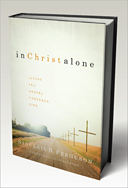
In Christ Alone: Living the gospel centred life by Sinclair B. Ferguson

In Christ Alone by Sinclair Ferguson

It's long been my practice to leave a book in the car that I can read when waiting for a doctor's or dentist's appointment or something. That way waiting time isn't wasted time. However, since investing in an Android tablet, loaded up with the Kobo e-Reader, I've been grabbing the tablet when I expect to be waiting around for a while. I've invested in several e-Books, usually at knock-down prices, but one of the first I downloaded was In Christ Alone by Sinclair Ferguson. It was going for only £0.99 at the time. Unbelievable. The title is really great for occasional reading, when you've got five or ten minutes to spare, as it's made up brief and punchy chapters that get straight to the point. 

If you are not already acquainted with Sinclair Ferguson's writings, then this might be a good place to start. You couldn't wish for a better theme than life in Christ and the theologian certainly warms to it. This title is informed by the theological acumen and exegetical skill that we have come to expect from Ferguson's pen, or keyboard more likely. But especially here, his gifts as a theologian and biblical scholar are at the service of a pastor-teacher with a keen desire to help the people of God live out of the fullness of their union with Christ.

Ferguson draws on the riches of God's Word to paint a fine portrait of the person and work of the Saviour. He is the second person of the Trinity, the Word made flesh for us and our salvation. He is our Prophet, Priest and King. He died for our sins and was raised from the tomb that we might live through him. In Christ we receive the gift of the Holy Spirit. By virtue of our union with him we are justified and called to a new life of faith and holiness. Ferguson gives attention to the practicalities of life in Christ, devoting pithy chapters to matters such as prayer, guidance, the mortification of sin, Christian liberty and humility in service. In the the final chapter we are given a glimpse of the rest that remains for the people of God.

This work is Ferguson at his best. In Christ Alone is theologically profound without being complicated, devotionally warm without being sentimental and practical without being a spiritual self-help manual. When reading I often had to pause and silently worship the Christ who brought me into saving union with himself by his Spirit and into communion with our God and Father. I doubt reading Hello magazine or a leaflet on the health benefits of tea while waiting for an appointment would have have the same effect. Highly recommended. 

Friday, January 04, 2013

Stephen Charnock on Christ and the theodrama

I know that posting quotations isn't proper blogging, which should involve at least some original writing. It's just typing stuff out. But I couldn't resist this one, which I came across when reading A Puritan Theology: Doctrine for Life, by Joel Beeke and Mark Jones. Puritan divine, Stephen Charnock sounds a bit like a seventeenth century version of theodramatist-in-chief, Kevin Vanhoozer (interviewed here). Charnock places Christ at the dramatic centre of the communicative action of God,  
Christ is the stage wherein all the attributes of God act their parts. (From Charnock, The Knowledge of Christ, in Works; 4:139). 
As Vanhoozer more recently put it,
Thinking of doctrine in dramatic rather than theoretical terms provides a wonderfully engaging and in integrative model for understanding what it means to follow – with all our mind, heart, soul and strength – the way, truth and life embodied and enacted in Jesus Christ. (From Vanhoozer, The Drama of Doctrine, p. 16.)
Admittedly, for Charnock  drama is a one-off handy metaphor, rather than the key idea that shapes his theologizing, but is is interesting to note this Puritan precedent for Vanhoozer's  theodramatic proposals.

Kevin Vanhoozer's follow up to Remythologizing Theology is  Divine Action and Providence, his contribution to Zondervan's promising looking 'New Studies in Dogmatics' series

Thursday, January 03, 2013

The blog is mightier than the tweet

Blogging increasingly seems like the elderly relative of the new media family. Young uns prefer to Tweet and update their Facebook status. But there is only so much that can be said in  Twitter's 140 character limit and  a Facebook status doesn't lend itself to a anything longer than a sentence or two. There is something to be said for articles that can explore subjects in a more reflective and considered way. Blogging is just the thing for that. John Stevens is master of the lengthy blog post.

That said, if my blog is anything to go by, most of my readers apparently prefer to access my blog content via Google Reader, email subscription or Facebook and Twitter feeds rather than visiting Exiled Preacher directly. With its longer posts, Blogger remains distinct from Facebook and Twitter, but feeds enable the grand old man of social networking to mix it with the new kids on the block. I probably get more comments and feedback on my blog posts on Facebook than on blog itself. 

Unbelievably, Exiled Preacher has been going for around seven years. I don't blog as frequently as I once did, but I continue to enjoy posting items on a reasonably regular basis. I probably do more personal newsy stuff now than I used to, but I still like to post up book reviews, theological reflections and do the occasional current affairs comment piece. Blogging is also a great format for interviews, of which I've done several. If I've written something for a local paper/magazine, Evangelical Times, or a theological journal it'll usually end up on the blog. Cyber-recycling.

So, I'll probably keep posting my displaced fragments from an exiled preacher. For the time being anyway.