Pages

Showing posts with label David VanDrunen. Show all posts

Wednesday, December 31, 2014

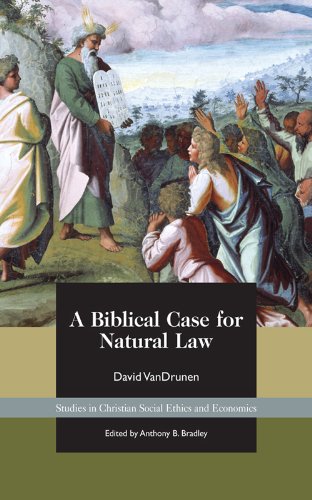
A Biblical Case for Natural Law by David Van Drunen


A Biblical Case for Natural Law by David Van Drunen
Acton Institute, Kindle Edition. 

I very much appreciated the author's Living in God's Two Kingdoms, and thought I'd have quick look at this brief monograph on natural law. In the work just referenced Van Drunen makes the point that in the 'common kingdom' the believer lives and works alongside the non-believer, both being subject to the same ethical rules. A Christian plumber is as obliged to fit a central heating system that is safe, economical and does not leak as his non-Christian colleague. That's fine when it comes to plumbing and the likes, but to what shared moral code may believer and non-believer appeal when it comes to ethical concerns more generally? According to Van Drunen, that's where natural law comes into its own.

He makes the case that natural law is the revelation of the righteousness of God to and in his human image bearers. Even fallen human beings have a sense of right and wrong. Paul condemns certain sins as 'against nature' and charges sinners with willful rebellion against what they know to be right, Romans 1:18, 19, 26, 27, 32. See also Romans 2:14-15, which Van Drunen takes as evidence that although Gentiles could not be judged for breaking the Ten Commandments, of which they had not heard, they would nevertheless be judged according to the standards of natural law to which their consciences bore witness. 

After devoting a chapter to Natural Law and the Two Kingdoms Doctrine, Van Drunen discusses how natural law applies in the Civil Kingdom and the Spiritual Kingdom. He discerns three main elements of natural law in Scripture that apply to all people in the civil realm regardless of their faith position, 'things that should not be done', the 'fear of God' (see Genesis 20),  and 'a common humanity' (see Job 31:13-15, Amos 1). 
As far as the spiritual kingdom is concerned, the writer argues that as the redemption involves the renewal of the image of God, a key component in natural law, that the "present, earthly existence of the spiritual kingdom cannot be at odds with that good creation and its natural law; it far transcends them." (VanDrunen, David (2012-03-20). A Biblical Case for Natural Law (Kindle Locations 858-859). Acton Institute. Kindle Edition). Scripture does not set aside natural law in the ethical life of the spiritual kingdom. Old Testament wisdom literature incorporates the insights  of non-Israelite proverbial sayings. Paul's 'household codes' in Ephesians 5-6 and Colossians 3-4 reflect Greco-Roman cultural norms, even as he frames his teaching in a distinctively Christian way. He wanted Christians to be mindful of the moral expectations of their non-Christian neighbours, see 1 Thessalonians 4:12, 1 Timothy 3:7 for example. And so Van Drunen concludes,
 As long as the church is a pilgrim in the present age, believers must conduct themselves in the church and in the world according to the nature of things and with critical yet appreciative appropriation of the world’s cultural achievements. (VanDrunen, David (2012-03-20). A Biblical Case for Natural Law (Kindle Locations 1001-1003). Acton Institute. Kindle Edition). 
It would be difficult to gainsay the basis thesis of this monograph, namely that natural law has biblical sanction and that it has applications both in the civil and spiritual realms. I also agree with the writer's 'two kingdoms' stance. But reading reading this work raised a number of questions for me:
  • What happens when a culture becomes so corrupted that 'things that should not be done' are often praised to the heavens, where a sense of 'common humanity' is eroded by racism, and there is 'no fear of God before their eyes'? A culture's sense of what is 'natural' may need to be challenged and corrected in the light of God's self-revelation in Holy Scripture. 
  • Which leads to another question; What is the relationship between the the cultural impact of biblical teaching and natural law? It was once thought that it was entirely 'natural' for white people to enslave black people. It took a sustained application of biblical norms to western culture to overturn that view so that nowadays slavery is viewed with abhorrence as a most unnatural infringement of human liberty and dignity.
  • How may a convincing case be made for natural law as a moral norm in a postmodern setting, where moral norms are viewed with suspicion and what may be viewed as 'natural' is fluid and subjective? Witness the widespread approval of same sex marriage in western society. 
  • To what extent may the church appeal directly to the ethical norms of Scripture  in its public theology? Believers may not be able to throw proof texts at every political policy and cultural development. There is no 'Christian view' of politics, economics, or plumbing. But does that mean that biblical principles on matters such as marriage, the unique dignity of human life and so on have no place in public discourse as biblical principles because only natural law applies in the civil kingdom? (See Dan Strange, Not Ashamed! The Sufficiency of Scripture for Public Theology
  • In terms of Reformed theology, the Westminster Confession teaches that the civil laws of Old Testament Israel should not to be applied as they are in the civil realm today, as under the New Testament there is a distinction between church and state, "To them also, as a body politic, He gave sundry judicial laws, which expired together with the State of that people; not obliging under any now, further than the general equity thereof may require." (WCF 19:4). While the confession acknowledges 'the light of nature' (1:1), it nevertheless allows that the 'general equity' of Old Testament teaching on civil matters does have enduring relevance for that realm under the New Testament, thus emphasising the applicability of biblical principles in the public square. How does Van Drunen's thesis harmonise with the stance taken by the confession?  
It's no doubt a bit much to expect the writer to address these questions in a brief monograph, but I'd be interested in what he had to say by way of response. Maybe I need to read his larger work, Natural Law and the Two Kingdoms: A Study in the Development of Reformed Social Thought? Of the making of many books there is no end...

Thursday, September 04, 2014

Living in God's Two Kingdoms by David VanDrunen

Image result for living in god's two kingdoms

Living in God's Two Kingdoms: A Biblical Vision for Christianity and Culture,
David VanDrunen, Crossway, 2010. Kindle Edition

Christians should be doing stuff, like transforming the culture and redeeming society and that. Preaching the gospel so that people get saved and nurturing disciples in the church is alright, but we've got to get with the world-changing, holistic, transformational program. What we need is a distinctively Christian approach to politics, education, the arts, medicine, engineering, plumbing, fast food serving and rubbish collecting. Anything less would be Pietism and we all know that's a Bad Thing. And anyway, if  believers don't make all kinds of stuff go Christian how's the new creation going to happen?   

Whoa up a bit. David VanDrunen's essential thesis is that it isn't in fact the duty of Christians to try and transform, redeem or Christianise the culture at all. 'What?' you may say, 'is he a Pietist,  or something?' Nooo. Good 'ol Calvinist. He seeks to recover the 'two kingdoms' vision of the Reformers as a way of engaging with the transformationalist tendencies of the likes of Tom Wright, Tim Keller and other influential figures. 

Essentially it boils down to this: there are two kingdoms. There is the 'common kingdom' which is ruled by God under the terms of the Nohaic covenant established in Genesis 9. Then there is the 'kingdom of God'. That is God's saving rule made known in the world through the covenant of grace in its various manifestations, from the Abrahamic to the new covenant. The believer belongs both to the kingdom of God and the common kingdom. That was the case under both old and new covenants as VanDrunen demonstrates.

In the common kingdom believers rub shoulders with non-believers as they engage in a variety of cultural pursuits including politics, work, education, the arts and so on. The believer will seek to honour the Lord in this context, but the same ethical standards will be expected of a Christian accountant, for example, as a non-Christian one. It is nonsense therefore to speak of 'Christian accountancy' or 'Christian plumbing'. Christian as well as non-Christian plumbers are both obliged to install central heating systems that don't leak like a sieve. OK, you would hope that a plumber who is a Christian wouldn't charge a little old lady the earth for fixing a dripping tap. But fair pricing policies aren't the exclusive preserve of believers. That's life in the common kingdom. 

The kingdom of God is made a visible reality in the church, the gathered people of God who meet to hear God's word proclaimed, partake of the sacraments and be built up in the faith. Ministerial power in the church is different from the power entrusted to rulers in the common kingdom. It is non-coercive and is limited to the preaching and application of the Word. Ministers must be not to overstep the mark by giving believers detailed instruction on how they should operate in the common kingdom in terms of involvement in politics, voting intentions and so on. Yes, general biblical principles must be worked out in the whole of life, but Christian liberty must be honoured when it comes to matters like political choices and decisions regarding how the children of believers should be educated. If the Bible doesn't say, either explicitly or by implication, 'thou shalt vote Conservative, or Labour, or Lib Dem, or Ukip, or Yes or No to Scottish independence' then pastors should not go beyond the teaching of Scripture when ministering to the people of God. The same goes for parental choices regarding their children's education, whether home, Christian School, State School, or whatever. 

VanDrunen calls for a biblical realism when it comes to the extent to which the world can be 'Christianised' by the activism of believers. The aim of the Christian is not to 'transform' or 'redeem' the common kingdom, for the form of this world is passing away. Redemption and transformation are only possible in the kingdom of God. That is not to say that believers may not strive to be 'salt and light' and try to make the world a better place. But even when they do that, their works in the common kingdom don't help to usher in the new creation. Christ has guaranteed that glorious future by completing the work God initially entrusted to Adam in Genesis 1 & 2. 

On which point I think that it's a blunder on the author's part to conflate the 'cultural mandate' of Genesis 1:26-28 with the 'covenant of works' in Genesis 2. The 'cultural mandate' was issued to man as man 'male and female' as God's image-bearers. It continues despite the fall, but is only finally fulfilled in Christ and the new creation. Adam's 'covenant of works' role, however does not continue. It was made with Adam specifically as federal representative of all humanity. We should certainly not think of ourselves as finishing off what he failed to do by our works in the common kingdom. Christ has accomplished that on our behalf by his redeeming work. As Herman Bavinck said, 'Christ takes is not to the beginning, but the end of the road that Adam had to walk.' Nevertheless, the langue of multiplication in Genesis 1 is also used of God's 'new humanity' in the Abrahamic covenant, Exodus 1 and also in Acts of the church. The cultural mandate of dominion and multiplication continues in the 'common kingdom', but grace perfects nature in the 'redemptive kingdom', Hebrews 2: 5-9, Revelation 7:9-10.

That said, I agree with VanDrunen's biblically argued cause for the two kingdoms view. It has helped me to think through one or two issues personally. Especially when it comes to involvement in the activities of the common kingdom.  As a governor in a local state secondary school it is not my duty to try and 'Christianise' the educational establishment in which I am involved, but rather to operate in line with the rules and guidelines set down for all governors irrespective of their faith. Yes, my faith informs and influences my approach to governance, as with everything else, but trying to 'redeem' the school would be misplaced. The church is the locus of God's redemptive activity, not the world of education, or any other cultural pursuits in the common kingdom for that matter. The transfomationist agenda is a grandiose distraction from getting on with the Great Commission that Jesus has laid upon the church. That's enough for us to be getting on with.