Pages

Showing posts with label Culture. Show all posts

Wednesday, December 31, 2014

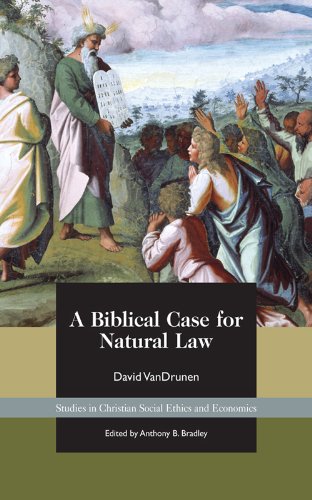
A Biblical Case for Natural Law by David Van Drunen


A Biblical Case for Natural Law by David Van Drunen
Acton Institute, Kindle Edition. 

I very much appreciated the author's Living in God's Two Kingdoms, and thought I'd have quick look at this brief monograph on natural law. In the work just referenced Van Drunen makes the point that in the 'common kingdom' the believer lives and works alongside the non-believer, both being subject to the same ethical rules. A Christian plumber is as obliged to fit a central heating system that is safe, economical and does not leak as his non-Christian colleague. That's fine when it comes to plumbing and the likes, but to what shared moral code may believer and non-believer appeal when it comes to ethical concerns more generally? According to Van Drunen, that's where natural law comes into its own.

He makes the case that natural law is the revelation of the righteousness of God to and in his human image bearers. Even fallen human beings have a sense of right and wrong. Paul condemns certain sins as 'against nature' and charges sinners with willful rebellion against what they know to be right, Romans 1:18, 19, 26, 27, 32. See also Romans 2:14-15, which Van Drunen takes as evidence that although Gentiles could not be judged for breaking the Ten Commandments, of which they had not heard, they would nevertheless be judged according to the standards of natural law to which their consciences bore witness. 

After devoting a chapter to Natural Law and the Two Kingdoms Doctrine, Van Drunen discusses how natural law applies in the Civil Kingdom and the Spiritual Kingdom. He discerns three main elements of natural law in Scripture that apply to all people in the civil realm regardless of their faith position, 'things that should not be done', the 'fear of God' (see Genesis 20),  and 'a common humanity' (see Job 31:13-15, Amos 1). 
As far as the spiritual kingdom is concerned, the writer argues that as the redemption involves the renewal of the image of God, a key component in natural law, that the "present, earthly existence of the spiritual kingdom cannot be at odds with that good creation and its natural law; it far transcends them." (VanDrunen, David (2012-03-20). A Biblical Case for Natural Law (Kindle Locations 858-859). Acton Institute. Kindle Edition). Scripture does not set aside natural law in the ethical life of the spiritual kingdom. Old Testament wisdom literature incorporates the insights  of non-Israelite proverbial sayings. Paul's 'household codes' in Ephesians 5-6 and Colossians 3-4 reflect Greco-Roman cultural norms, even as he frames his teaching in a distinctively Christian way. He wanted Christians to be mindful of the moral expectations of their non-Christian neighbours, see 1 Thessalonians 4:12, 1 Timothy 3:7 for example. And so Van Drunen concludes,
 As long as the church is a pilgrim in the present age, believers must conduct themselves in the church and in the world according to the nature of things and with critical yet appreciative appropriation of the world’s cultural achievements. (VanDrunen, David (2012-03-20). A Biblical Case for Natural Law (Kindle Locations 1001-1003). Acton Institute. Kindle Edition). 
It would be difficult to gainsay the basis thesis of this monograph, namely that natural law has biblical sanction and that it has applications both in the civil and spiritual realms. I also agree with the writer's 'two kingdoms' stance. But reading reading this work raised a number of questions for me:
  • What happens when a culture becomes so corrupted that 'things that should not be done' are often praised to the heavens, where a sense of 'common humanity' is eroded by racism, and there is 'no fear of God before their eyes'? A culture's sense of what is 'natural' may need to be challenged and corrected in the light of God's self-revelation in Holy Scripture. 
  • Which leads to another question; What is the relationship between the the cultural impact of biblical teaching and natural law? It was once thought that it was entirely 'natural' for white people to enslave black people. It took a sustained application of biblical norms to western culture to overturn that view so that nowadays slavery is viewed with abhorrence as a most unnatural infringement of human liberty and dignity.
  • How may a convincing case be made for natural law as a moral norm in a postmodern setting, where moral norms are viewed with suspicion and what may be viewed as 'natural' is fluid and subjective? Witness the widespread approval of same sex marriage in western society. 
  • To what extent may the church appeal directly to the ethical norms of Scripture  in its public theology? Believers may not be able to throw proof texts at every political policy and cultural development. There is no 'Christian view' of politics, economics, or plumbing. But does that mean that biblical principles on matters such as marriage, the unique dignity of human life and so on have no place in public discourse as biblical principles because only natural law applies in the civil kingdom? (See Dan Strange, Not Ashamed! The Sufficiency of Scripture for Public Theology
  • In terms of Reformed theology, the Westminster Confession teaches that the civil laws of Old Testament Israel should not to be applied as they are in the civil realm today, as under the New Testament there is a distinction between church and state, "To them also, as a body politic, He gave sundry judicial laws, which expired together with the State of that people; not obliging under any now, further than the general equity thereof may require." (WCF 19:4). While the confession acknowledges 'the light of nature' (1:1), it nevertheless allows that the 'general equity' of Old Testament teaching on civil matters does have enduring relevance for that realm under the New Testament, thus emphasising the applicability of biblical principles in the public square. How does Van Drunen's thesis harmonise with the stance taken by the confession?  
It's no doubt a bit much to expect the writer to address these questions in a brief monograph, but I'd be interested in what he had to say by way of response. Maybe I need to read his larger work, Natural Law and the Two Kingdoms: A Study in the Development of Reformed Social Thought? Of the making of many books there is no end...

Thursday, September 04, 2014

Living in God's Two Kingdoms by David VanDrunen

Image result for living in god's two kingdoms

Living in God's Two Kingdoms: A Biblical Vision for Christianity and Culture,
David VanDrunen, Crossway, 2010. Kindle Edition

Christians should be doing stuff, like transforming the culture and redeeming society and that. Preaching the gospel so that people get saved and nurturing disciples in the church is alright, but we've got to get with the world-changing, holistic, transformational program. What we need is a distinctively Christian approach to politics, education, the arts, medicine, engineering, plumbing, fast food serving and rubbish collecting. Anything less would be Pietism and we all know that's a Bad Thing. And anyway, if  believers don't make all kinds of stuff go Christian how's the new creation going to happen?   

Whoa up a bit. David VanDrunen's essential thesis is that it isn't in fact the duty of Christians to try and transform, redeem or Christianise the culture at all. 'What?' you may say, 'is he a Pietist,  or something?' Nooo. Good 'ol Calvinist. He seeks to recover the 'two kingdoms' vision of the Reformers as a way of engaging with the transformationalist tendencies of the likes of Tom Wright, Tim Keller and other influential figures. 

Essentially it boils down to this: there are two kingdoms. There is the 'common kingdom' which is ruled by God under the terms of the Nohaic covenant established in Genesis 9. Then there is the 'kingdom of God'. That is God's saving rule made known in the world through the covenant of grace in its various manifestations, from the Abrahamic to the new covenant. The believer belongs both to the kingdom of God and the common kingdom. That was the case under both old and new covenants as VanDrunen demonstrates.

In the common kingdom believers rub shoulders with non-believers as they engage in a variety of cultural pursuits including politics, work, education, the arts and so on. The believer will seek to honour the Lord in this context, but the same ethical standards will be expected of a Christian accountant, for example, as a non-Christian one. It is nonsense therefore to speak of 'Christian accountancy' or 'Christian plumbing'. Christian as well as non-Christian plumbers are both obliged to install central heating systems that don't leak like a sieve. OK, you would hope that a plumber who is a Christian wouldn't charge a little old lady the earth for fixing a dripping tap. But fair pricing policies aren't the exclusive preserve of believers. That's life in the common kingdom. 

The kingdom of God is made a visible reality in the church, the gathered people of God who meet to hear God's word proclaimed, partake of the sacraments and be built up in the faith. Ministerial power in the church is different from the power entrusted to rulers in the common kingdom. It is non-coercive and is limited to the preaching and application of the Word. Ministers must be not to overstep the mark by giving believers detailed instruction on how they should operate in the common kingdom in terms of involvement in politics, voting intentions and so on. Yes, general biblical principles must be worked out in the whole of life, but Christian liberty must be honoured when it comes to matters like political choices and decisions regarding how the children of believers should be educated. If the Bible doesn't say, either explicitly or by implication, 'thou shalt vote Conservative, or Labour, or Lib Dem, or Ukip, or Yes or No to Scottish independence' then pastors should not go beyond the teaching of Scripture when ministering to the people of God. The same goes for parental choices regarding their children's education, whether home, Christian School, State School, or whatever. 

VanDrunen calls for a biblical realism when it comes to the extent to which the world can be 'Christianised' by the activism of believers. The aim of the Christian is not to 'transform' or 'redeem' the common kingdom, for the form of this world is passing away. Redemption and transformation are only possible in the kingdom of God. That is not to say that believers may not strive to be 'salt and light' and try to make the world a better place. But even when they do that, their works in the common kingdom don't help to usher in the new creation. Christ has guaranteed that glorious future by completing the work God initially entrusted to Adam in Genesis 1 & 2. 

On which point I think that it's a blunder on the author's part to conflate the 'cultural mandate' of Genesis 1:26-28 with the 'covenant of works' in Genesis 2. The 'cultural mandate' was issued to man as man 'male and female' as God's image-bearers. It continues despite the fall, but is only finally fulfilled in Christ and the new creation. Adam's 'covenant of works' role, however does not continue. It was made with Adam specifically as federal representative of all humanity. We should certainly not think of ourselves as finishing off what he failed to do by our works in the common kingdom. Christ has accomplished that on our behalf by his redeeming work. As Herman Bavinck said, 'Christ takes is not to the beginning, but the end of the road that Adam had to walk.' Nevertheless, the langue of multiplication in Genesis 1 is also used of God's 'new humanity' in the Abrahamic covenant, Exodus 1 and also in Acts of the church. The cultural mandate of dominion and multiplication continues in the 'common kingdom', but grace perfects nature in the 'redemptive kingdom', Hebrews 2: 5-9, Revelation 7:9-10.

That said, I agree with VanDrunen's biblically argued cause for the two kingdoms view. It has helped me to think through one or two issues personally. Especially when it comes to involvement in the activities of the common kingdom.  As a governor in a local state secondary school it is not my duty to try and 'Christianise' the educational establishment in which I am involved, but rather to operate in line with the rules and guidelines set down for all governors irrespective of their faith. Yes, my faith informs and influences my approach to governance, as with everything else, but trying to 'redeem' the school would be misplaced. The church is the locus of God's redemptive activity, not the world of education, or any other cultural pursuits in the common kingdom for that matter. The transfomationist agenda is a grandiose distraction from getting on with the Great Commission that Jesus has laid upon the church. That's enough for us to be getting on with. 

Friday, June 10, 2011

All Watched Over by a God of Loving Grace


Here are some thoughts on some the the issues raised by Adam Curtis' series, All Watched Over by Machines of Loving Grace. Catch up with the films here. See my review of the series here.

1. They believe in anything

Ayn Rand very consciously rejected the Judeao-Christian tradition. In its place she  posited a new kind of self-organising society based on human selfishness. Rand and her fellow travellers really believed that her theories could transform the world for the better. Putting her ideas into practice she had an adulterous relationship with one of her acolytes. It seemed the logically selfish thing to do. But when he in turn was unfaithful to her, Rand was outraged and threw him out. Her selfishness was logical, his was unforgivable. Thinking that unrestrained selfishness might be the way to achieve human happiness was a naive dream. It puts me in mind of G. K. Chesterton's quip that, "When people stop believing in God, they don't believe in nothing - they believe in anything." The apostle Paul devastatingly exposes the proud delusions of those who in professing themselves to be wise become fools in Romans 1:18-23. 

2. What is man?

Are human beings little more than nodes in a delicately balanced ecosystem, or deterministic gene-replicators? Clearly we are part of the world. We are dependent on what the earth provides for life and health. Passing on our genes through reproduction is an important aspect  of human life. But is man basically a self-replicating flesh and blood computer? The Bible teaches that human beings, all human beings, whatever their race or state of health are made in the image of God. We have a God-given mandate to subdue the earth, re-shape our surroundings and change the world for the better, Genesis 1:26. In a fallen world carrying out this mandate is subject to frustration and disappointment. But the biblical injunction to "love your neighbour as yourself" (Matthew 22:39) demands that we endeavour to improve the lot of our fellow man. Our behaviour is not mechanistically pre-determined. We are free to make choices and we will be held accountable for our actions. 

3. In the state we're in we need the State 

The ideologues who saw human beings as nodes in a self-correcting ecosystem believed that without State interference society could achieve a utopian state of self-organised equilibrium. As pointed out, the hippies who endeavoured to put this into practice soon came to realise that things aren't so easy. Human beings are sinners. Without the checks and balances provided by the State with its laws and judicial system, society is at the mercy of those who grab power for themselves and use it to their own advantage at the expense of others. The communes had no mechanism for standing up to bullies. Despite talk of "Love and peace, man" the experimental communities failed to reckon on the stubborn fact of the total depravity of man in sin. The State is a necessary bulwark against the worst excesses of human sinfulness, Romans 13:1-7. A democratically accountable State may be, as Churchill put it the "least worst form of government",  but it is certainly better than no government at all. 

4. The rise of the machines

Adam Curtis' key thesis is that human beings have ceded control of the world to machines. Applying Ayn Rand's ideas to the world of economics Alan Greenspan believed that computers would allow the financial system to self-correct. It was therefore thought to be unnecessary for the Sate to intervene to prevent markets spiralling out of control.

The advent of personal computing and the internet has undoubtedly been a positive factor, facilitating easy communication between people across the globe. But we cannot entrust the running of the world to machines. That would be to opt out of our God-given "creation mandate". Machines must be our servants, not our masters. The distinction between human beings and machines must be maintained. Human behaviour cannot simply be understood in mechanistic terms. Human beings, made in the image of God are more than flesh and blood IT systems.

Early developers of personal computing and the world wide web hoped that the internet would enable the achievement of Rand's utopian vision of a self-organising society based on heroic self-expression. The vested interests on politicians could then be swept aside. However, this has not been the case. Social networking sites such as Facebook have done little more than commercialise personal trivia. Our private thoughts are now for sale and friendship has become a financially valuable commodity. Facebook hasn't changed the world. It just means that the world can know that you've just had a shower. And don't forget to click on a few ads while keeping up with the latest gossip. Facebook is now worth an estimated  $76.4bn. That's money earned from your status updates. Social networking has given big business a vested interest in the private lives of millions of users.

Now, I'm not saying that social networking is a bad thing per se. I have a Facebook account and FB is a good way of keeping up with friends, exchanging information and so on.  For what it's worth this is my 1,000th blog post, so I can hardly claim to be a convinced anti-techno Luddite.  But blogging and social networking hasn't made us into world changing  heroes of self-expression as Rand and her followers hoped. Hardly.

5. All watched over by a God of loving grace

Adam Curtis' films raise questions concerning the relationship between man and machine, but they do not propose answers. He has exploded the idea that computers will enable human beings to live in harmony with the environment, "all watched over by machines of loving grace". But how can humanity be saved from the evils of selfishness, greed and the abuse of power?

This is exactly where the Christian gospel comes in. The Bible recognises the true greatness of man, his inventive artistry and technological capability. But the Christian faith is not blind to the fact that human beings are deeply flawed creatures. We are sinners. That is why we have a tendency to mess things up so badly, as even idealistic hippies found to their cost. The most serious thing about sin, however, is not it's disastrous social consequences. Sin is rebellion against our Creator. We are not machines, but his image bearers and he will hold us accountable for our actions.

The good news is that our Creator is a God of loving grace. He sent his Son, Jesus Christ into the world as one of us. Jesus came to die for our sins and be raised from the dead so that we might be forgiven and put right with God. In Christ God has acted not simply to save human beings, but also to rescue the whole creation from the ruinous effects of sin. When Jesus returns at the end of the age, he will usher in a new heavens and a new earth where righteousness dwells and love prevails. Utopian  schemes want the fruits of redemption without a Redeemer, which is why they are doomed to failure.

Machines make for a poor God-substitute. It is folly for human beings to place their unquestioning trust in technology. We need to turn from our IT-olatry to the living God. The Christian believer lives secure in the knowledge that we are all watched over by a God of loving grace, Psalm 139:1-6. 

Wednesday, June 08, 2011

All Watched Over by Machines of Loving Grace


Tuesday evening saw the broadcast of the last of three programmes in the excellent BBC2 series, All Watched Over by Machines of Loving Grace. If you are based in the UK you can catch up with the series here. The programmes explore the idea that machines have been allowed to take over the modern world, with disastrous consequences. 

The first film, Love and Power Adam Curtis explores Ayn Rand's proposal that if people were allowed to give expression to their selfish desires, then society would organise itself without the need for formal political power. Distrusted politicians would soon find themselves out of a job. The advent of computer technology led to Rand's ideas on a self-organising society being applied to the wider world. In terms of the economy, it was thought by Alan Greenspan and others that computers would allow the financial system to correct itself, leading to and end of boom and bust. Then the credit crunch happened. The only people who seemed to benefit when it all went wrong were the bankers who caused the problem in the first place.

Next, in The Use and Abuse of Vegetational Concepts, Curtis critiques idea of nature as terms of a self-regulating ecosystem. Theorists mistakenly applied the mechanical concept of equilibrium to "spaceship earth" in an endeavour to respond to the environmental crisis. Hippies latched on to this notion and gathered themselves into non-hierarchical communes. They hoped that with the aid of machines, man and nature could live together in harmony, "all watched over by machines of loving grace". But every singly one of their experimental communities failed. Dominant individuals began to rule the roost. The "self-regulating" communes allowed for no checks and balances to curb the worst excesses of human nature. 

Further research demonstrated that the idea that the natural world spontaneously moves towards equilibrium was a myth. Nature exists in a constant state of flux. Dire predictions of environmental catastrophe were based on a mechanical model of nature in which human beings were mere "nodes" in the ecosystem. No account was taken of the fact that human beings can change the system by choosing to act differently on a personal and political level. 

The final programme, The Monkey in the Machine and the Machine in the Monkey the documentary maker explores the impact of a new view of humanity in which human beings are depicted as little more than gene replicating machines. This idea was developed by scientists George Price and Bill Hamilton and popularised by Richard Dawkins in his book, The Selfish Gene. Price couldn't live with the implications of his theory. He converted to an extreme form of Christianity, devoting his life to helping down and outs in an attempt to show that he was not a prisoner of his selfish genes. Hamilton followed his ideas through to their logical conclusion and advocated eugenics. He  argued that the sick should be left to die in order that inferior DNA be weeded out from the human gene pool.

The film charts the development of these theories against the backdrop of catastrophic post-colonial policies in Rwanda that saw millions die in tribal conflicts. Conflicts made worse by the plundering of Africa's mineral wealth in order to manufacture gaming consoles for western consumers. Curtis posits that seeing ourselves as deterministic computer-like gene replicators  is a way of avoiding our responsibility to try and change the world for the better. We have become machines without loving grace. 

All Watched Over by Machines of Loving Grace made for unusually intelligent and thought-provoking television. Some aspects of Curtis' case might no doubt be called into question. But his key thesis concerning the dire results of seeing human beings as little more than cogs in a global system is a timely wake up call for western culture. See here for an interview with Adam Curtis in The Guardian, where he discusses  his TV series. In the next post I hope to reflect on some of the issues raised by the programmes from a Christian perspective. 

Tuesday, March 03, 2009

Christ and Culture Revisited by D. A. Carson

Christ and Culture Revisited by D. A. Carson,
IVP/Apollos, 2008, 243pp
How should Christians view their relationship to culture? The classic response was formulated by Richard Niebuhr in his still influential Christ and Culture, 1951. He suggested five possible ways of modelling the interface between Christ and culture, 1) Christ against Culture. This position set Christ in opposition to culture, emphasising the falseness of the world and the need for believers to adopt a hostile stance to to the values and achievements of society. This is the Fundamentalists' preferred model. 2) The Christ of Culture suggests an altogether more cosy relationship between Christ and culture. The culture is seen as an expression of the imminent presence of Christ in all men. Gnostics and theological liberals tend towards this viewpoint. However, the uniqueness of Christ as set forth is biblical revelation is often compromised and the seriousness of sin minimised. 3) Christ above Culture acknowledges the uniqueness of Christ, but attempts a synthesis between Christ and the culture as seen in the theology of Thomas Aquinas. He sought to integrate philosophy and theology, law and gospel into one grand system. Aquinas provided the intellectual underpinnings for medieval Christendom, where Christ and culture were unified (at least in theory). As has been pointed out, option three runs the risk of institutionalising the gospel, and conflating the Kingdom of God with the prevailing culture. Lutherans have proposed a more dualistic model: 4) Christ and Culture in Paradox. Luther knew full well that all human culture has been corrupted by sin. But he was also aware that this is God's world in Christians which have been called to live for his glory. The believer simply has to cope with the tensions of this situation, which will remain unresolved until the consummation. This paradoxical stance has led to cultural conservatism amongst some Lutherans. Evils such as slavery or the rise of National Socialism have been viewed as symptoms of the unavoidable tension that exists between Christ and the kingdom of this world, and left unchallenged. Then we come to 5) Christ the Transformer of Culture. According to Niebur, this option is in keeping with certain strands of biblical teaching and is the preferred option of Augustine and the Reformers. However, at least as Niebur understands it, this model tends towards the universal transformation of culture by the power of Christ. The problem is that in this construction, the distinction between the church as the people of God, and the world that lies under his judgement has been eroded. Yes, Christians may and should have a transformative effect upon a society, but there will be no total cultural renewal this side of the new creation.
Carson criticises Niebuhr's "five model" approach on a number of grounds. Apart from option 2, all of his models have some basis in Scripture. They are not to be set against each other as competing options. That way lies reductionism. Also, some of his models may be more applicable than others in certain cultural situations. The Bible has a positive view of the state and its powers (Romans 13), but Scripture also knows that the state can become an agent of demonic oppression (Revelations 13). Believers in the West will be aware of the many paradoxes that exist between Christ and culture. But we are also in a position to try and effect cultural change through the democratic process. For Christians living under radical Islamic regimes, where persecution is rife and cultural transformation seems pretty unlikely, option 1 provides the most relevant model. Bearing all this in mind, we are not entitled to elevate any single one of Niebuhr's models as the only option that is open to Christians in every given situation.
What then does Carson propose in place of Niebur? He suggests that we should view the Christ/culture relationship in the light of the great turning points of redemptive history namely, Creation and the Fall, Israel and the Law, Christ and the New Covenant, and A Heaven to Be Gained and a Hell to Be Feared. God created this word and declared it very good. Human beings are God's image bearers with a responsibility to govern and care for the created environment. But we sinned against God and brought suffering and death into the world. The essence of sin is idolatry, the attempt to de-god God and put man in his place. We deserve nothing but his judgement and wrath. But God did not abandon this fallen, rebellious world. He still upholds all things and showers the human race with his good gifts. This means that while all human cultures are deeply affected by sin, they are not altogether devoid of good things as a result of God's common grace. But beyond "common grace" God has chosen to bring the blessing of saving grace to the nations. He entered into a covenant relationship with Abraham and his descendants, the children of Israel. Israel was constituted as theocratic nation subject to God's law.
The promise of the Abrahamic covenant was ultimately fulfilled in the coming of Christ, the incarnate Word of God. By his, life, death and resurrection, Christ has inaugurated the kingdom of God. Unlike Israel, the church is not a theocratic nation. The church comprises the people of God who have been gathered out of all nations. This poses a question for the relationship between the Christian and the state. How should followers of King Jesus relate to the powers that be? Jesus himself addressed this issue saying that we must, "Give back to Caesar what is Caesar's, and to God what is God's" (Matthew 22:21). Caesar's power is not ultimate. He cannot take the place of God. But the state has been ordained by God to keep law and order in society and Christians must respect this fact (Romans 13:1-7). While we aught to be good citizens and work for the benefit of society, we know that there will be no earthly utopia this side of the consummation. We have to live with the tensions characteristic of the last days where the kingdom of God has come but has not yet been fully realised. Jesus' kingly rule will be contested until he returns and only then will every knee shall bow and every tongue confess that he is Lord.
Carson argues that viewing the Christ/culture relationship from the standpoint of the key stages of biblical theology will give us a robust and adaptable way of handling the subject. His approach is rooted in the non-negotiables of Scripture and is flexible enough to be applied to a whole range of cultural situations. While Niebuhr's models may be of some value, no single one of them may be accorded canonical authority and some are only of use in particular cultural settings.
In the remainder of the book Carson uses his redemptive historical grid to reflect on a whole range of issues. Refining Culture and Redefining Postmodernism are discussed in chapter 3. Secularism, Democracy, Freedom and Power are given the Carson treatment in chapter 4. The relationship between Church and State is further probed in chapter 5, before the book concludes with a summarising chapter On Disputed Agendas, Frustrated Utopias and Ongoing Tensions. Carson writes on all these subjects with great insight and understanding. He mainly has the American situation in mind, but is also aware of what is happening in the UK, Europe and the developing world. He challenges the hardline secularist vision of culture, found all too often in the West which attempts to push the Christian faith to the sidelines of society. With this in mind, Carson attempts to set out a scriptural account of the relationship between church and state. The distinction between church and state in the New Testament suggests that the church should not be established as the religious arm of the state (the Church of England should therefore be disestablished - see here). But this does not mean that the Christian faith has no role in the public square. Jesus Christ is Lord of all. While his Lordship may be contested, believers have been called to bear witness to Christ in every area of life.
In this book Carson helps us to think through the often difficult relationship between Christ, his followers and culture. He makes a helpful distinction between the task of the church in fulfilling the Great Commission and the role of the individual believer who may engage with the culture on a whole range of levels including politics, the arts and social reform. Ever the careful scholar, Carson interacts critically with a wide range of authors from Augustine to Hauerwas and Derrida to Kuyper. His proposals avoid the extremes of Fundamentalist rejection and Liberal accommodation. We must endeavour be faithful to the Lord Jesus and "seek the good of the city" until he comes to make all things new. Carson doesn't tell us whether we should like Coldplay or Chopin, though. I suppose we'll have to work that one out for ourselves.